Biometric data protection is a legal and operational discipline that governs how organizations collect, store, process, and delete physiological and behavioral identifiers such as fingerprints, facial geometry, iris scans, and voiceprints. The discipline sits at the intersection of US state statutes with private litigation exposure, EU and UK regulations that classify biometrics as special category data, and federal technical standards that dictate image quality and matching thresholds. Treating it as a generic privacy program produces compliance gaps that surface as class action filings, supervisory authority audits, or FedRAMP gating during procurement. Two neighboring regimes impose their own overlays on the same data: the COPPA compliance guide covers the under-13 rules that stack on top of biometric consent, and the AI content copyright analysis covers the training-data question that facial datasets raise. The IPv6 adoption guide covers the adjacent infrastructure angle.
What Counts as Biometric Data Under the Law
Biometric data protection obligations begin with statutory scope, and the scope changes by jurisdiction. Three definitions drive most compliance decisions, and they do not align cleanly with each other. A US subsidiary of a European parent that maps its program against GDPR scope alone will routinely under-inventory the data covered by Illinois law, because the statutory term "biometric information" reaches further than the GDPR Article 9 trigger.
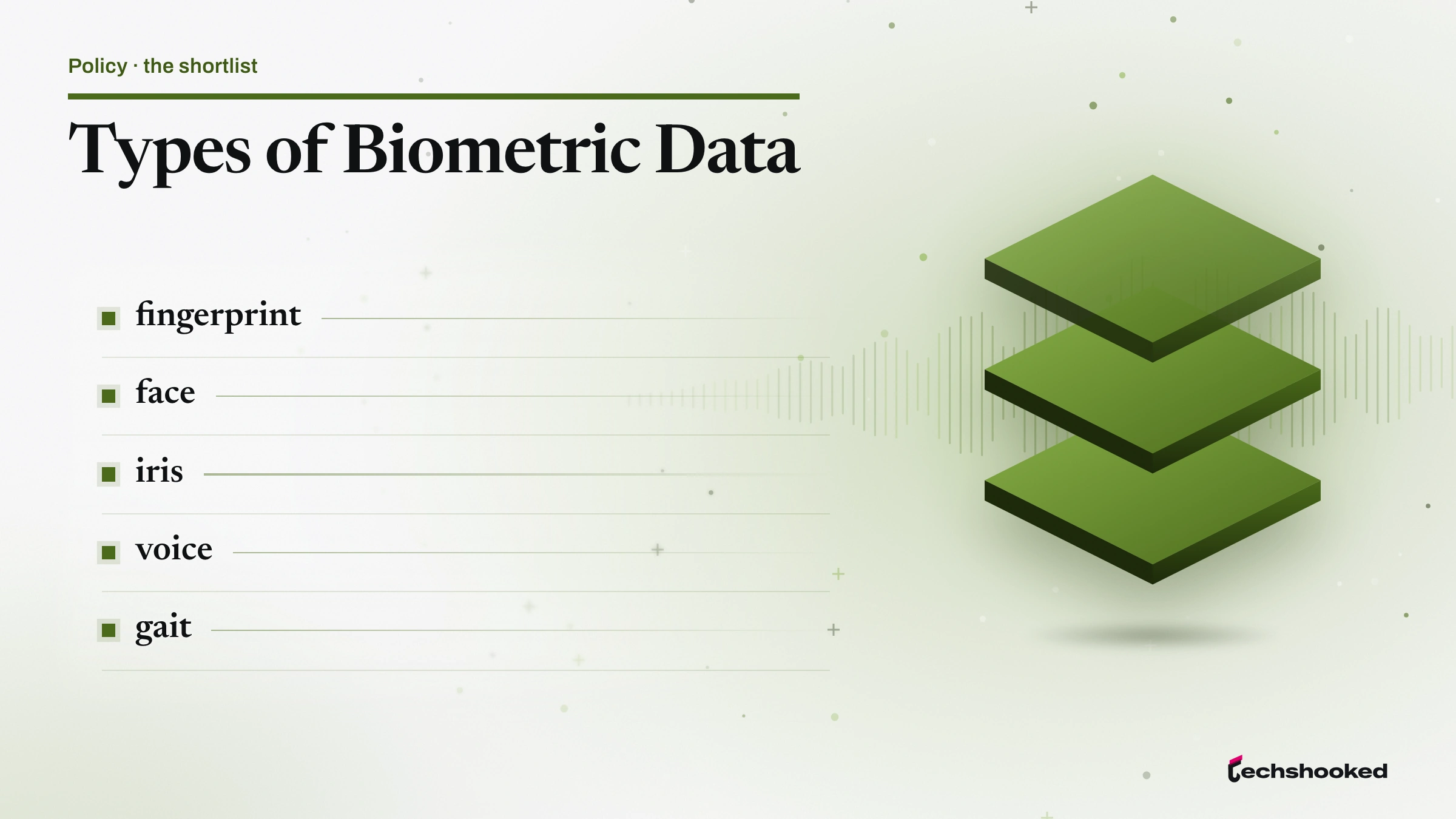
- Biometric identifier (BIPA, 740 ILCS 14/10). Retina or iris scans, fingerprints, voiceprints, hand geometry, and facial geometry scans used to identify an individual. The statute explicitly excludes writing samples, written signatures, photographs, human biological samples for scientific testing, demographic data, tattoo descriptions, and physical descriptions.
- Special category data (GDPR Article 9(1)). Biometric data processed for the purpose of uniquely identifying a natural person. A general photograph is not special category data unless it is run through facial recognition software to produce a biometric template.
- Biometric information (BIPA). Any information, regardless of how captured, converted, stored, or shared, that is based on an individual's biometric identifier and used to identify that individual. The category is wider than biometric identifier and includes derived data such as templates and embeddings.
The practical consequence is that a biometric information system deployed in Chicago may sweep in derived feature vectors that the same vendor's EU deployment treats as ordinary personal data. Mapping data flows across the two regimes is a precondition to scoping cross-border transfers, and the data localization laws and cloud services impact brief covers the residency layer that sits beneath this analysis.
The BIPA Framework: Consent, Retention, and Private Right of Action
Biometric data protection obligations under the Illinois Biometric Information Privacy Act (BIPA, 740 ILCS 14, enacted August 2008) are the highest-risk compliance driver for US-operating organizations. The statute splits into five obligations that organizations must satisfy before a single fingerprint is captured.
- Written retention policy (Section 15(a)). Before collecting biometric data, the organization must establish and make publicly available a written retention policy governing permanent destruction when the initial purpose is fulfilled or within three years of the last interaction, whichever is earlier. A policy that says "we retain data for business purposes" does not meet the statute.
- Written release prior to collection (Section 15(b)). The subject must be informed in writing that biometric identifiers or information are being collected, told the specific purpose and the length of term for which the data will be collected, stored, and used, and must provide a written release. Consent obtained after collection fails the test.
- Prohibition on sale and profit (Section 15(c)). Biometric identifiers and information may not be sold, leased, traded, or otherwise profited from. Feeding biometric features into advertising profiles, or licensing the resulting datasets, triggers the prohibition.
- No disclosure without consent (Section 15(d)). Disclosure or redisclosure requires a written release, a legal mandate, or financial transaction authorization permitted by the statute. Storing templates with a third-party cloud vendor requires a written contractual agreement that binds the vendor to the same restrictions.
- Private right of action and damages (Section 20). Any aggrieved person may bring an action. Damages run to $1,000 or actual damages per negligent violation, $5,000 or actual damages per intentional or reckless violation, plus attorney's fees.
The Illinois Supreme Court held in Rosenbach v Six Flags, 2019 IL 123186 that an aggrieved person is any individual injured by a violation, not only those who can show actual harm. A bare procedural failure, such as collecting a thumbprint without a compliant written release, is itself the injury. Combined with class certification mechanics, the private right of action has produced settlements above the $100 million mark in matters against Facebook ($650 million), Google ($100 million), and TikTok ($92 million). GDPR enforcement does not parallel this exposure. Supervisory authorities can fine up to 4 percent of global annual turnover, but EU data subjects do not hold an equivalent statutory damages instrument they can fire on their own. Readers tracking the broader US comparison can review compare CCPA and GDPR regulations for the general state privacy law backdrop.
The consent architecture BIPA mandates is not a checkbox layered on top of an existing terms of service. The written retention policy must precede collection, the written release must be specific to the biometric purpose, and the destruction obligation governs every downstream copy.
GDPR and UK GDPR: Explicit Consent and DPIA Requirements
Biometric data protection under GDPR (Regulation (EU) 2016/679) operates through the special category rules in Article 9. The trigger is not capture; it is processing for unique identification. UK GDPR mirrors the structure and adds the conditions in Schedule 1 Part 1 of the Data Protection Act 2018.
| Obligation | GDPR Article | UK GDPR Equivalent | Practical Trigger |
|---|---|---|---|
| Special category classification | Article 9(1) | Article 9(1) | Processing biometric data to uniquely identify a person, not capture alone. |
| Explicit consent | Article 9(2)(a) and Article 7 | Schedule 1 Part 1 | Freely given, specific, informed, unambiguous, and stronger than standard implied consent; cannot be bundled with general terms of service. |
| DPIA obligation | Article 35 and Recital 91 | Article 35 plus ICO DPIA guidance | Biometric processing for unique identification is high-risk and requires a data protection impact assessment before deployment. |
| Purpose limitation | Article 5(1)(b) | Article 5(1)(b) | Employee time-and-attendance biometrics cannot be repurposed for behavioral analytics without new explicit consent. |
| Storage limitation | Article 5(1)(e) | Article 5(1)(e) | Templates must be deleted when the consented purpose ends; indefinite retention is not curable by initial consent. |
| Data subject rights | Articles 15 to 22 | Articles 15 to 22 | Withdrawal of consent and erasure require deletion of derived templates and third-party copies. |
The ICO Biometric Data Guidance (August 2023) introduces a three-tier taxonomy: identifiers in use, identifiers at rest, and biometric characteristics not processed for identification. Each tier maps to a distinct control set, and the highest tier carries a presumption that a data protection impact assessment is mandatory. Organizations subject to both EU and UK regimes must satisfy both simultaneously; the UK adequacy decision permits transfers between the two but does not unify the underlying compliance obligations. Purpose limitation in particular bites harder than teams expect: a clocking system that was scoped for payroll cannot quietly grow into a productivity analytics feed without a fresh lawful basis. For a broader view of how these obligations land on US-headquartered operators, see GDPR impact on US tech industry.
NIST Biometric Standards and ICO Guidance: Technical Compliance Anchors
Biometric data protection compliance is not satisfied by legal documents alone. Federal standards govern image quality, template format, and matching algorithm choices, and they are gating criteria for FedRAMP authorization and many enterprise procurements.
- NIST SP 800-76-2 (Biometric Specifications for Personal Identity Verification, 2013, updated 2022). Sets image quality, template format, and matching algorithm requirements for federal biometric systems. Practical controls include fingerprint image quality at NFIQ 2 score of 40 or higher, ICAO 9303 compliant face image capture, and ISO/IEC 19794-6 iris formats.
- NIST IR 8408 (Understanding Bias in Facial Recognition Technology, January 2022). Documents demographic differentials in false match and false non-match rates across the NIST FRVT benchmarks. Any organization running facial recognition for access control or employee monitoring should test its specific user population demographics; an unexamined differential is a documented gap under ICO DPIA guidance.
- NIST SP 800-53 Rev 5 control families. IA-3 (Device Identification and Authentication) and IA-8 (Identification and Authentication for Non-Organizational Users) cover the minimum controls for biometric authentication. PE-3 (Physical Access Control) and AC-2 (Account Management) come into play when biometrics gate physical premises or user accounts.
- ICO Biometric Data Guidance (August 2023) classification. Recognition systems sit in the highest risk band with a mandatory DPIA, identifiers at rest require encryption and access controls, and physiological or behavioral characteristics not used for identification fall back to standard personal data rules. Use the taxonomy to classify the use case before selecting controls.
A biometric information system that meets SP 800-76-2 quality thresholds but fails to capture bias evidence under IR 8408 will pass a procurement review and fail a regulator audit. The two artifacts are complementary, not interchangeable. A biometric data breach involving template exposure compounds the problem because the underlying physiology cannot be reissued, so technical containment depends on rotation of cryptographic protection keys and decommissioning of the affected matcher rather than credential reset. Adjacent policy and ethics questions for one modality are covered in facial recognition tech ethics and regulations.
Multi-Jurisdiction Compliance Architecture: Building the Consent and Retention Stack
Biometric data protection across multiple jurisdictions requires a layered consent architecture, not a single policy document. The six components below assemble into a working compliance stack that survives audit in Brussels, London, and Springfield.
- Statutory scope mapping. Map each jurisdiction where data subjects reside against the applicable statute. US: BIPA in Illinois (most comprehensive), Texas Capture or Use of Biometric Identifier Act (CUBI, Tex. Bus. and Com. Code Chapter 503), Washington My Health My Data Act 2023 (biometric data covered), and New York City Local Law 144 (automated employment decision tools using biometric proxies). EU and EEA: GDPR Article 9. UK: UK GDPR Article 9 plus ICO guidance. Texas and Washington lack a private right of action and rely on state attorney general enforcement, which reduces direct litigation exposure but does not eliminate regulatory risk.
- Notice architecture by jurisdiction. BIPA requires written notice before collection, stating the specific purpose and retention term, as a standalone document rather than a clause buried in terms of service. GDPR requires an Articles 13 and 14 compliant privacy notice that names the categories of special data, the lawful basis (explicit consent for biometrics), the retention period, and data subject rights. A combined notice can satisfy both regimes, but counsel must review it against each statute's wording.
- Consent capture and withdrawal infrastructure. For BIPA, the written release must precede collection and should be stored separately from the biometric data itself, ideally as a signed paper record or its wet-signature digital equivalent. For GDPR, consent records must include what was consented to, when, through which mechanism, and whether it has been withdrawn. Article 7(3) requires withdrawal to be as easy as giving consent; build it into the subject access request workflow rather than spinning up a parallel process.
- Retention schedule and destruction obligation. Set retention to the lesser of BIPA's three-year ceiling and GDPR's storage limitation principle. For employment biometrics, the purpose ends at termination, so an automated deletion trigger of termination plus 90 days (allowing a dispute window) is more defensible than running to the BIPA cap. Apply the more restrictive of the two regimes per data subject based on residency.
- Third-party and vendor obligations. BIPA Section 15(d) requires a written contractual agreement before disclosure to a third-party cloud vendor that binds the processor to the destruction obligation and the prohibition on profit. GDPR Article 28 requires a data processing agreement with all processors handling special category data. A combined BIPA and GDPR vendor addendum is operationally efficient but must include both statutes' specific language verbatim.
- Breach response protocol. A biometric data breach triggers GDPR's 72-hour supervisory authority notification under Article 33 and, where the risk to rights and freedoms is high, individual notification under Article 34. BIPA itself has no standalone breach notification clause, but Illinois Personal Information Protection Act (815 ILCS 530) requires notification when biometric data points are included in a breach, and the disclosure can itself become evidence of a Section 15(d) violation. Because templates cannot be re-issued, the incident response plan must include matcher decommissioning and key rotation for affected individuals.
The six components share one architectural principle: the consent architecture, the written retention policy, and the destruction obligation must operate as one machine, not as three documents stored in different SharePoint folders. Transfer mechanics that move biometric data across borders sit one layer above this stack and are covered in navigate cross border data transfer regulations.
Further reading
- GDPR Article 9: Processing of Special Categories of Personal Data
- Cookieless Advertising vs Cookie-Based Advertising: Targeting and Consent
- Economics of Privacy: ROPI Framework and Cost-Benefit Analysis
- How Content Moderation Pipelines Work: ML Classifiers, Human Review, and Appeals
Additional references: NIST Cybersecurity Framework; NIST AI RMF; IETF RFC 6973.
Frequently Asked Questions
Does GDPR cover biometric data differently from other personal data?
GDPR Article 9 classifies biometric data processed to uniquely identify a natural person as special-category personal data, which requires explicit consent (a stronger standard than general GDPR consent) or another specific Article 9(2) condition such as an employment law obligation or vital interests. Standard personal data under Article 6 can rely on legitimate interests as a legal basis; special category biometric data cannot use legitimate interests as a standalone basis. Organizations must also complete a data protection impact assessment before deploying biometric recognition systems. General photographs are not automatically special category PII unless they are processed through recognition software to produce an identifying template.
What makes BIPA more litigation-risky than other US privacy laws?
BIPA's private cause of action allows any aggrieved person to sue without proving actual harm. The Illinois Supreme Court confirmed in Rosenbach v Six Flags (2019 IL 123186) that a technical violation of the notice or consent requirements constitutes injury. Per-violation statutory damages of $1,000 for negligent violations and $5,000 for intentional or reckless violations, combined with class action availability, mean exposure scales with the headcount whose biometric data was collected without compliant consent. Texas CUBI and Washington's biometric protections are enforced by state attorneys general only, removing the class action engine that drives the largest BIPA settlements.
When is a DPIA mandatory for biometric systems?
A data protection impact assessment is mandatory under GDPR Article 35 when processing is likely to result in a high risk to individuals' rights and freedoms. Biometric processing for unique identification meets that threshold per GDPR Recital 91 and ICO DPIA screening guidance. Specifically, a DPIA is required before deploying facial recognition for access control, fingerprint-based employee time-and-attendance systems beyond a small population, iris scanning at entry points, or any large-scale biometric processing. ICO guidance also recommends a DPIA for biometric data used in automated decision-making even at modest volumes. The assessment must address necessity, proportionality, residual risk to data subjects, and the mitigations planned before the system goes live.