AI content copyright is a legal framework that determines whether machine-generated creative works qualify for protection under existing intellectual property statutes and who holds enforceable rights over those works. The doctrine sits at the intersection of three regulatory tracks moving at different speeds: the US Copyright Office insists on a human author, the European Union has built transparency obligations into the EU AI Act without resolving authorship, and WIPO is still circulating discussion papers rather than binding treaty text. The practical result for creators, publishers, and counsel is a jurisdictional patchwork in which the same prompt and the same model output can produce a registrable work in one country, an unprotectable file in a second, and an unresolved liability question in a third.
What AI Content Copyright Actually Covers

AI content copyright encompasses three distinct ownership questions that statutes drafted before generative AI tools were available have never directly answered. The first asks whether output produced by a model satisfies the originality and authorship requirements of national copyright law. The second asks who, among the developer, the operator, and the prompter, holds any rights that do attach. The third asks whether copying protected works into training corpora itself triggers liability. Each question maps to a different body of law and a different enforcement surface, which is why the field reads as fragmented rather than unified.
The categorical distinctions below underpin every section that follows. The US Copyright Office introduced the same vocabulary in its March 2023 Copyright Registration Guidance for works produced by machine, and EU regulators have since echoed it in implementing texts.
- Doctrine
- The legal question of whether an AI-generated work satisfies the originality and human-authorship requirements of national copyright law, and on what terms registration or enforcement is available.
- Autonomous output
- A work produced by a model with minimal human creative input beyond a short prompt; treated by the Copyright Office as a work produced by machine and outside the protection of copyright statute.
- AI-assisted work
- Output where a human exercises substantial creative control over prompts, parameters, selections, and edits, producing a hybrid result that may qualify for protection as a work of human authorship.
The boundary between the second and third category is where the human authorship threshold operates. Move across it in either direction and the available intellectual property rights change sharply. How cross-border digital regulation reshapes content rights is treated in data localization laws.
The US Position: Copyright Office Guidance and Court Rulings
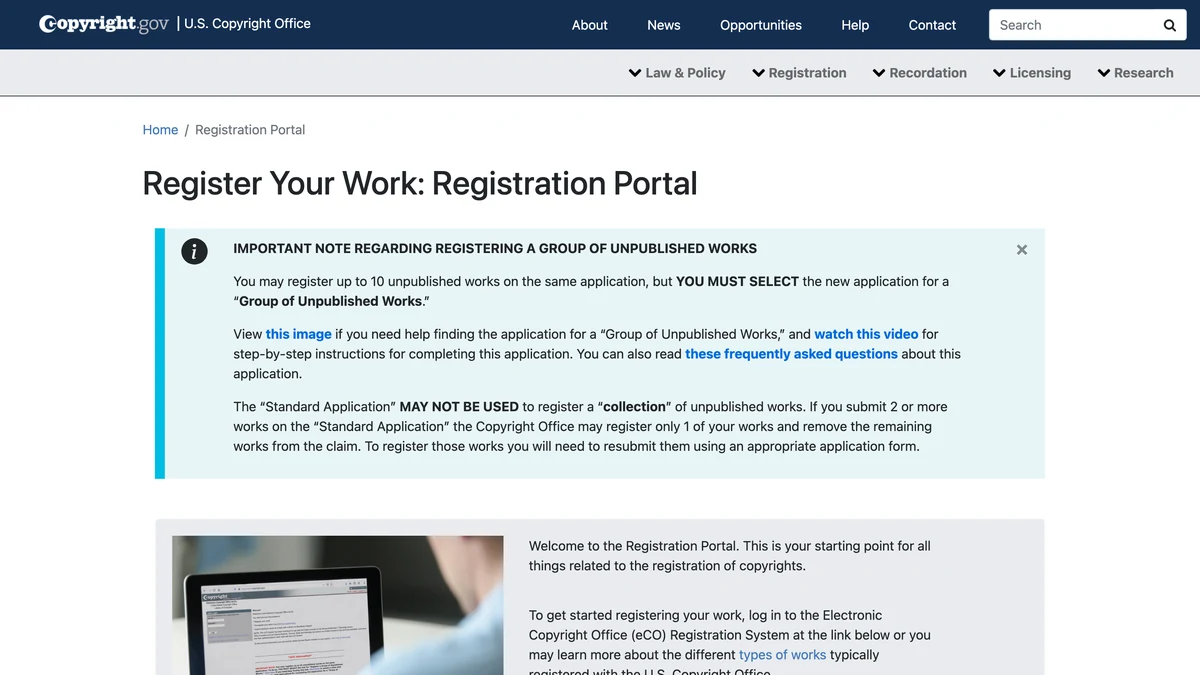
AI content copyright in the United States rests on three sources of law that interlock but do not always agree. The constitutional baseline comes from Feist Publications, Inc. v. Rural Telephone Service Co., 499 US 340 (1991), which fixes original creative expression by a human author as the minimum threshold for protection. The administrative position comes from the Copyright Office Copyright Registration Guidance published at 88 Fed. Reg. 16190 on March 16, 2023, which refuses registration of works produced entirely by machine and requires applicants to disclose AI-generated portions on Form CO. The judicial position is still forming through Thaler v. Vidal, 43 F.4th 1207 (Fed. Cir. 2022), which held that AI systems cannot be named inventors under the Patent Act, and the parallel Thaler v. Perlmutter proceeding in the District of Columbia, which tests the same logic for purely autonomous images.
The Office reads these sources together to reject a binary human or AI classification. Registration is available where a human author selected, coordinated, or arranged AI-generated material in a way that meets the originality bar. That is a fact-intensive test rather than a categorical rule, and applicants who overstate human contribution risk invalidation of any resulting copyright registration. The table maps three common production patterns to their likely outcomes at the registry.
| Production scenario | Human creative control | Likely Office outcome | Recommended filing approach |
|---|---|---|---|
| Fully autonomous output | None beyond a short prompt | No registrable copyright | Disclose AI origin; rely on trade secret or contract |
| Prompted and curated output | Detailed prompts, multi-output selection, light editing | May qualify on selection and arrangement | Register human-authored layer; disclose AI portions on Form CO |
| AI-assisted creative work | Human controls structure, voice, sequence, and final expression | Qualifies as a work of human authorship | Register as standard literary or visual work |
The same framework drives the litigation posture in active US copyright infringement cases brought against model developers, where the question is whether training conduct, output reproduction, or both, expose the defendant to liability.
The EU Framework: AI Act Obligations and Copyright Directive Tensions
Copyright in AI-generated works in the European Union operates at two interlocking levels. The EU AI Act, Regulation (EU) 2024/1689, in force August 1, 2024, imposes transparency obligations on providers of general-purpose AI models. Article 53 requires those providers to publish a sufficiently detailed summary of the content used for training, so that rights holders can identify potential infringement and enforce their intellectual property rights. The Act does not assign ownership of any model output, but it builds an evidentiary base that previously did not exist.
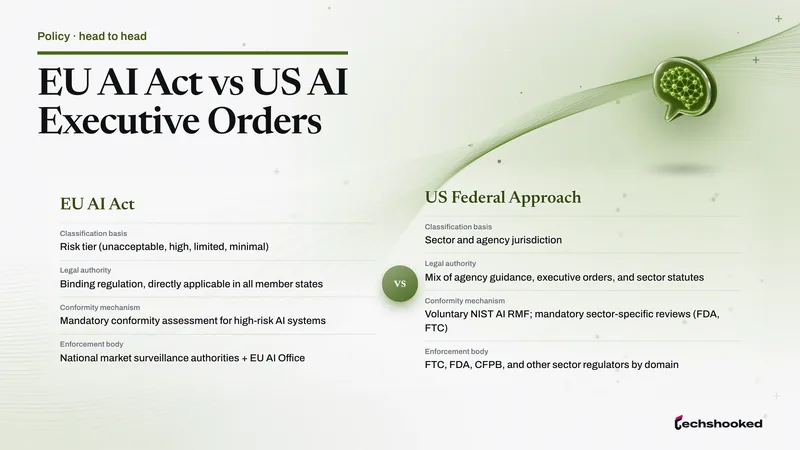
The second level is the Copyright in the Digital Single Market Directive, Directive (EU) 2019/790. Article 3 creates a mandatory text and data mining exception for scientific research conducted by qualifying institutions. Article 4 creates a broader text and data mining exception for commercial use, subject to a rights holder opt-out expressed through machine-readable signals. AI developers that ingest opted-out works face copyright infringement exposure under member state implementations of the DSM Directive, independently of any AI Act sanction. The comparative analysis of AI regulation across the EU, US, and China sets out the broader regulatory map.
Four operational obligations follow for any publisher releasing AI-assisted content into the EU market:
- Verify training data provenance for the model used, including whether the provider honored Article 4 opt-outs and whether any digital rights management metadata in source files was respected.
- Disclose machine-generated content origin where national implementations of the DSM Directive or the AI Act require it, in particular for commercial publishing and broadcast contexts.
- Monitor general-purpose AI provider transparency summaries published under Article 53 for evidence that proprietary or licensed works appear in the training corpus without authorization.
- Assess whether the output reproduces protected expression from training corpora, which courts across the EU have not yet resolved as a derivative-works question.
The WIPO Lens: International Copyright Standards and the Treaty Gap
Copyright in AI-generated works at the international level rests on instruments drafted decades before any generative AI system existed. The Berne Convention for the Protection of Literary and Artistic Works (1886, as amended) requires member states to protect original intellectual creations of an author, a term Berne never defines non-humanly. The WIPO Copyright Treaty of December 20, 1996 extends Berne to digital works without addressing AI authorship. Both leave the threshold question of what counts as creative expression to national law.
WIPO Adjacent scholarship surveyed in IEEE Computer (AI authorship). has run the Intergovernmental Committee track and the AI and IP Policy Forum series since 2019, but no binding instrument has emerged. The 2020 Revised Issues Paper on Intellectual Property Policy and Artificial Intelligence identifies three ownership models proposed by member states, none of which WIPO has endorsed. The table below sets them against the jurisdictions whose practice most closely tracks each model.
| Ownership model | Who holds the rights | Closest current practice | Implication for creators |
|---|---|---|---|
| Public-domain model | No one; output is immediately in the public domain | US Copyright Office position for fully autonomous output | Maximum reuse freedom; no exclusive monetization rights |
| Developer-ownership model | The provider of the model | Proposed in WIPO IGC discussions; no major jurisdiction has adopted it | Risk that downstream creators cannot claim rights in third-party model output |
| User-ownership model | The human who prompted or directed the system | UK Copyright, Designs and Patents Act 1988, Section 9(3) for computer-generated works | Aligns with commercial expectations; depends on local human-contribution test |
The treaty gap matters because every cross-border ownership dispute over machine-produced material resolves under conflict-of-laws rules rather than a harmonized standard. A French illustrator who finds their style replicated by a US-hosted model has different remedies than a Japanese studio whose catalog appears in a transparency summary. Until WIPO members converge on one of the three models, that asymmetry is the operating environment.
Training Data and Developer Liability: The Infringement Exposure Map
AI content copyright disputes split into two distinct exposure vectors. The first is developer liability for ingestion of copyrighted works into training data. The second is user liability for publishing output that substantially reproduces protected expression from those corpora. Rights holders can pursue both, and the human authorship threshold determines which party carries each risk. This is where the authorship-gap analysis becomes a practical compliance question rather than an academic one.
The active US docket is shaping the developer side. Authors Guild v. OpenAI (S.D.N.Y., filed 2023), Getty Images v. Stability AI (parallel US and UK filings), and New York Times v. Microsoft and OpenAI (S.D.N.Y., filed December 2023) each turn on whether ingesting full works into a training set qualifies as transformative use under 17 USC Section 107. No US court of appeals has ruled on the question as of May 2026, and district court reasoning has split. For the governance layer that organizations should apply while the case law settles, see the NIST AI Risk Management Framework (AI RMF 1.0), which treats intellectual property exposure as a managed risk category. Related accountability questions sit in the coverage of AI-driven recruitment discrimination and AI error accountability guidelines.
The four-factor fair use test, applied to training conduct, produces this litigation landscape:
- Purpose and character of use. Commercial training is contested against the transformative-use defense; courts have split on whether model weights constitute a new expressive use or a substitute.
- Nature of the copyrighted work. Training corpora are dominated by creative expression rather than factual material, which tilts the factor toward rights holders.
- Amount and substantiality used. Models routinely ingest entire works, the maximum the factor recognizes, which weighs against fair use.
- Market effect. Where model output competes directly with licensable human creative work, this factor weighs decisively for the rights holder and is the factor courts cite most often.
The user-liability vector is narrower but real. A publisher whose output reproduces a recognizable passage or composition can be named as a secondary infringer even where the developer carries primary infringement exposure. Documenting prompts, selections, and edits is the principal evidentiary defense.
Protecting AI-Assisted Work: A Practical Framework for Creators
AI content copyright protection for AI-assisted output rests on five operational disciplines. Treated together, they harden registration claims, narrow ownership dispute exposure, and create the documentary record that the Copyright Office and EU regulators now expect. Each step maps to a specific statutory or contractual lever rather than to general best-practice advice.
- Document human creative control at every stage. Maintain version histories, prompt logs, output candidate sets, and selection records that show which decisions a human author made. The March 2023 guidance requires disclosure of AI-generated portions on Form CO; contemporaneous records support the selected, coordinated, or arranged claim and function as the principal defense if a competing claimant raises an ownership dispute.
- Register the human-authored layer. File copyright registration for the specific expressive elements that result from human creative decisions, including structure, sequence, voice, and arrangement of model-produced material. Partial filings protect the human-authored layer even where the AI-generated substrate is unprotectable, and accurate AI-contribution disclosure is now a precondition to an enforceable claim.
- Use work made for hire contracts deliberately. Organizations commissioning AI-assisted creative work from contractors should rely on work made for hire provisions under 17 USC Section 101, which vests copyright in the commissioning party by contract rather than relying on the human authorship threshold alone. The work made for hire doctrine applies automatically only for employees or for one of the nine statutory categories; outside those, a signed agreement is the safer instrument.
- Apply digital rights management controls. The C2PA content credentials standard, supported by Adobe, Microsoft, and the BBC, embeds tamper-evident provenance metadata into AI-assisted content and provides attribution verification at the file level. Layered with digital rights management protections under 17 USC Section 1201, content credentials extend enforcement reach to platforms that respect provenance signals. For the transparency angle behind this approach, see explainable AI versus black-box models.
- Audit platform terms of service before commercial release. Model providers including OpenAI, Midjourney, Stability AI, and Adobe Firefly each publish output-ownership clauses that differ materially. Some assign ownership to the user, some retain a broad license for the provider, and some leave the question unresolved. Read the live terms against the intended commercial use rather than relying on the prior version.
The five steps cumulate. Each one is weak in isolation and durable together, because each closes a different gap that the current generative AI policy stack leaves open.
Further reading
- US Copyright Office: Registration Guidance for Works Containing AI-Generated Material
- EU AI Act, Regulation (EU) 2024/1689
- EU Copyright in the Digital Single Market Directive, Directive (EU) 2019/790
- WIPO: Artificial Intelligence and Intellectual Property Policy
- NIST AI Risk Management Framework (AI RMF 1.0)
- C2PA Content Credentials Technical Specification
- 5G Security Architecture vs 4G: Authentication, Encryption, and Network Slicing
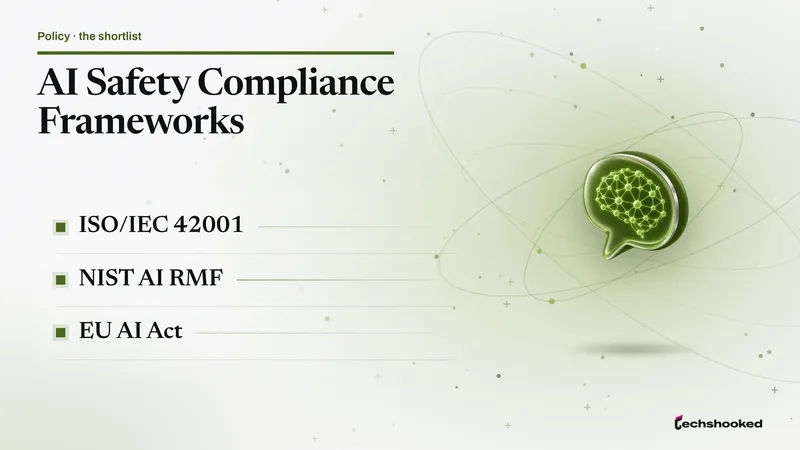
- AI Safety Compliance: How to Meet ISO/IEC 42001, NIST AI RMF, and EU AI Act Standards
- ICANN vs Domain Registrars: How DNS Governance Actually Works
Frequently Asked Questions
Who owns AI-generated content?
Ownership depends on jurisdiction and on the level of human creative control. In the US, the Copyright Office will not register works produced entirely by machine; copyright vests in a human author only where that author selected, coordinated, or arranged the model-produced material with original expression. In the UK, Section 9(3) of the Copyright, Designs and Patents Act 1988 assigns authorship of computer-generated works to the person by whom the arrangements necessary for the creation of the work are undertaken, which can vest copyright in the AI operator. The EU has not adopted a unified AI authorship rule; the EU AI Act addresses transparency rather than ownership, leaving the question to member state copyright law.
How does copyright in AI-generated works differ from traditional copyright protection?
Traditional copyright presumes originality from the act of human authorship. The newer doctrine requires applicants to affirmatively demonstrate and disclose the human contribution, because the human authorship threshold cannot be assumed when a model is in the production loop. A second structural difference is the ingestion-liability layer that does not exist for traditional works: providers can face infringement claims for copying protected material into model corpora, an exposure that conventional content creators never carried.
What does the EU AI Act require AI developers to disclose about copyright and training inputs?
EU AI Act Article 53 requires providers of general-purpose AI models placed on the EU market, including non-EU providers, to publish a sufficiently detailed summary of the content used for training. The summary must let rights holders identify whether their works were used without license, while protecting confidential business information. The transparency requirement operates alongside Article 4 of the DSM Directive, which lets rights holders opt out of commercial text and data mining; developers that trained without honoring opt-outs face an independent path to copyright infringement liability under member state law.