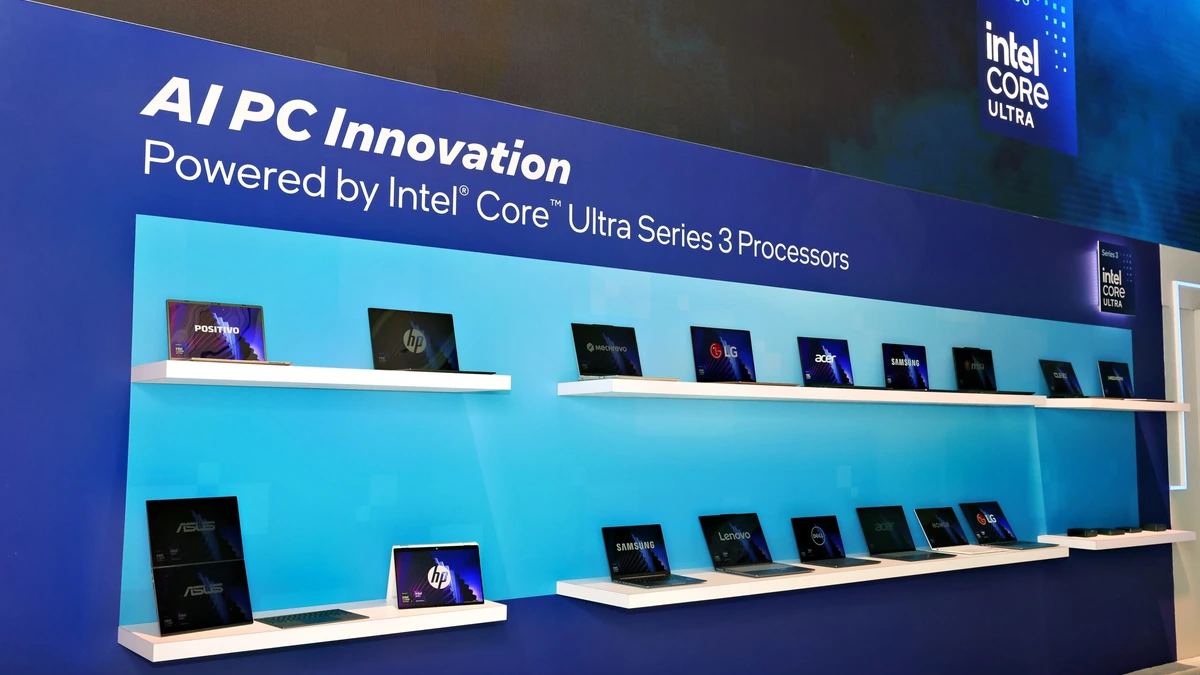
The most consequential thing about Intel Core Ultra Series 3 is not its core count but where it is made. Intel said at CES 2026 that the Panther Lake family is the first client processor built on Intel 18A, the company's newest logic node and one it manufactures in the United States. For a company that spent the past few years insisting its foundry turnaround was on schedule, a shipping consumer chip is the first real evidence that carries weight beyond a roadmap slide.
The lineup tops out at up to 16 CPU cores and an Intel Arc GPU with as many as 12 Xe-cores, alongside a neural processing unit rated at 50 TOPS. Two new parts, the Core Ultra X9 and Core Ultra X7, sit above the mainstream Series 3 chips and target thin-and-light laptops that still need sustained CPU and graphics performance rather than just burst speed. Client SVP Jim Johnson framed the generation around efficiency, a larger GPU, and x86 app compatibility, the last a pointed contrast with the Arm-based Copilot+ machines Intel is trying to hold off.
The headline performance numbers come from a single comparison: the Core Ultra X9 388H against last year's Core Ultra 9 288V. On that basis Intel claims up to 60 percent better multithreaded performance in Cinebench 2024 at 25W, and up to 77 percent faster gaming at 1080p high settings averaged across 45 titles with 2x upscaling. It also puts the top part at up to 27 hours of local video playback on a Lenovo IdeaPad reference design. Every figure is Intel's own, measured in its labs, and none was independently verified at announcement.
Intel pushed the edge-AI story harder than the laptop one in places, citing 1.9 times the large-language-model throughput of NVIDIA's Jetson Orin AGX 64GB and 4.5 times the throughput on vision-language-action models. Those claims aim squarely at the embedded and robotics market where NVIDIA has been unchallenged, and they signal that Intel wants Panther Lake to sell into more than clamshells. Pricing, as usual for a platform launch, was not disclosed.
Pre-orders open January 6, laptops ship globally on January 27, and edge systems follow through the first quarter, with more than 200 designs promised from partners. The volume commitment is the part worth watching. Benchmark deltas from a hand-picked comparison are easy to stage on a stage; sustaining 18A output across 200 shipping SKUs at competitive yields is the harder problem, and it is the one that determines whether this launch marks the point Intel's manufacturing actually turned or just the point it said so again.