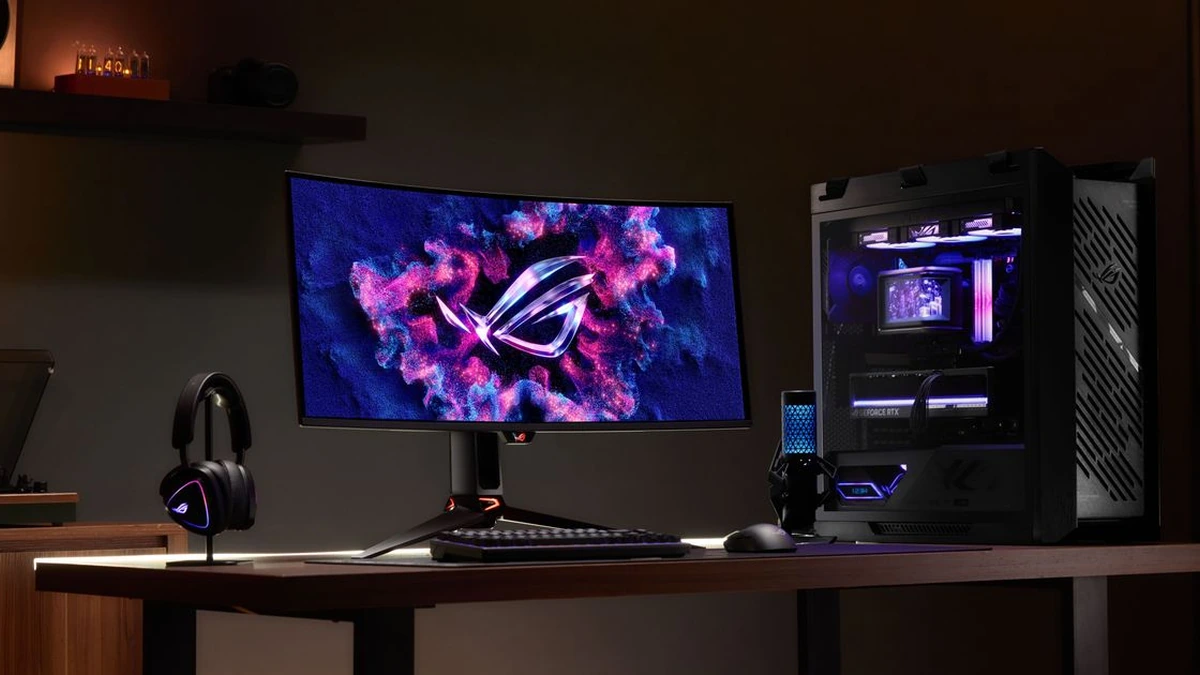
OLED gaming monitors have a text problem, and ASUS is betting a new panel layout fixes it. At CES 2026 the company introduced its first ROG RGB OLED displays, which drop the diamond and triangular subpixel arrangements most OLED panels use in favor of a conventional red-green-blue stripe. ASUS says the change cuts the color fringing that makes small fonts and window edges look soft on current OLEDs, the single complaint that keeps many desktop users on LCD.
The monitor leading the announcement on January 4 is the ROG Swift OLED PG34WCDN, which ASUS calls its first RGB OLED gaming display. It runs a 34-inch WQHD QD-OLED panel at 360Hz with a 0.03ms response time and an 1800R curve, and carries DisplayPort 2.1a plus 90W USB-C. A lower-cost sibling, the ROG Strix OLED XG34WCDMS, keeps the same 34-inch WQHD format but steps the refresh rate down to 280Hz.
The more interesting engineering sits in the Tandem variant, which stacks two emitting layers and removes the white subpixel that OLEDs normally add to boost brightness. ASUS says that structure raises color volume by up to 27 percent at high luminance, and the design's flagship is the 26.5-inch ROG Swift OLED PG27UCWM, a Tandem RGB OLED with a dual mode of 4K at 240Hz or FHD at 480Hz and Dolby Vision support. A separate coating ASUS calls BlackShield film is meant to raise perceived black levels by 40 percent and more than double scratch resistance, and the 32-inch ROG Swift OLED PG32UCDM Gen 3 fills out the group with a 4K QD-OLED panel at 240Hz.
Text clarity has been the honest weak point of every consumer OLED monitor, so a genuine subpixel rework is more consequential than another refresh-rate bump. It also puts ASUS ahead of a shift the whole panel industry is working toward, since RGB Tandem OLED is the direction Samsung Display and LG Display have both signaled for the next few years.
The figures worth treating with caution are the ones only ASUS can measure. The 27 percent color-volume gain, the 40 percent black-level improvement, and the claim that ASUS holds the number one position in OLED monitor share worldwide are all vendor numbers without independent testing behind them yet, and none of the CES listings carry prices. Whether the stripe layout closes the gap to LCD text will come down to how these panels read on a desk, not on a spec sheet.