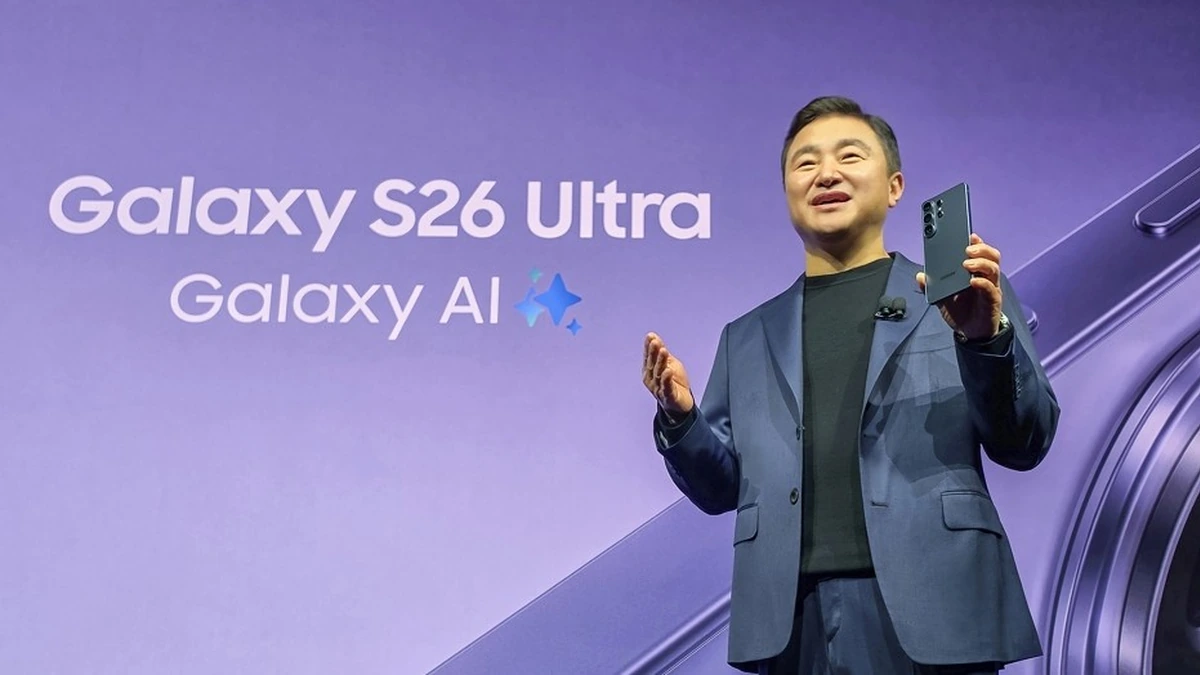
Samsung's pitch for the Galaxy S26 is that you should notice the phone less, not more. Announced at Galaxy Unpacked 2026, the third-generation Galaxy AI lineup is built around software that Samsung says works in the background to cut the number of steps a task takes, from managing plans to editing photos. "We focused on making AI feel effortless, working quietly in the background so people can focus on what matters," said TM Roh, who heads Samsung's Device eXperience division. The Galaxy S26, S26+ and S26 Ultra share one design language and open for pre-order on February 25 in Cobalt Violet, White, Black and Sky Blue, with Pink Gold and Silver Shadow exclusive to Samsung.com.
The line splits along familiar tiers. The 6.3-inch Galaxy S26 and 6.7-inch S26+ run a Snapdragon 8 Elite Gen 5 for Galaxy or an Exynos 2600 depending on market, while the 6.9-inch S26 Ultra uses the customized Snapdragon part with a redesigned vapor chamber that spreads heat along the sides of the processor. Samsung quotes a 39 percent gain in NPU performance on the Ultra over the S25 Ultra, the figure that matters most for always-on AI, alongside a 19 percent CPU and 24 percent GPU improvement. All three ship on Android 16 with One UI 8.5 and carry seven years of security updates.
The clearest new hardware claim sits on the Ultra: a built-in Privacy Display that Samsung says is a first for mobile phones. By controlling how pixels disperse light, it narrows side viewing angles when switched on while keeping the screen clear for the person holding it, and it can activate automatically for PIN entry or selected apps, with a Maximum Privacy mode that obscures side views further. Samsung frames it as privacy at the pixel level, a step past the stick-on films it aims to replace, though the practical test is how much of the display's brightness and color survive with the feature engaged.
On the agent side, the Galaxy S26 pairs an upgraded conversational Bixby with a choice of third-party agents including Gemini and Perplexity, reachable from a single entry point. Samsung says the phone can carry out multi-step tasks on a user's behalf, using booking a taxi through Gemini as the worked example, while Now Brief and Now Nudge surface reminders and suggestions based on context, such as pulling trip photos when a friend asks for them. Photo Assist and Creative Studio handle natural-language editing, and Circle to Search gains multi-object recognition. These are the features Samsung leans on to argue the phone is becoming an agent rather than a menu of tools.
Security runs underneath the AI story. Samsung extended its post-quantum cryptography to system processes such as software verification and firmware protection, added PQC-backed end-to-end encryption to Knox Matrix for services like eSIM transfers, and layered on AI call screening that summarizes an unknown caller's intent plus a Private Album that hides photos without a separate account. The camera work centers on wider apertures on the Ultra for low light and a horizontal lock for steadier video, with the AI image processor now extending to the selfie camera.
The strategy is the interesting part. Samsung is asking buyers to pay flagship prices for capability they are meant not to see, which is a harder sell than a bigger number on a spec sheet, and much of the marquee software depends on third-party models from Google and Perplexity rather than Samsung's own. The Privacy Display and the customized silicon, both detailed in Samsung's Galaxy S26 announcement, are the parts genuinely exclusive to this generation; how much the "effortless" AI actually changes daily use, against a Pixel or iPhone making similar background-assistant claims, is what the reviews will have to settle.