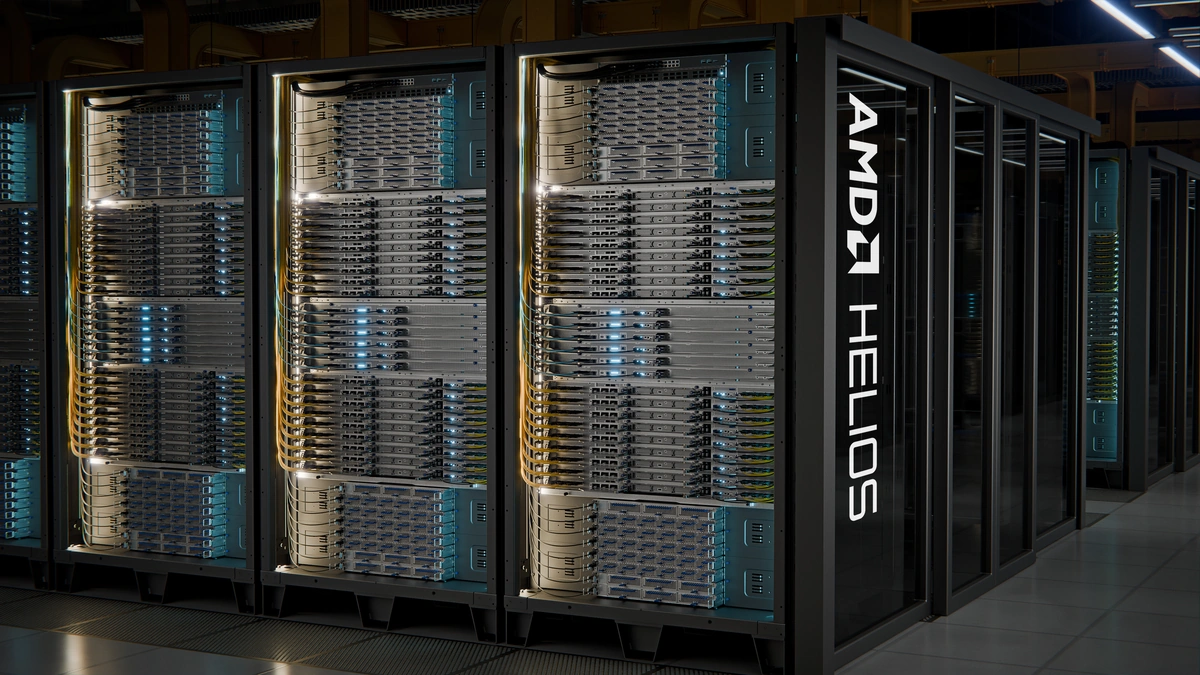
Microsoft will deploy AMD's next-generation Helios rack-scale AI systems on Azure to run frontier-model inference for its own AI services and for enterprise customers, under an expanded infrastructure partnership between the two companies. AMD plans to begin shipping Helios hardware to customers, including Microsoft, in the second half of 2026.
The AMD Helios Rackscale Solution combines AMD Instinct MI455X GPUs, sixth-generation EPYC "Venice" CPUs, Pensando networking hardware and the ROCm software stack into one integrated platform built for large-scale AI training and inference, per AMD. Microsoft says Azure will run Helios for inference workloads spanning frontier models, Azure AI services and customer applications.
Beyond the GPU racks, Azure is adding two EPYC-powered virtual machine series built on the same sixth-generation "Venice" processors: Azure HDv2, aimed at agentic AI and data-pipeline workloads, and Azure HXv2, aimed at semiconductor design work. AMD chair and CEO Lisa Su called the expansion a milestone in delivering "leadership compute solutions" for Azure customers, while Microsoft chairman and CEO Satya Nadella said the collaboration gives customers "the performance, scale and choice they need to build and run the next generation of AI applications."
The companies are also extending AMD hardware into Azure's networking layer, integrating Azure Boost with AMD Pensando DPUs to improve networking performance and connection processing across the Azure fleet, building on Microsoft's existing Pensando deployment. For Azure customers, the expansion adds a second rack-scale AI platform alongside the cloud's existing Nvidia-based infrastructure, giving frontier-model builders and enterprise AI teams another option for training and inference capacity as compute demand keeps climbing.