AMD Ryzen is a processor family that covers the full range of laptop and desktop computing from thin-and-light efficiency to workstation-class multi-core throughput. Apple M Series takes the opposite route: a single ARM-based system-on-chip with CPU, GPU, Neural Engine, and memory fused onto one package. For a laptop buyer choosing between a Windows machine and a MacBook, that architectural split shapes everything that follows, from memory bandwidth ceilings to which professional applications run natively and which run through a translation layer.
Architecture Differences: x86 Zen 5 vs ARM Unified Memory
AMD Ryzen mobile chips built on the Zen 5 architecture use the x86 instruction set, pair compute dies with separate I/O components through a chiplet design, and connect to standard LPDDR5X system memory over an external bus. Apple M Series uses an ARM instruction set with a unified memory architecture (unified memory architecture (UMA)) where CPU cores, GPU cores, the Neural Engine, and DRAM all sit on the same package. The arXiv paper Apple vs. Oranges: Evaluating the Apple Silicon M-Series SoCs for HPC Performance and Efficiency characterizes UMA as a shared memory pool between CPU, GPU, and accelerators that is designed to increase bandwidth and reduce memory latency.
The two approaches reflect different priorities. Ryzen retains the Windows and Linux platform compatibility that x86 has anchored for decades, supports discrete GPU pairings in higher-power laptop chassis, and offers configurable thermal design power (TDP) bands across the same silicon. Apple M Series trades component flexibility for tighter integration, and the resulting on-package memory is set at order time rather than upgraded later. The AMD Ryzen mobile processor product page lists the current Ryzen laptop families that compete in this segment.
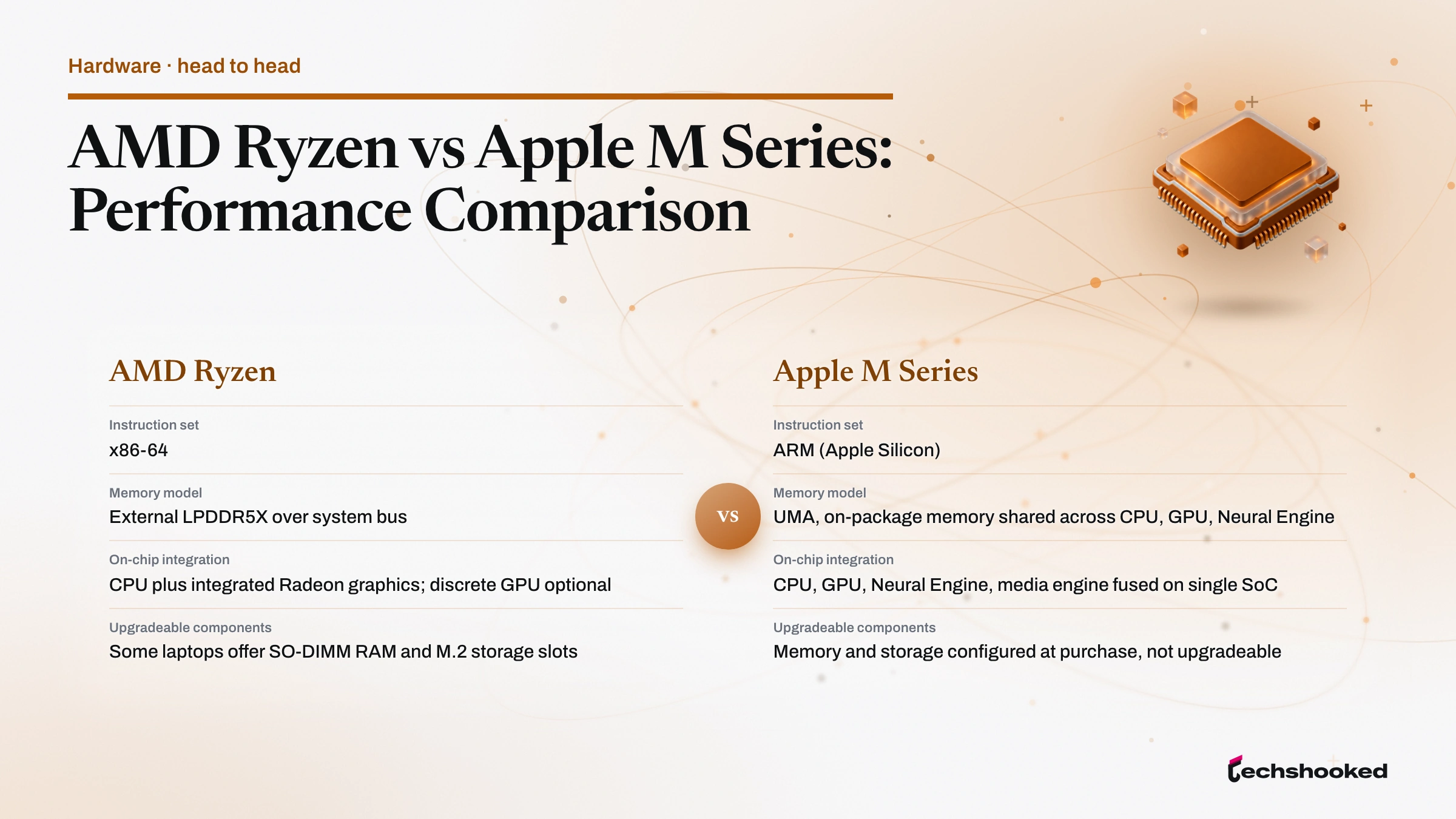
| Architecture dimension | AMD Ryzen (Zen 5 mobile) | Apple M Series (M4 and M5 generation) |
|---|---|---|
| Instruction set | x86-64 | ARM (Apple Silicon) |
| Memory model | External LPDDR5X over system bus | UMA, on-package memory shared across CPU, GPU, Neural Engine |
| On-chip integration | CPU plus integrated Radeon graphics; discrete GPU optional | CPU, GPU, Neural Engine, media engine fused on single SoC |
| Upgradeable components | Some laptops offer SO-DIMM RAM and M.2 storage slots | Memory and storage configured at purchase, not upgradeable |
| Platform fit | Windows, Linux | macOS only |
The Apple Silicon vs Intel vs AMD processor comparison puts this design against both x86 vendors in the same frame.
Memory Bandwidth and CPU Throughput Compared
Memory bandwidth is where the AMD Ryzen and Apple M Series architectures diverge most visibly. Apple publishes its on-package memory bandwidth figures directly in the technical specifications: the 14-inch MacBook Pro with the base Apple M5 chip lists 153 GB/s memory bandwidth alongside a 10-core CPU and 10-core GPU, while the M5 Pro and M5 Max tiers reach 307 GB/s and 460 GB/s respectively. These figures apply to the entire SoC, so GPU and Neural Engine workloads share the same pool without crossing a PCIe boundary.
Ryzen mobile chips paired with LPDDR5X system memory operate at lower headline bandwidth numbers because the CPU and GPU sit on opposite sides of an external memory bus. AMD's Ryzen mobile product page documents the current laptop families, and configurations vary by laptop vendor and chassis. The practical multi-core performance ceiling for Ryzen depends on TDP envelope and chassis cooling rather than memory bandwidth alone, while Apple M Series multi-core performance scales with the on-package memory tier that ships with each chip.
| Chip tier | bandwidth | Upgradeable post-purchase |
|---|---|---|
| Apple M5 | 153 GB/s | No |
| Apple M5 Pro | 307 GB/s | No |
| Apple M5 Max | 460 GB/s | No |
| AMD Ryzen mobile (LPDDR5X soldered) | Varies by laptop, typically below Apple M5 Pro tier | No |
| AMD Ryzen mobile (SO-DIMM) | Lower than soldered LPDDR5X | Yes |
For background on how memory and storage choices shape day-to-day system behavior, our explainer on how SSDs, RAM, and motherboards affect system performance covers the supporting components.
Single-Core and Sustained Performance Under Load
AMD Ryzen and Apple M Series both clear the threshold most users need for everyday work, so the meaningful gap shows up at the boundaries: peak single-core ceilings, sustained multi-core throughput under continuous load, and what happens when the chassis stops being able to dissipate heat. The same paper, Apple vs. Oranges: Evaluating the Apple Silicon M-Series SoCs for HPC Performance and Efficiency, reports that the M4 GPU reaches a peak of 2.9 FP32 TFLOPS while the M4 CPU peaks at 1.5 FP32 TFLOPS, with GPU and accelerator efficiency exceeding 200 GFLOPS per watt across all four chip generations studied. AMD does not publish equivalent TFLOPS-per-watt figures in a directly comparable form, and the AMD Ryzen mobile product page is the appropriate vendor reference for generation-level capability claims.
- Burst single-core ceiling. Both platforms hit competitive single-core performance for short bursts. Apple M Series typically holds its peak frequency without throttling thanks to UMA cache locality and the cool-running ARM cores. Ryzen mobile chips with Zen 5 architecture can match or exceed Apple's burst single-core performance in chassis with adequate cooling.
- Sustained multi-core throughput at default TDP. Apple M Series sustained workload performance is consistent because its thermal design power envelope and chassis are tuned together by one vendor. Ryzen sustained multi-core performance ranges widely depending on whether the laptop vendor configures the same silicon at 28W, 45W, or 54W.
- Fan-throttled performance floor. In fanless or passively cooled configurations, Apple M Series sustains a higher floor because efficiency cores carry background work at a fraction of the thermal cost. Ryzen passively cooled designs typically trail at sustained load because x86 sustained workload performance leans more heavily on active cooling.
Our roundup of the best CPU for productivity and gaming applies these tradeoffs to specific buyer scenarios.
AI Workloads and the Neural Processing Unit (NPU) Factor
AMD Ryzen and Apple M Series both ship a dedicated Neural Processing Unit (NPU) for on-device AI inference, but the surrounding software stack determines which workloads benefit. Apple routes Core ML, Final Cut Pro, and DaVinci Resolve effects through its Neural Engine and media engine. AMD routes Windows AI features and supported applications through the Ryzen AI NPU, with the broader x86 ecosystem providing fallback paths on CPU and integrated Radeon graphics.
- Apple Neural Engine. A 16-core Neural Engine is included in the M5 chip according to Apple's MacBook Pro (14-inch, M5) specifications, and it handles on-device machine learning inference for Core ML applications without crossing the package memory boundary.
- AMD Ryzen AI NPU. The Ryzen AI mobile family integrates an NPU for Windows Copilot+ workloads. The AMD Ryzen mobile product page is the canonical vendor reference for the current Ryzen AI generation.
- Hardware-accelerated encoding. Apple's media engine accelerates ProRes and H.265 natively for Final Cut Pro and DaVinci Resolve. AMD's Radeon media engine provides hardware-accelerated encoding for H.264, H.265, and AV1 across Windows creative applications.
The choice between the two NPU paths usually follows the application, not the chip. A video editor working in ProRes on Final Cut Pro will see the Apple Neural Engine and media engine carry more of the load, while a Windows-native AI workflow built around Copilot+ features will benefit from the Ryzen AI NPU and its x86 software ecosystem.
Gaming and Creative Workflow Platform Fit
AMD Ryzen and Apple M Series sit on opposite sides of the gaming library coverage question. A Ryzen laptop running Windows has direct access to the full Steam catalog, Xbox Game Pass for PC, the Epic Games Store, and the long tail of older titles that never received macOS ports. Apple M Series runs macOS-native titles, a smaller catalog of ported games, and Windows titles routed through the Game Porting Toolkit translation layer, which adds CPU overhead and compatibility caveats.
- Gaming library coverage. Ryzen plus Windows is the broader platform compatibility option for PC gaming. Apple M Series gaming library coverage is improving through the Game Porting Toolkit but remains narrower than the Steam catalog on Windows.
- Creative suite native support. Adobe Creative Cloud, DaVinci Resolve, and Blender run native on both platforms. Final Cut Pro and Logic Pro are Apple-only. The Avid Pro Tools workflow runs on both, with platform compatibility differences in plugin availability.
- Codec acceleration. Apple's media engine accelerates ProRes natively and offers hardware-accelerated encoding for H.265. AMD's Radeon media engine offers hardware-accelerated encoding for H.264, H.265, and AV1, with broader codec support across Windows video tools.
For the deeper question of when CPU choice matters more than GPU choice in these workflows, see CPU vs GPU: what matters for productivity or gaming.
Power Efficiency and Battery Life Tradeoffs
AMD Ryzen and Apple M Series both deliver competitive power efficiency on light tasks, but the gap widens at sustained heavy load. The authors of Apple vs. Oranges: Evaluating the Apple Silicon M-Series SoCs for HPC Performance and Efficiency measured GPU and accelerator efficiency above 200 GFLOPS per watt on all four chips, M1 through M4. Ryzen Zen 5 architecture mobile chips offer configurable TDP ranges that laptop vendors tune for either battery life or sustained performance, with the AMD product documentation as the vendor reference for current Ryzen mobile families.
- Idle and light browsing. Performance per watt is close on both platforms for web browsing, email, and document editing. Apple M Series efficiency cores carry background work at a small power cost; Ryzen mobile chips at their lowest configurable TDP setting narrow the gap considerably.
- Medium sustained load. For video playback, document editing with many open tabs, and light development work, Apple M Series typically holds a measurable performance per watt lead. Ryzen mobile remains competitive in well-tuned chassis.
- Heavy sustained load. Under continuous compilation, video encode, or rendering, Apple M Series retains the larger power efficiency advantage. Ryzen mobile at performance-mode TDP draws more wall power but offers higher absolute throughput in some workloads, especially when paired with a discrete GPU.
For buyers weighing battery-anchored portability against desktop-anchored throughput, our laptops vs desktops vs workstations guide walks through the form-factor decision in detail.
Further reading
Frequently Asked Questions
What are the main architectural differences between AMD Ryzen and Apple M Series?
AMD Ryzen uses the x86 instruction set with separate CPU compute and either integrated or discrete graphics, connected to standard LPDDR5X system memory. Apple M Series uses an ARM-based design where CPU, GPU, Neural Engine, and memory sit on a single package sharing the same memory pool at bandwidths ranging from 153 GB/s on the base M5 to 460 GB/s on M5 Max. The practical difference is that Apple M Series avoids the bandwidth bottleneck between CPU and GPU memory, while AMD Ryzen retains compatibility with the Windows software and gaming ecosystem and supports discrete GPU upgrades in desktop configurations.
Can AMD Ryzen processors be used in Apple devices?
No. AMD Ryzen processors are not compatible with Apple devices. Apple's Mac lineup runs exclusively on Apple Silicon chips, which are custom ARM-based SoCs designed and manufactured by Apple. AMD Ryzen chips are x86-based and run on Windows and Linux platforms. There is no upgrade or retrofit path between the two architectures.
How do AMD Ryzen and Apple M Series compare for battery life in laptops?
Apple M Series laptops consistently achieve longer battery life under equivalent workloads because the ARM-based UMA design consumes less power per unit of compute than current x86 implementations. Peer-reviewed research on M1 through M4 confirmed GPU and accelerator efficiency exceeding 200 GFLOPS/W. AMD Ryzen AI-series mobile processors running at their lowest configurable TDP setting (around 15W) narrow the gap on light tasks such as document editing and web browsing, but Apple M Series retains a meaningful efficiency lead under sustained heavy workloads.