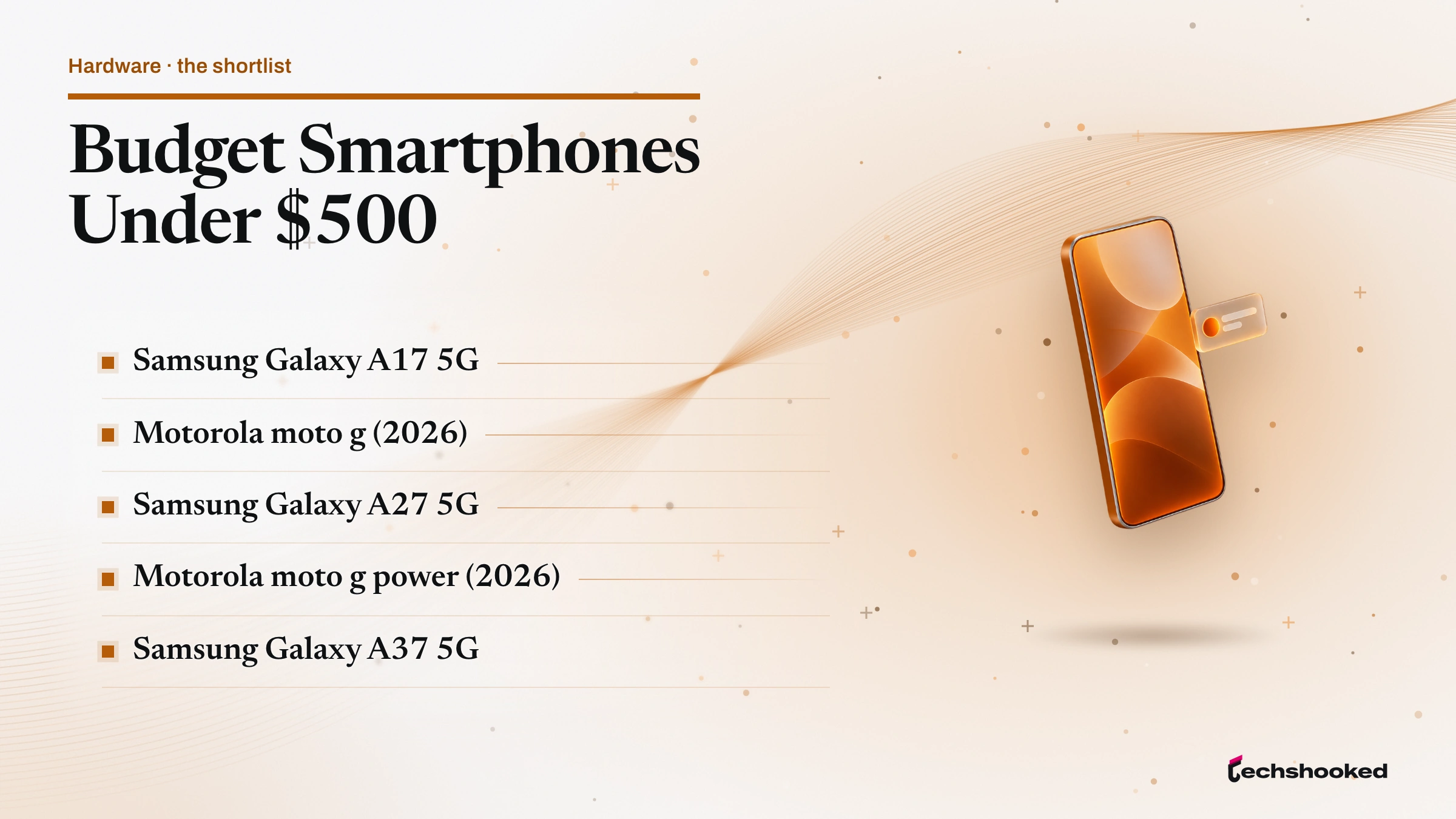
A budget smartphone is a consumer device category that delivers core Android or iOS functionality including capable cameras, sufficient RAM for multitasking, and multi-day battery life at sub-flagship retail prices.
That price ceiling has not come with the spec ceiling it once implied. A budget phone purchased today can run a mid-range processor competitive with flagships from two product generations ago, shoot usable low-light photos through multi-frame processing pipelines, and hold a charge across a full day of heavy use. The tradeoffs are real but they are specific, and knowing where each price tier draws its lines is the only way to buy well.
What a Budget Smartphone Actually Delivers in the Under-$500 Bracket
A budget smartphone in the under-$500 range is not a single device class. Three distinct sub-brackets divide the space by what manufacturers can fit inside a given bill of materials. Understanding those divisions before looking at any brand comparison prevents the most common purchasing mistake: comparing a $189 handset to a $479 one as if the gap is cosmetic.
At minimum, any phone worth considering for a three-year ownership horizon should clear 6GB RAM and 128GB storage, and 8GB is the safer choice for heavy multitasking. Below those floors, multitasking degrades within 18 months as apps grow heavier. 5G connectivity is now table-stakes across all three tiers; even sub-$200 models from Motorola and Samsung ship with sub-6GHz 5G radios. The hidden cost the spec sheet never lists is OS update commitment: a device that stops receiving security patches two years in becomes a liability regardless of how well its battery holds up. For context on how OS architecture shapes update policy, see the full breakdown in iOS vs Android: Platform Architecture, Privacy, and Enterprise Compared.
| Sub-bracket | Typical processor | Display | OS update floor | Representative models |
|---|---|---|---|---|
| $150-$299 | Dimensity 6300 / Snapdragon 4 Gen 2 | 60-120Hz LCD or AMOLED, 720p-1080p | 6 years OS and security (Samsung) | Motorola moto g (2026), Samsung Galaxy A17 5G |
| $300-$399 | Snapdragon 6 Gen 3 / Dimensity 6300 | 120Hz LCD or AMOLED, 1080p | 6 years OS and security (Samsung) | Samsung Galaxy A27 5G, Motorola moto g power (2026) |
| $400-$499 | Samsung Exynos 1480 | Super AMOLED, 1080p | 6 years OS and security | Samsung Galaxy A37 5G |
Performance Comparison: Mid-Range Processors and Real-World Speed
Every budget smartphone in this price range ships with a mid-range processor, but the gap between the bottom and top of that category is wide enough to affect daily use for the full ownership horizon. Processor tier is the single specification with the most compounding effect: it determines app launch times, camera processing speed, gaming frame stability, and how long until the phone feels sluggish under a heavier OS build.
At the entry tier, processors like the Snapdragon 4 Gen 2 or MediaTek Dimensity 6100+ deliver AnTuTu scores in the 400,000-500,000 range, sufficient for social media, streaming, and light productivity. Mid-tier phones add headroom in different ways. Samsung's Galaxy A27 5G steps up to a Snapdragon 6 Gen 3, while Motorola's moto g power (2026) keeps the MediaTek Dimensity 6300 from the $299.99 moto g (2026) and adds 8GB of RAM, a sharper FHD+ display and OIS on the main camera. At the top of the bracket, Samsung's Exynos 1480 powers the Galaxy A37 5G at $489.99. Google no longer sells a Pixel under $500: the Pixel 10a starts at $599 on the Google Store Pixel 10a page.
RAM and storage configuration compounds processor selection. An 8GB RAM device on UFS 3.1 flash opens apps visibly faster than a 6GB device on UFS 2.2, even when the processors are equivalent. Storage generation matters more than capacity for perceived speed: UFS 3.1 sequential read speeds run roughly twice those of UFS 2.2. Refresh rate adds a third variable that shapes perception more than benchmarks: a 60Hz panel makes interfaces feel slow against a 120Hz one, independent of the underlying processor speed, and every phone in this guide now runs at 90Hz or faster. For how these camera systems play out at the flagship end of Android, the Best Android Phones for Photography: Camera Systems Compared article covers the upper tier in detail.
| Device (US list price, October 2026) | Processor | AnTuTu tier | RAM config | Storage | Display refresh rate |
|---|---|---|---|---|---|
| Samsung Galaxy A17 5G ($269.99) | 2.4GHz octa-core | Entry | 4GB | 128GB | 90Hz FHD+ Super AMOLED |
| Motorola moto g (2026) ($299.99) | MediaTek Dimensity 6300 | Entry | 4GB plus RAM Boost | 128GB | 120Hz HD+ LCD |
| Samsung Galaxy A27 5G ($379.99) | Snapdragon 6 Gen 3 | Mid | 6GB | 128GB | 120Hz FHD+ Super AMOLED |
| Motorola moto g power (2026) ($399.99) | MediaTek Dimensity 6300 | Entry | 8GB plus RAM Boost | 128GB | 120Hz FHD+ LCD |
| Samsung Galaxy A37 5G ($489.99) | Exynos 1480 | Upper mid | 6GB (128GB) or 8GB (256GB) | 128GB-256GB | 120Hz FHD+ Super AMOLED |
Prices are list prices on Samsung's and Motorola's US stores as of October 2026, before trade-in credits and promotions.
Camera Quality: What Budget Smartphones Sacrifice and What They Retain
The camera is the most visible trade-off in any budget smartphone comparison. The gap between a $179 phone and a $479 one is not evenly distributed across all specs. It concentrates in sensor size, optical image stabilization (OIS) presence, and the quality of the computational photography pipeline processing those sensor inputs.
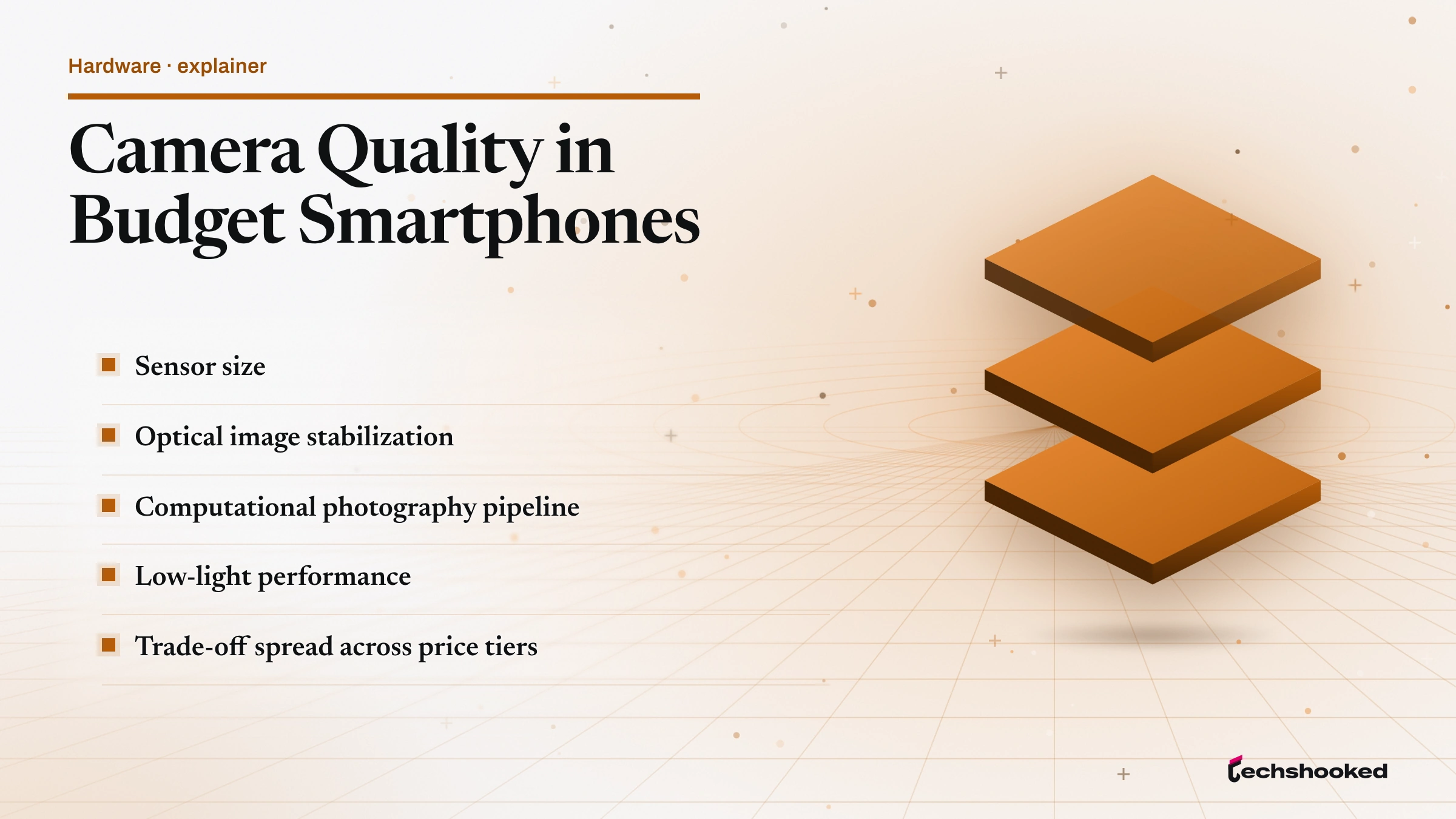
Sensor size drops from the 1/1.5-inch sensors found in flagship cameras down to 1/2.0-inch to 1/2.55-inch at the $400-$499 sub-bracket, and further to 1/3.0-inch at the entry tier. A smaller sensor gathers less light per pixel, which shows most clearly in low-light conditions and fast-motion shots. Camera aperture follows a similar gradient: f/1.7 at the top tier widens to f/1.8-f/2.0 at entry, reducing the light-gathering advantage that night mode algorithms depend on.
Optical image stabilization is absent on most sub-$300 models. Samsung's Galaxy A17 5G is the exception at $269.99: Samsung lists OIS on its main camera, which reduces motion blur in low light and at medium shutter speeds. Computational photography compensates partially where OIS is absent: multi-frame night modes stack several exposures to cut noise, and Samsung highlights improved Nightography on the Galaxy A37 5G's rear cameras. Display brightness affects camera usability in a practical sense: screens below 600 nits make it difficult to frame shots outdoors, a common issue at the entry tier.
Samsung lists the camera hardware for its top pick in this bracket on the Samsung Galaxy A37 5G product page: a 50MP main camera, an 8MP ultrawide and a 5MP macro.
Five criteria for evaluating a budget device camera
- Sensor size: Entry tier ($150-$299) averages 1/3.0-inch; mid-tier ($300-$399) reaches 1/2.55-inch; top tier ($400-$499) approaches 1/2.0-inch. Larger wins in low light and dynamic range.
- OIS presence: Absent on most sub-$300 models; Samsung lists it on the Galaxy A17 5G. Critical for video stabilization and night mode sharpness.
- Night mode algorithm quality: Google's Pixel pipeline now starts above this bracket (Pixel 10a, $599). Samsung highlights improved Nightography on the Galaxy A37 5G. Entry-tier devices process fewer frames per stack, producing noisier low-light output.
- Ultrawide inclusion: Common from about $350, at low resolution: 5MP on the Galaxy A27 5G and 8MP on the Galaxy A37 5G. Fixed-focus ultrawide lenses produce soft corners but are acceptable for landscape framing.
- Video resolution ceiling: Entry tier caps at 1080p30; top tier reaches 4K30. None in this bracket offer 4K60 or log-profile capture.
Battery Life and Charging: Where Budget Phones Often Win
Battery endurance is one area where a budget phone frequently outperforms devices costing twice as much. Mid-range processors draw less sustained power than the high-performance cores in flagship SoCs. Manufacturers also fit larger cells into budget phones because battery capacity is a low-cost differentiator that shows up in benchmark comparisons consumers actually run.
Cell sizes now cluster around 5,000mAh-5,200mAh (typical) in every tier: Motorola lists 5,200mAh for both the moto g (2026) and the moto g power (2026), and Samsung lists 5,000mAh for the Galaxy A27 5G and the Galaxy A37 5G (per the Samsung Galaxy A27 5G product page). Charging speed is where they split. Motorola's TurboPower reaches 30W; the Galaxy A37 5G supports 45W Super Fast Charging 2.0 (up to 60% in 30 minutes), while the Galaxy A27 5G reaches up to 45% in 30 minutes. Those speeds depend on a charger that supports the matching USB-C Power Delivery or PPS profile, not only on the phone.
5G connectivity introduces a power variable. Most budget 5G phones use sub-6GHz bands only, as confirmed by GSMA Intelligence data on global sub-6GHz deployment, and sub-6GHz draws power comparable to LTE in most real-world conditions. The GSMA State of Mobile Internet Connectivity report shows mmWave 5G remains concentrated in dense urban environments and is absent from mainstream sub-$600 devices, removing the high-baseband-drain scenario for most budget phone owners. A phone that loses security patches becomes a security risk before its battery degrades, shortening the effective device lifespan independent of hardware health; factor the software support window into every ownership calculation.
For a look at how foldable form factors are reshaping expectations for battery and display at higher price points, see Smartphone Trends: Foldables and What They Signal for the Mid-Range.
- $150-$299: 4500mAh-5200mAh cells; 10W-30W fast charging (varies by model; charger may not be included); wireless charging absent; battery endurance typically 1.5-2 full days under moderate use.
- $300-$399: 5000mAh-5200mAh cells; up to 30W on the moto g power (2026), with Motorola's 33W charger sold separately; wireless charging absent except on select regional variants; battery endurance extends to 2 days under moderate use with display brightness at auto.
- $400-$499: 5,000mAh (Galaxy A37 5G); 45W Super Fast Charging 2.0 with a separately sold 45W charger; wireless charging is not among the Galaxy A37 5G's listed features; battery endurance 1-1.5 days under mixed heavy use due to always-on 120Hz AMOLED displays.
Charging figures and prices are from Motorola's and Samsung's US product pages as of October 2026.
Which Budget handset Fits Which Buyer: A Tier-by-Tier Decision Guide
Matching a sub-$500 phone to the right buyer requires mapping purchase criteria to price tier rather than chasing the highest spec sheet at the lowest price. The four buyer profiles below reflect the decision axes that actually vary by use case: update longevity, camera priority, productivity requirements, and procurement cost controls.
First smartphone buyer or secondary device ($150-$299). The priority is longevity of core function: 5G connectivity for forward compatibility, minimum RAM and storage floors of 6GB and 128GB, and a 4500mAh+ cell. OS update commitment of at least three years is the floor. Motorola's moto g (2026) ($299.99) and Samsung's Galaxy A17 5G ($269.99, six years of OS and security updates) are representative models; both ship with 4GB of RAM (Motorola adds RAM Boost, which borrows storage as virtual memory), below the 6GB floor. Camera aperture at this tier is limited and low-light performance is weak, but daytime photography is functional. Price-to-performance ratio peaks here for buyers who need a working phone, not a camera system.
Camera-conscious but cost-constrained ($300-$399). OIS on the main camera, a 90Hz or faster refresh rate, and a camera aperture of f/1.7-f/1.8 are the differentiating features. Samsung's Galaxy A27 5G ($379.99, Snapdragon 6 Gen 3) and Motorola's moto g power (2026) ($399.99, MediaTek Dimensity 6300, 120Hz display) are representative. Samsung commits to six OS upgrades and six years of security updates for the Galaxy A27 5G, which covers a three-year ownership plan with years to spare.
Near-flagship value seeker ($400-$499). Computational photography pipeline quality and software update longevity are the deciding factors at this tier. Samsung's Galaxy A37 5G ($489.99) pairs an Exynos 1480 chip and a 6.7-inch FHD+ Super AMOLED display with six OS upgrades, six years of security updates and IP68 water resistance. Google's seven-year update policy now starts above this bracket, with the Pixel 10a at $599. Battery endurance is adequate rather than excellent. Price-to-performance ratio at this tier reflects the premium on software longevity rather than raw hardware specification.
Small-business or education procurement. Android Enterprise Recommended (AER) certification, which requires a minimum three-year security patch floor per Google's Android Enterprise Recommended requirements, is the starting filter. Global 5G band compatibility reduces device fragmentation across regions. Price-to-performance ratio matters more than any individual feature. Samsung Galaxy A-series devices at the $350-$499 tier satisfy AER requirements, and Samsung now commits to six years of security updates on the Galaxy A27 5G and A37 5G. For a detailed comparison of Samsung Galaxy and iPhone in enterprise deployments, see Samsung Galaxy vs iPhone for Business once published.
Prices in this guide are US list prices as of October 2026.
| Buyer profile | Price tier | Camera priority | Update floor | Battery priority | 5G type |
|---|---|---|---|---|---|
| First buyer / secondary device | $150-$299 | Low (daytime casual) | 3 years security | High (4500mAh+ cell) | Sub-6GHz |
| Camera-conscious buyer | $300-$399 | High (OIS + aperture) | 6 years OS (Samsung) | Medium | Sub-6GHz |
| Near-flagship value seeker | $400-$499 | High (comp. photo pipeline) | 6 years OS | Medium (thinner chassis) | Sub-6GHz |
| Business / education procurement | $350-$499 | Low (secondary) | 6 years OS + AER | Medium | Sub-6GHz, global bands |
Further reading
- Best Android Phones for Photography: Camera Systems Compared , Android camera systems above the $500 threshold, including flagship sensor and OIS configurations
- SmartThings vs Home Assistant vs Hubitat: Smart Home Hub Comparison for Advanced Users
Technical refs: NIST SP 800-124 Rev 2 Mobile Device Security; IETF RFC 8200 IPv6 (mobile networking).
Frequently Asked Questions
Do budget Android phones under $500 support 5G?
Mid-tier phones across all sub-brackets under $500 now include 5G as a standard feature, though coverage type varies. Entry-tier models ($150-$299) typically support sub-6GHz 5G bands only, which deliver speeds comparable to mid-band LTE in non-congested networks. The $400-$499 tier may support broader sub-6GHz band configurations for better carrier compatibility. mmWave 5G, required for dense urban gigabit coverage, is absent below $600 on mainstream models. Verify your carrier's 5G band map against the device's supported bands before purchasing.
How many years of software updates should I expect from a value phone?
OS update commitment varies significantly by manufacturer and tier. Samsung now sets the pace under $500: the Galaxy A17 5G, A27 5G and A37 5G each get six OS upgrades and six years of security updates, per Samsung. Google's seven-year policy starts above this bracket, with the Pixel 10a at $599. Motorola publishes no multi-year OS upgrade commitment for the moto g (2026) or moto g power (2026). A shorter update window reduces the effective ownership horizon and increases security exposure; factor the update floor into total cost of ownership.
Is fast charging available on entry phones under $500?
Rapid charging is available on most budget models above $250, but speeds vary. Motorola's TurboPower delivers 30W on the moto g (2026) and the moto g power (2026); Samsung's Galaxy A37 5G supports 45W Super Fast Charging 2.0 with a separately sold 45W charger. Entry-tier models below $200 often ship with 10W-15W chargers and may not include a charger in-box. Wireless charging is not among the listed features of the phones in this guide; it remains a feature of pricier models. Charging specs are from Motorola's and Samsung's US product pages as of October 2026.