A wearable device is a body-worn computing instrument that monitors biometric data and surfaces actionable health metrics throughout the day. The category has split into three durable form factors with distinct daily-use profiles: the smartwatch, the smart ring, and the dedicated fitness tracker. Each shares a common sensor lineage but resolves the form factor trade-off between screen real estate, battery endurance, and discretion in a different way. Choosing among them is less a question of which one is technically better and more a question of which compromise fits how a reader actually wears, charges, and reads from a device every day.
What a Wearable Device Actually Measures
Every modern wearable device leans on the same three sensor primitives, regardless of whether it sits on the wrist or the finger. Optical photoplethysmography (PPG) drives heart rate and heart rate variability (HRV) readings by pulsing green and infrared light into the skin and measuring backscatter. A multi-axis accelerometer, often paired with a gyroscope, handles step counts, motion classification, and the bulk of sleep stage tracking. A skin temperature sensor adds a slow-moving baseline that surfaces illness onset, menstrual cycle phase, and recovery drift. Pulse oximetry, the basis of SpO2 measurement (blood oxygen saturation), uses the same PPG hardware at a second wavelength to estimate oxygen saturation, typically as a spot reading rather than continuous health monitoring.
- Optical PPG sensor: measures pulse rate, HRV, and SpO2 measurement. Present on smartwatches, smart rings, and most fitness trackers.
- Accelerometer and gyroscope: capture steps, cadence, fall events, and sleep stage tracking. Universal across the three form factors.
- Skin temperature sensor: provides nightly baseline deviation used by recovery score algorithm logic. Present on premium models in all three categories.
- Electrodermal activity (EDA) sensor: detects sweat-driven skin conductance shifts tied to stress response. Concentrated on smartwatches and select trackers, absent from current rings.
- GPS receiver: maps outdoor route, pace, and elevation. Exclusive to GPS-enabled smartwatch models and a subset of tracker models.
How Smartwatches Compare as a Wearable Device Category
A smartwatch is the most feature-dense wearable device of the three, trading battery life for a screen that handles notification delivery, on-device apps, and an always-on display. The form factor supports the widest sensor array and is the only one of the three that natively handles outdoor route tracking through an onboard GPS-enabled smartwatch radio. Apple positions the Apple Watch Series 10 around a thinner case and a wide-angle OLED with always-on behavior, per the Apple Watch Series 10 specifications page. Samsung documents comparable sensor coverage and notification handling on Galaxy Watch hardware through its product documentation.
The smartwatch trade-off lands on charging cadence. The screen, the radios, and the higher sample rates all draw current, which is why a typical smartwatch sits in a one-to-two-day battery life cycle rather than the multi-day range posted by rings and trackers. Activity tracking accuracy on the wrist is generally strong for cadence-driven sports, weaker for sports that lock the wrist (cycling grips, weightlifting) where the sensor cannot read pulse cleanly.
| Attribute | Apple Watch Series 10 | Garmin Forerunner class |
|---|---|---|
| Display | Wide-angle OLED, always-on display | MIP transflective, always-on display |
| GPS | Dual-frequency onboard | Multi-band onboard |
| Notification delivery | Full iOS notification mirroring | Smartphone notification mirroring, reply on Android |
| Battery life cycle | About one day with always-on | Multi-day with always-on |
| Sensor count | PPG, ECG, SpO2, temperature, EDA-adjacent | PPG, SpO2, temperature on premium tier |
| Price tier | Premium | Mid to premium |
How Smart Rings Compare as a Wearable Device Category
A smart ring is the most discreet wearable device on the market and the form factor that leans hardest into passive biometric sensing. With no screen and no haptic notification interface beyond a single-vibration alert on select models, the ring concentrates compute and battery budget on continuous health monitoring of the wearer's pulse, temperature, and movement. Oura documents the sensor stack on the Oura Ring 4, including its PPG array, skin temperature sensor, and accelerometer, on its Oura Ring 4 product page. Samsung sells the Galaxy Ring against a similar feature brief, with deeper hooks into the Samsung Health platform on compatible phones.

The smart ring sensor array sits closer to the digital artery on the finger, which produces clean HRV and sleep stage tracking signals at rest. The ring's recovery score algorithm typically blends overnight HRV, resting pulse, respiratory rate, and skin temperature into a single morning readiness number. The form factor trade-off is twofold: no display means notifications are gone, and high-motion exercise often produces noisier activity tracking accuracy than a wrist sensor because the finger is a more mobile mounting point during gripping motions.
| Attribute | Oura Ring 4 | Samsung Galaxy Ring |
|---|---|---|
| Smart ring sensor array | PPG, skin temperature, accelerometer | PPG, skin temperature, accelerometer |
| Battery life cycle | Multi-day on a single charge | Multi-day on a single charge |
| App ecosystem | Oura app, subscription tier for advanced metrics | Samsung Health, tightest on Galaxy phones |
| Notification delivery | None | None |
| Form discretion | High, jewelry profile | High, jewelry profile |
How Dedicated Fitness Trackers Compare as a Wearable Device Category
A dedicated fitness tracker is the focused middle wearable device, slimmer than a smartwatch and screen-equipped unlike a ring. The category targets activity tracking accuracy, sleep stage tracking, and continuous health monitoring at a longer battery life cycle than a full smartwatch, while keeping enough display to handle short notification delivery and on-wrist controls. Google documents the Charge 6 sensor set, including built-in GPS and an ECG-capable electrical sensor, on the Fitbit Charge 6 product page. Garmin positions the Vivosmart line against the same band-style category with a focus on multi-day endurance.
Trackers are the right wearable device when a buyer wants serious health metrics but does not want to charge nightly. The compromise is screen size: notification text is short, app interaction is limited, and there is no general-purpose app ecosystem on the device itself.
| Attribute | Fitbit Charge 6 | Garmin Vivosmart class |
|---|---|---|
| Step and pulse accuracy | PPG plus ECG-capable electrical sensor | PPG with body battery context |
| Battery cycle | Multi-day per Fitbit specifications | Roughly a week per Garmin specifications |
| GPS | Onboard | Connected GPS through phone |
| SpO2 measurement | Spot and overnight | Spot and overnight |
| Price tier | Mid | Mid |
Cross-Form-Factor Comparison: Where Each Wearable Device Excels
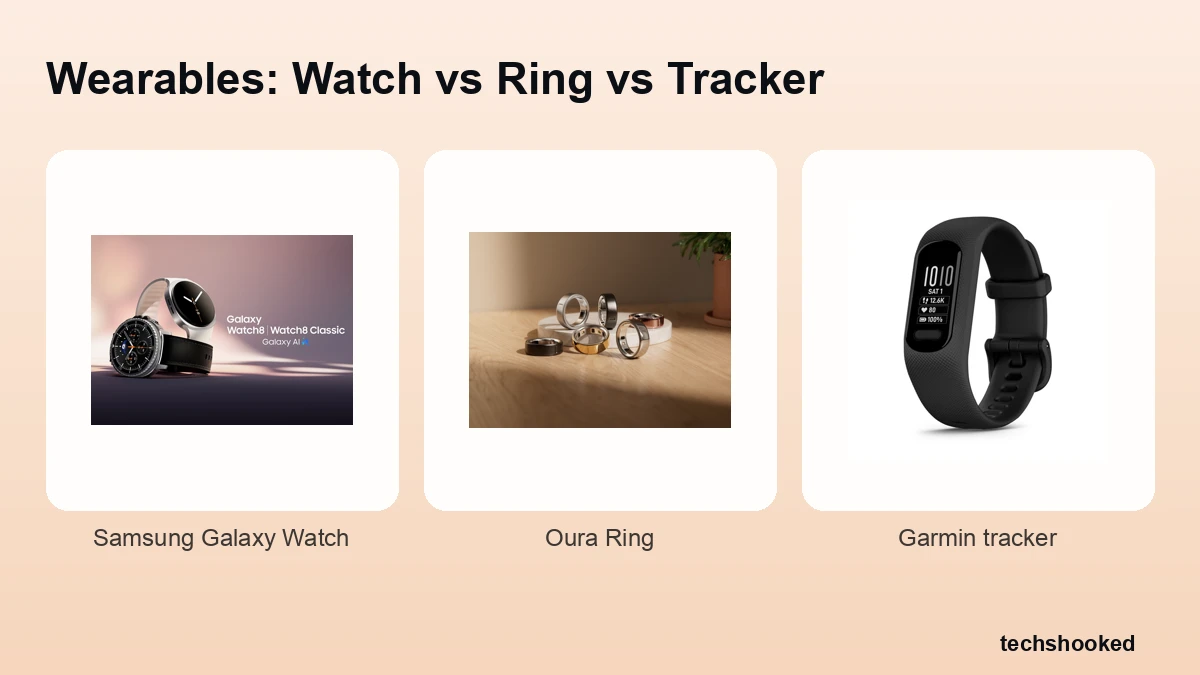
Once each wearable device category is understood on its own terms, the cross-form-factor comparison reduces to a small set of daily-use criteria. The smartwatch leads on notification handling, app reach, and athletic GPS tracking through its onboard GPS-enabled smartwatch radio. The smart ring leads on discretion, on multi-day battery endurance, and on overnight signal quality from the smart ring sensor array. The dedicated tracker sits in the middle, leading on price-to-feature ratio and on battery duration versus smartwatches while keeping a usable screen. A study of consumer and research-grade wearables, Investigating sources of inaccuracy in wearable optical heart rate sensors (npj Digital Medicine, 2020), found them reasonably accurate at rest, with absolute error during activity on average 30% higher than at rest.
| Daily-use criterion | Smartwatch | Smart ring | Fitness tracker |
|---|---|---|---|
| Sleep-stage analysis depth | Comparable | Leads | Comparable |
| Notification handling | Leads | Trails (no display) | Comparable on short alerts |
| Athletic GPS tracking | Leads | Trails (no GPS) | Comparable on GPS-equipped models |
| Battery endurance | Trails (1 to 2 days) | Leads (multi-day) | Leads (multi-day) |
| Discretion | Trails | Leads | Comparable |
| Price-to-feature ratio | Trails at premium tier | Subscription-sensitive | Leads |
Choosing the Right Wearable Device for Your Daily Health Priority
The right wearable device is a function of which trade-off is least acceptable, not which feature list is longest. A short decision sequence narrows the field quickly.

- What is the primary daily goal? If continuous health monitoring of sleep, HRV, and recovery is the goal, a smart ring or a sleep-focused tracker covers it without the smartwatch overhead. If outdoor training with route data is the goal, a GPS-enabled smartwatch or a GPS-equipped tracker is required.
- Are on-wrist notifications a daily requirement? If yes, a smartwatch or a screen-equipped tracker is the right wearable. A smart ring will not satisfy this need.
- How long between charges is acceptable? Nightly charging suits a smartwatch. A multi-day battery cycle behavior points to a ring or a tracker. Athletes who travel are usually better served by the longer cycle.
- How important is discretion? A ring is invisible at a meeting and at sleep; a watch is not. Discretion matters more in formal-dress workplaces and during overnight wear for users sensitive to a wrist device.
- What is the budget ceiling, including subscriptions? Several ring vendors gate advanced recovery score algorithm outputs behind a subscription, while most smartwatch and tracker recovery metrics ship without an ongoing fee. Calculate three-year cost, not the sticker price.
Health wearable Data Privacy and Platform Lock-In
Every body-worn device generates a steady stream of identifiable health data through passive biometric sensing, and the platform that ingests that data shapes what happens to it next. Consumer health data captured by a wearable form factor falls outside HIPAA jurisdiction in the United States because the vendor is not a covered entity, which leaves data handling to vendor privacy policies and to general consumer protection law. The NIST control catalog in NIST Special Publication 800-53 Revision 5 is the reference frame most enterprise health-data pipelines use, particularly the AU (audit) and SC (system and communications protection) families that apply to data in transit and at rest. A systematic review of 17 manufacturers' privacy policies, Privacy in consumer wearable technologies: a living systematic analysis of data policies across leading manufacturers (npj Digital Medicine, 2025), rated third-party data sharing among its criteria and found inconsistent data governance across the industry.
- Data storage jurisdiction: confirm whether HRV and sleep-stage monitoring data is stored in the buyer's country or routed across borders.
- Third-party data sharing: read the policy for advertising partners, research partners, and insurance partners.
- Ecosystem lock-in: Apple Health, Google Fit, Samsung Health, and proprietary apps export data on different schedules and in different formats.
- Subscription dependency: confirm which continuous monitoring features keep working if the subscription lapses.
- Account deletion path: confirm that account deletion erases sensor history rather than anonymizing and retaining it.
Further reading
- Fitness Tracker Comparison: Fitbit vs Garmin vs Oura Ring
- Long Lasting Fitness Trackers For Daily Use
- Apple Watch vs Samsung Galaxy Watch Comparison
Frequently Asked Questions
What are the main differences between a smartwatch and a smart ring as a wearable platform?
A smartwatch delivers an always-on display and full notification handling; a smart ring sacrifices the screen for a smaller footprint and longer battery life. Smartwatches support GPS and app ecosystems; smart rings concentrate on passive biometric sensing and sleep-stage detection with minimal user interaction. The right choice depends on whether on-wrist notifications or discretion is the higher daily priority.
Can a smart ring track fitness activity as accurately as a smartwatch?
Smart rings match smartwatches on heart rate variability and sleep cycle tracking but trail on activity tracking accuracy during high-motion workouts because the ring's sensor position on the finger is farther from the body's core pulse than the wrist. GPS-based route tracking is unavailable on current rings. For step counting and resting biometrics the gap is small; for athletic training load a smartwatch or a dedicated GPS tracker leads. See also: Laptops Vs Desktops Vs Workstations 2025.
Which consumer wearable is better for notification handling: a smartwatch or a smart ring?
A smartwatch is better for notifications. Smart rings have no display and no haptic notification interface beyond a single-vibration alert on select models. A GPS-enabled watch can show message previews, call IDs, and app alerts on screen. If notification flow is a daily requirement, a smartwatch or fitness tracker with a display is the appropriate body-worn wearable category.