A smart speaker ecosystem is a platform that combines voice-activated hardware, a cloud-hosted natural language engine, and a third-party device integration layer to let users control smart home devices, retrieve information, and automate routines by spoken command. The category looks uniform from the outside: three black or white cylinders sitting on three kitchen counters. The architecture underneath is not. Picking between Google Home, Amazon Alexa, and Apple HomePod is a decision about which natural language processing stack, which device compatibility graph, and which privacy posture you want running in the background of your house for the next five years. The fanless PC guide, the guide to how SSDs, RAM, and motherboards affect performance, and the laptops versus desktops versus workstations comparison cover the adjacent hardware choices.
What a Smart Speaker Ecosystem Is
A smart speaker ecosystem succeeds or fails on the NLU layer first. Voice recognition accuracy in a quiet room is largely solved across the three platforms; the meaningful differences show up in noisy rooms, in accented speech, and when a user issues a multi-step command that depends on the previous turn. Google Home, running Google Assistant against the Knowledge Graph, holds the strongest record on free-form general queries and on multi-step command chains that pivot mid-sentence. Independent academic benchmarks from the Stanford OVAL lab and from third-party voice testing firms place Google Assistant ahead of both rivals on disambiguation tasks and follow-up questions that omit the subject.
Amazon Alexa carries the largest skill library, with more than 100,000 published Alexa Skills as of early 2026, and ships some of the strongest hardware in the category. Recent Echo and Echo Show units use a seven-microphone beamforming far-field microphone array tuned for room-scale capture, and the AZ1 Neural Edge chip handles first-stage wake-word detection on device. The trade is that Alexa's free-form conversational NLU still trails Google Assistant on knowledge-graph queries, and its skills directory pushes some integrations behind invocation phrases that users forget.
Apple HomePod runs Siri on the Neural Engine inside the S7 chip in the second-generation HomePod, which moves a larger share of common voice command processing on device. Its far-field microphone array uses four elements tuned for in-room beam steering. Siri lags on broad world-knowledge questions but performs well on HomeKit scenes, calendar entries, and reminders. Wake-word stages also differ: Google and Amazon both run dual-stage detection with on-device keyword spotting followed by cloud confirmation, while Apple keeps the entire "Hey Siri" pipeline on the device, a heritage that traces back to iOS, as covered in the iOS vs Android comparison.
| Platform | NLU engine | Primary processing | Multi-step command support | Far-field mic array | Wake-word stage |
|---|---|---|---|---|---|
| Google Home (Nest Audio) | Google Assistant, Knowledge Graph backed | Cloud, with local fallback on Nest devices | Yes, conversational context across turns | 2-mic Nest Audio, 7-mic Nest Hub Max | Dual-stage: on-device plus cloud confirmation |
| Amazon Alexa (Echo 4th gen) | Alexa NLU with AZ1 Neural Edge | Hybrid; first-stage on device, intent in cloud | Partial; sequential routines via Alexa app | 7-mic beamforming array | Dual-stage: AZ1 on device plus cloud verify |
| Apple HomePod (2nd gen) | Siri on Neural Engine, S9 chip | On device for wake-word and many intents | Limited; strongest inside HomeKit scenes | 6-mic array | On device only, no cloud wake-word stage |
Matter Protocol and Third-Party Device Compatibility
A smart speaker ecosystem is only as portable as the protocol that binds it to your lights, locks, and thermostats. The Matter protocol, ratified by the Connectivity Standards Alliance Complementary standards: IETF RFC 8520 (MUD for IoT) and NIST IR 8425 (Consumer IoT Profile). in late 2022 and since extended through version 1.6, is an IP-based interoperability standard that runs over Thread or Wi-Fi and lets a single certified device join Google, Amazon, Apple, and Samsung SmartThings simultaneously. Matter is the first credible answer to a decade of fragmented smart home integration, and it is the single most important variable in third-party device compatibility today.
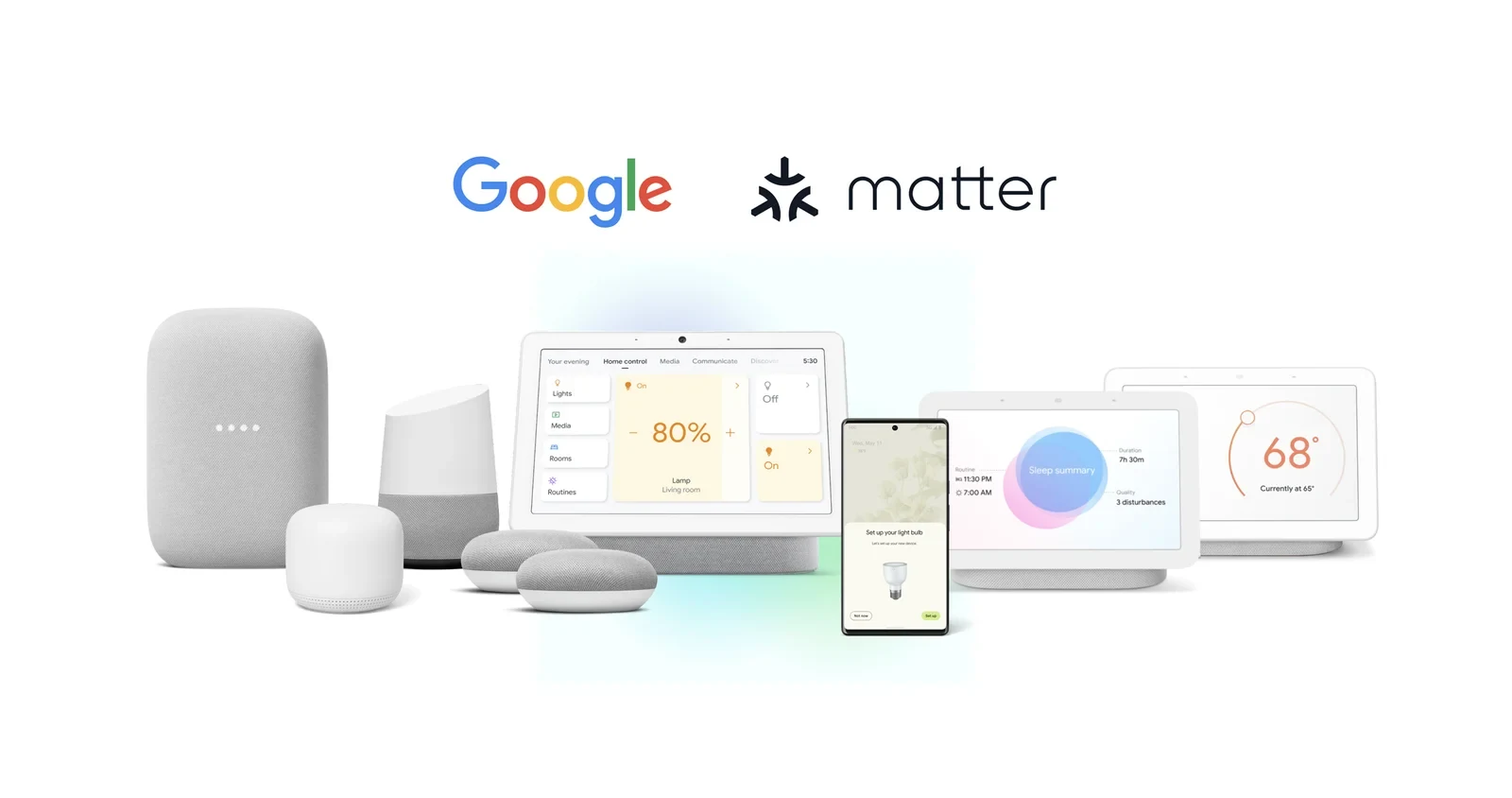
Google was an early Matter adopter. The Nest Hub Max and Nest Hub second generation act as Thread Border Routers natively, and the Google Home app handles Matter commissioning with a single QR code scan. Amazon added Matter support across the Echo fourth generation and the dedicated Echo Hub released in 2023, both of which serve as Thread Border Routers. The Alexa app commissions Matter devices, but the Alexa Skills surface stays parallel; a Matter-certified bulb still needs separate commissioning in Apple Home or Google Home if a user wants those apps to see it. Apple HomePod second generation and HomePod mini are Thread Border Routers as well, and the Apple Home app commissions Matter accessories alongside legacy HomeKit Accessory Protocol devices.
The deeper distinction is where smart home integration actually executes. Apple Home runs HomeKit and Matter scenes against a local hub when one is present, with no cloud round-trip required to flip a switch. Google Home pushes more decisions through Google's cloud, with local processing reserved for Nest-branded devices and for routines authored under the local execution preview. Alexa sits between the two, with local routines available on Echo Hub but most third-party skill invocations still routed through Amazon's cloud.
Ecosystem lock-in remains the unresolved cost. Matter reduces the friction for new certified accessories, but it does not retroactively rescue a household full of Zigbee bulbs, Z-Wave sensors, or proprietary cameras. A Ring camera bound to Alexa cannot speak to Apple Home. Philips Hue bulbs running their original Zigbee bridge need a Hue bridge upgrade and a Matter bridge mode before they appear in Apple Home or Google Assistant. Legacy protocol mechanics are covered in the Smart Home Hubs: Zigbee vs Z-Wave Protocols piece, and camera-tier choices appear in Best Smart Home Security Systems.
- Tier 1, Matter native with Thread Border Router on board: HomePod 2nd gen, HomePod mini, Nest Hub 2nd gen, Echo Hub, Echo 4th gen.
- Tier 2, Matter capable via app commissioning but no Thread radio: older Echo Dot and Nest Mini units that bridge Matter over Wi-Fi only.
- Tier 3, proprietary ecosystem only: Ring doorbells on Alexa, HomeKit-only locks on Apple, original Zigbee Hue bulbs without a Matter bridge upgrade.
Platform Comparison: Google Nest, Amazon Alexa, and Apple HomePod
A voice-assistant ecosystem reveals its real character at the table below, where six axes line up against the three platforms. The cells stay short on purpose; the prose that follows isolates the one trade-off that defines each ecosystem.
| Platform | NLU quality (general) | Third-party device compatibility | Matter + Thread | Audio tier | Privacy posture | Lock-in risk |
|---|---|---|---|---|---|---|
| Google's smart home line (Nest Audio / Hub) | Strongest; Knowledge Graph plus context | Broad; Works with Google Nest Hub program | Native; Thread Border Router on Nest Hub | Mid; multi-room stereo via Nest Audio | Cloud-default; Guest Mode and auto-delete | Moderate; recommissioning needed for legacy |
| Amazon Alexa (Echo / Echo Show) | Solid; trails on free-form knowledge | Largest; 100,000+ Alexa Skills catalog | Native on Echo Hub and Echo 4th gen | Mid; Echo Studio adds spatial audio | Cloud-default; mic mute and review opt-out | High for Ring and Fire TV households |
| Apple HomePod (2nd gen / mini) | Weakest on world knowledge; sharp on HomeKit | Narrow; HomeKit plus Matter only | Native; Thread Border Router on every unit | Highest; computational audio with Atmos | On-device wake-word; rotating identifier | High once HomeKit-only devices accumulate |
Nest devices is the right pick when general voice command quality and information retrieval matter more than audio fidelity. The Nest Audio pair is competent for multi-room music and good enough for podcasts, but it does not pretend to compete with HomePod on Atmos content. The defining trade is that Google offers the smartest assistant in exchange for the deepest cloud dependency among the three.
Amazon Alexa wins on third-party device compatibility and on integration density inside Amazon's own surface area. A household that already runs Ring cameras, a Fire TV, and an Amazon Prime subscription gets the most use out of the Echo Show, which adds a touch display to the voice surface. The defining trade is breadth at the cost of NLU depth; Alexa understands more devices than it understands sentences. Thermostat choices specifically are covered in Compare Smart Thermostats: Nest, Ecobee, Honeywell.
HomePod is the audio enthusiast's pick and the privacy enthusiast's pick at the same time. The second-generation HomePod offers room-sensing EQ and Dolby Atmos height mixing that neither Nest Audio nor Echo Studio matches on Atmos content, and it runs more voice command processing on device than either rival. The defining trade is reach; Siri's general knowledge still lags, and HomeKit's certified device list is smaller than either Works with Google Nest line or Works with Alexa. Wider smart home context appears in Understanding Smart Home Technology.
Privacy Posture and Data Handling
A voice ecosystem sits in the kitchen or the living room with a powered microphone array, and the privacy question is not whether the microphone is on; it is what happens between wake-word detection and cloud transmission. All three vendors publish documentation on this in detail, and the architectural differences are real.
Apple's HomePod, per Apple's Siri privacy disclosure, runs wake-word detection fully on the Neural Engine; voice requests sent to Apple servers carry a rotating random identifier rather than the Apple ID, and Siri audio is not used to train models by default following the 2019 grading policy change. Alexa, per the Alexa Privacy Hub, runs dual-stage detection (AZ1 Neural Edge on device plus cloud verification on Echo 4th generation), stores recordings under the user's account by default, and offers review opt-out plus deletion via voice command or the Alexa app. Echo devices include a physical microphone disconnect button as a hardware-level guarantee.
Google's Nest line line, per Google's Assistant privacy documentation, treats Voice and Audio Activity as off by default for new accounts; users who opt in can apply auto-delete windows of 3, 18, or 36 months. Guest Mode on Nest Hub prevents storage of voice and search history during a session. The always-on microphone concern, addressed in FTC IoT guidance and in NIST IR 8425, is best evaluated against the architectural distinction between edge-triggered wake-word detection (the actual design) and continuous cloud streaming (a misconception). Voice recognition accuracy and privacy posture intersect here: stronger on-device NLU means less audio leaves the device. Broader voice and data hygiene controls show up in the Best Privacy Tools for Enterprises guide, and the Apple side is grounded in the iOS vs Android comparison.
- HomePod mini: on-device wake-word, rotating identifier, no default model training, no separate mute switch by design.
- The Alexa platform: dual-stage wake-word, default recording storage, review opt-out, hardware mic disconnect.
- Google's assistant: dual-stage wake-word, Voice and Audio Activity off by default, auto-delete windows, Guest Mode.
Which Voice platform ecosystem to Choose
A voice-assistant platform choice is ultimately a household-fit question, not a leaderboard. Five buyer archetypes cover most cases.
- The Google Search and Android household: Google's Home platform setup is the natural fit because Google Assistant NLU leads on general queries and Nest devices integrate cleanly with Android Auto and Google TV. The decisive trade is accepting heavier cloud dependency.
- The Prime household with Ring cameras or Fire TV: Amazon's Alexa concentrates the most value inside an existing Amazon footprint, and the Echo Show adds a display surface. The decisive trade is weaker free-form NLU.
- The iPhone, Apple TV, and HomeKit household: HomePod 2nd-gen delivers the strongest audio, the deepest local processing, and the tightest HomeKit binding with no cloud requirement for scene execution. The decisive trade is narrower general-knowledge voice command performance.
- The mixed-brand household optimizing for future flexibility: prioritize Matter-certified devices regardless of hub brand, and buy a Thread Border Router-capable hub (any HomePod, Nest Hub 2nd gen, or Echo Hub) so that commissioning portability survives a later ecosystem switch. Reduces ecosystem lock-in cost more than any other single decision.
- The privacy-first buyer who dislikes cloud voice processing: HomePod mini is the lowest-cost entry point with on-device wake-word detection and the rotating identifier model.
For deeper hub-hardware alternatives outside the three primary platforms (Home Assistant, Hubitat, Aqara M3), see SmartThings Alternatives and Best Smart Home Hubs.
Further reading
- How To Secure Your IoT Devices for hardening tactics that apply to every smart speaker on the network.
- IoT Home Energy Devices: Matter, ROI, and Smart-Home Energy Management
- MacBook Air vs MacBook Pro: Which Apple Laptop Should You Buy?
- Amazon Echo Hub home screen redesign
Frequently Asked Questions
Can Google's home ecosystem, Alexa, and Apple speaker devices work together in the same house?
Devices from all three ecosystems can coexist on the same Wi-Fi network, but they do not talk to each other directly. Matter-certified accessories can be commissioned through multiple ecosystems at once as of Matter 1.2, so a single Philips Hue Matter bulb can appear in both the Google Home app and the Apple Home app without buying extra hubs. Non-Matter legacy devices remain siloed; a Ring camera added to Alexa cannot be controlled from Google Nest Audio or Apple Home without a third-party bridge.
Which smart assistant is best for Apple HomeKit devices?
HomePod lineup is the only smart speaker that controls HomeKit accessories natively, with no third-party bridge required. Google's ecosystem and Alexa ecosystem do not implement the HomeKit Accessory Protocol and cannot directly drive HomeKit-certified hardware. Buyers with existing HomeKit locks, sensors, or lighting who want voice control should pick a HomePod or use an iPhone as the controller; switching to Google's home stack or Alexa would force replacing HomeKit-only accessories with Matter-certified or platform-compatible equivalents.
Does Google Nest speakers or Alexa record conversations without the wake word?
Both The Google ecosystem and Alexa use on-device wake-word detection designed to send audio to the cloud only after the wake word is detected; neither platform continuously streams ambient audio to servers. Independent security researchers have documented rare false wake-word activations that cause brief unintended uploads, and both vendors disclose these in transparency reports. The physical microphone mute button on Echo devices provides a hardware disconnect for users who want a guaranteed no-transmit state. The HomePod runs the full "Hey Siri" pipeline on device, so no audio leaves the unit until Siri is engaged.