The enterprise privacy tools stack is a category-spanning suite of software that organizations deploy to discover, classify, govern, and operationalize personal data across a modern enterprise environment.
The vendor landscape conflates six distinct product categories under one banner, and that conflation is where most privacy budgets quietly bleed. A buyer who treats privacy tooling as a single procurement decision typically ends up with two overlapping data inventories, a consent store that does not talk to the data subject rights fulfillment engine, and a DLP deployment that duplicates tokenization controls a separate vendor already provides. The category map below separates the six purchases an enterprise privacy program actually makes, identifies the overlap zones that waste spend, and sequences the categories against a privacy program maturity model so a Stage 1 buyer does not pay for Stage 3 features that the team will not use for two years.
The Six Categories of the Privacy Operations Stack
Enterprise privacy tools resolve into six product categories that practitioners procure independently, even when one vendor packages several of them into a single SKU. The taxonomy below covers those six categories; each category answers a different regulatory or operational obligation, and each ships with a different evaluation rubric.
- Data discovery and classification
- Automated scanning of structured and unstructured data stores to locate personally identifiable information (PII) and other sensitive categories. The category produces the inventory every downstream control depends on. Representative vendors: BigID, OneTrust DataDiscovery, Securiti.
- Consent and preference management (CMP)
- Capture, storage, and downstream propagation of user consent signals across web, mobile, and connected-device surfaces. A CMP is a consent management platform in vendor taxonomy; the practitioner term is broader because it includes preference centers and downstream signal propagation. Representative vendors: OneTrust CMP, TrustArc, Didomi.
- Data subject rights automation (DSAR)
- Intake, identity verification, routing, and fulfillment of access, deletion, portability, and rectification requests within statutory deadlines. Representative vendors: DataGrail, Transcend, OneTrust DSAR.
- Privacy posture management (PPM) and privacy ops
- Continuous monitoring of compliance posture, risk register maintenance, regulatory mapping across jurisdictions, and evidence collection for audit. Representative vendors: OneTrust GRC, BigID, TrustArc.
- Data loss prevention (DLP)
- Inspection and control of data flows at endpoint, network, and cloud surfaces to prevent unauthorized exfiltration of regulated datasets. Representative vendors: Microsoft Purview DLP, Symantec DLP, Forcepoint DLP.
- Tokenization and pseudonymisation tooling
- Operational deployment of de-identification controls in live systems, distinct from the cryptographic primitives themselves. The cryptographic mechanism layer is covered in the hub article on the difference between encryption and tokenization; this category covers the vendor products that operationalize those primitives at scale.
The taxonomy is not arbitrary. The PT (Privacy) control family in NIST SP 800-53 Rev 5 maps directly onto these six categories: PT-3 corresponds to data discovery, PT-4 to consent management, PT-5 to DSAR fulfillment, and PT-7 to DLP, with PT-2 and PT-8 covering the posture and de-identification surfaces. Treating the categories as separate buying decisions aligns the procurement conversation with the control framework auditors actually use.
What Each Category Solves and When You Need It
Enterprise privacy tools become necessary at specific operational moments, not as a generic compliance overlay. The triggering events below are the moments where manual processes break and tooling spend earns its place. The NIST Privacy Framework describes the same logic at the GOVERN function level; the trigger list translates that framework into procurement signals a buyer can act on.
- Data discovery and classification becomes necessary the first time the team cannot answer a data subject rights request without manually querying twelve systems. A discovery scan that produces a single PII inventory across structured databases, object storage, and SaaS endpoints is the prerequisite for every other category functioning correctly. SaaS data sprawl is the most common trigger surface; see How To Secure SaaS Applications At Scale for the SaaS-side context.
- CMP becomes necessary the moment a public-facing web property collects cookies or tracking signals from EU, California, Brazilian, or Canadian visitors. The visitor jurisdiction sets the obligation, not the company's headquarters location.
- DSAR automation becomes necessary when monthly request volume crosses roughly twenty. Below that threshold manual fulfillment is tolerable; above it the team will miss the statutory clock under any data protection regulation that imposes a thirty-day or forty-five-day response window.
- PPM becomes necessary when the organization is audited, when it operates across three or more jurisdictions with different data protection regulation footprints, or when the privacy risk register stops fitting on a spreadsheet. A Data Privacy Impact Assessment often surfaces the gap that justifies the platform purchase.
- DLP becomes necessary when a regulated dataset, personally identifiable information, protected health information, or cardholder data, traverses an unmanaged endpoint or an unsanctioned cloud storage surface. The CISA Cross-Sector Cybersecurity Performance Goals define the data-protection baseline DLP coverage is measured against.
- Tokenization and pseudonymisation tooling becomes necessary when a data-sharing agreement requires technical de-identification for analytics or partner use cases, or when a residency obligation forces operational re-identification controls. Section 8 of the OWASP Application Security Verification Standard is the application-layer complement to the infrastructure controls.
An organization at Stage 1 maturity may legitimately not need all six categories simultaneously. Buying discipline starts with rejecting the assumption that a privacy program requires a complete stack on day one; the triggering events above are gating, and a category without a trigger is a category not yet earning its line item. Obligations under GDPR, HIPAA and CCPA are usually what trigger the first purchase.
Where Tool Categories Overlap and Budget Goes to Waste
Enterprise privacy tools overlap in three predictable zones, and the overlap is where most buyers double-pay without realizing it. The vendor pitch deck never highlights the overlap, because each vendor positions its product as the centerpiece of the stack rather than the complement to the existing footprint. The three zones below cover roughly eighty percent of duplicated-spend cases in privacy ops procurement.
| Overlap Zone | Categories Involved | Trigger for Wasted Spend | Resolution |
|---|---|---|---|
| Discovery inside PPM | Data discovery and classification + privacy posture management | Buyer procures standalone discovery (BigID) and a separate PPM (OneTrust GRC); two PII inventories must be reconciled | Default to PPM-native discovery; add standalone only when the scanner reaches a data store the PPM vendor does not support, typically unstructured on-premises NAS |
| Preference store sprawl | Consent and preference management + DSAR | OneTrust CMP and a competing standalone DSAR product write to different preference databases; consent reconciliation conflicts surface during fulfillment | Confirm the CMP vendor's DSAR module covers fulfillment before procuring a standalone DSAR tool; check the underlying preference-store schema |
| De-identification inside DLP | Data loss prevention + tokenization tooling | Microsoft Purview DLP already performs tokenization at egress on covered surfaces; a separate tokenization purchase for the same surface duplicates control | Map the DLP vendor's de-identification capabilities against the actual egress points before procuring a separate tokenization layer |
OneTrust's product breadth is the most common source of buyer confusion because the same brand sells in five of the six categories. The product modules share a brand but not always a database; a CMP and a DSAR module from the same vendor can write to separate preference stores depending on the deployment topology, and the consent reconciliation question must be answered in the contract, not in the pitch. The same caution applies to BigID, which sells both discovery and PPM and may duplicate functionality a customer already runs in a competing scanner. Compliance exposure does not increase with stack size; it increases with the gaps between tools that nobody owns.
Tool Categories in a Privacy Program Maturity Model
Enterprise privacy tools sequence across three privacy program maturity stages, and buying out of sequence is the second largest source of wasted budget after category overlap. The privacy program maturity model below is the buying roadmap that anchors the rest of the category map; it answers the question a procurement committee actually asks, which is not what to buy but when to buy it.
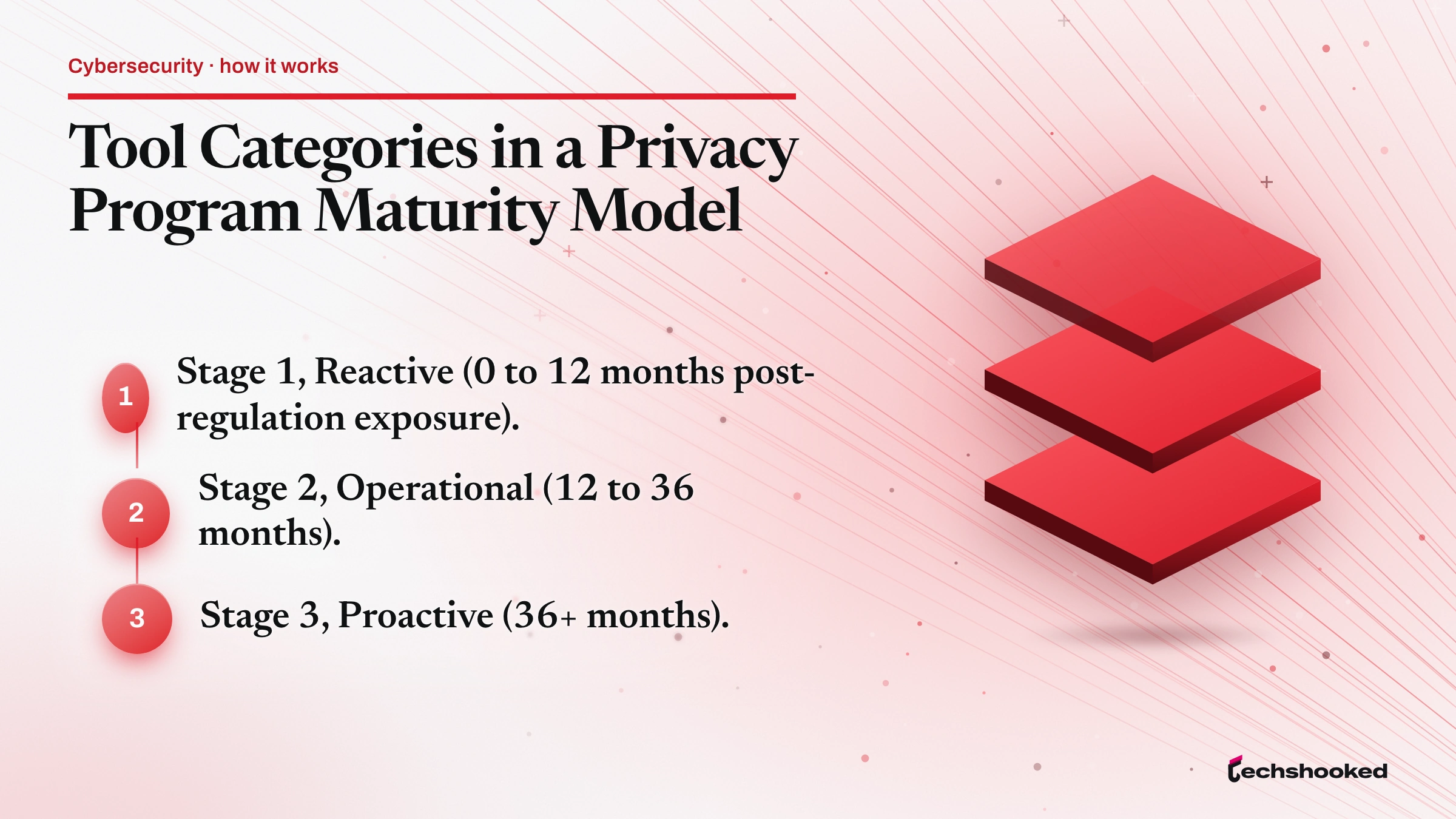
- Stage 1, Reactive (0 to 12 months post-regulation exposure). Data discovery and classification is the mandatory first purchase because no downstream category functions without a PII inventory. A CMP is the second mandatory purchase for any web-facing property collecting EU or California visitor data. Privacy by design exists at this stage as a documented policy, not as embedded engineering practice; data minimization shows up in the data retention schedule rather than in the data model. Risk register management is a spreadsheet.
- Stage 2, Operational (12 to 36 months). DSAR automation lands when request volume crosses the manual-fulfillment threshold. DLP arrives when a regulated dataset moves through an unmanaged surface that a discovery scan has identified. A lightweight PPM tool replaces the spreadsheet risk register, often as a module of an existing GRC platform rather than a standalone purchase. Privacy by design starts appearing as design-review checkpoints; data minimization shows up in API schema reviews. For the regulated-data control pattern context that drives Stage 2 buying decisions, see Best Practices for Securing Regulated Data.
- Stage 3, Proactive (36+ months). A full PPM platform with automated regulatory mapping across jurisdictions replaces the lightweight tooling. Tokenization and pseudonymisation tooling enters scope for analytics data-sharing and partner use cases. Privacy by design is embedded as SDLC gates with named control evidence, and data minimization is enforced at the schema level. A NIST Privacy Framework targeted profile, mapped to the organization's ISO/IEC 27001:2022 information security management system where one exists, is typically the alignment target at this stage, and the zero-trust network layer documented in Zero Trust Network Architecture serves as the architectural complement to privacy by design at the application layer.
Buying a Stage 3 PPM platform during Stage 1 is the most expensive mistake in privacy operations procurement; the platform's regulatory mapping features cannot be exercised without a PII inventory the team has not yet produced, and the seat license bills against value the program will not extract for eighteen months. The maturity sequence is descriptive of mature programs, not aspirational; treat it as a buying calendar.
Where Privacy Tools Sit in the Broader Stack
Enterprise privacy tools sit alongside several adjacent cybersecurity controls that share data flows or regulatory obligations without sharing product taxonomy. The connection points below clarify where the privacy operations stack hands off to neighboring control families and where compliance exposure can fall through the gap.
- Cryptographic primitives sit upstream of the tokenization category. The de-identification tooling vendors operationalize the cryptographic mechanisms documented in the hub article; the buyer who skips the primitives discussion ends up procuring a tokenization product without an opinion on the underlying key management model.
- SIEM and DLP intersect on regulated-event data. Splunk and IBM QRadar process security event data that often contains personally identifiable information, which means SIEM ingest pipelines inherit data protection regulation obligations the SOC team did not write into its SLA; the cost comparison in Splunk vs IBM QRadar Pricing Analysis covers the volume side of that obligation.
- Authentication is a DSAR prerequisite. A data subject rights fulfillment workflow cannot release personal data without verifying the requester's identity; the federation patterns documented in MFA vs SSO: A Comprehensive Comparison are the upstream identity proof the privacy tooling consumes.
- Credential management is the secret-side complement. Password managers govern credentials and shared secrets; privacy tools govern personal data about identified individuals. The two categories rarely overlap in product, but they share access-control evidence; the operational patterns in Best Password Managers for Business often surface as DPIA Step 5 mitigation evidence.
Further reading
- Difference Between Encryption and Tokenization (hub article covering the cryptographic primitives the tokenization tooling category operationalizes)
- Conducting a Data Privacy Impact Assessment (DPIA methodology that surfaces which tool categories a processing activity requires)
- How To Secure SaaS Applications At Scale (SaaS context where data discovery and DLP tooling becomes necessary)
- Best Practices for Securing Regulated Data (regulated-data control patterns that drive Stage 2 and Stage 3 tooling decisions)
- MFA vs SSO: A Comprehensive Comparison (identity verification as a prerequisite for DSAR fulfillment)
Frequently Asked Questions
Should an enterprise build its own privacy ops stack or buy an integrated platform?
Most enterprises below 5,000 employees are better served by an integrated platform than by assembling point solutions, because the integration cost of stitching together standalone data discovery, DSAR, and CMP tools typically exceeds the premium of an integrated vendor within 18 months. The calculus shifts at scale: organizations with complex on-premises data stores, multi-jurisdiction regulatory footprints, or an existing DLP investment that already covers some PPM functions should evaluate a best-of-breed approach. The critical evaluation criterion is whether the candidate platform's data discovery layer covers all data store types in scope; most integration failures occur because the platform does not support an unstructured or legacy store that holds the highest-risk PII.
When does a DPIA replace the need for a standalone privacy operations tool?
A Data Privacy Impact Assessment does not replace privacy operations tooling; the two serve different functions in the privacy program. A DPIA is a point-in-time risk assessment conducted before a high-risk processing activity goes live. Privacy operations tooling provides continuous monitoring, automated DSAR fulfillment, and ongoing consent management across existing data flows. An organization at Stage 1 maturity may use DPIA outputs as inputs to a manual privacy risk register, deferring a PPM platform purchase until DSAR volume or regulatory audit pressure makes manual management unsustainable. See the full DPIA methodology for the triggering criteria.
Can an enterprise skip the consent management platform category if it does not serve EU users?
Skipping a CMP is defensible only when the organization's web properties collect no cookies or tracking technologies from EU or California residents and operate outside PIPEDA-governed Canadian markets, LGPD-governed Brazilian markets, and comparable opt-in regimes. For most B2B SaaS or e-commerce organizations with global traffic, some portion of visitors will fall under at least one opt-in requirement, making a CMP necessary regardless of the organization's primary market. The threshold for CMP necessity is not the organization's jurisdiction but the visitor's jurisdiction at the moment of data collection.