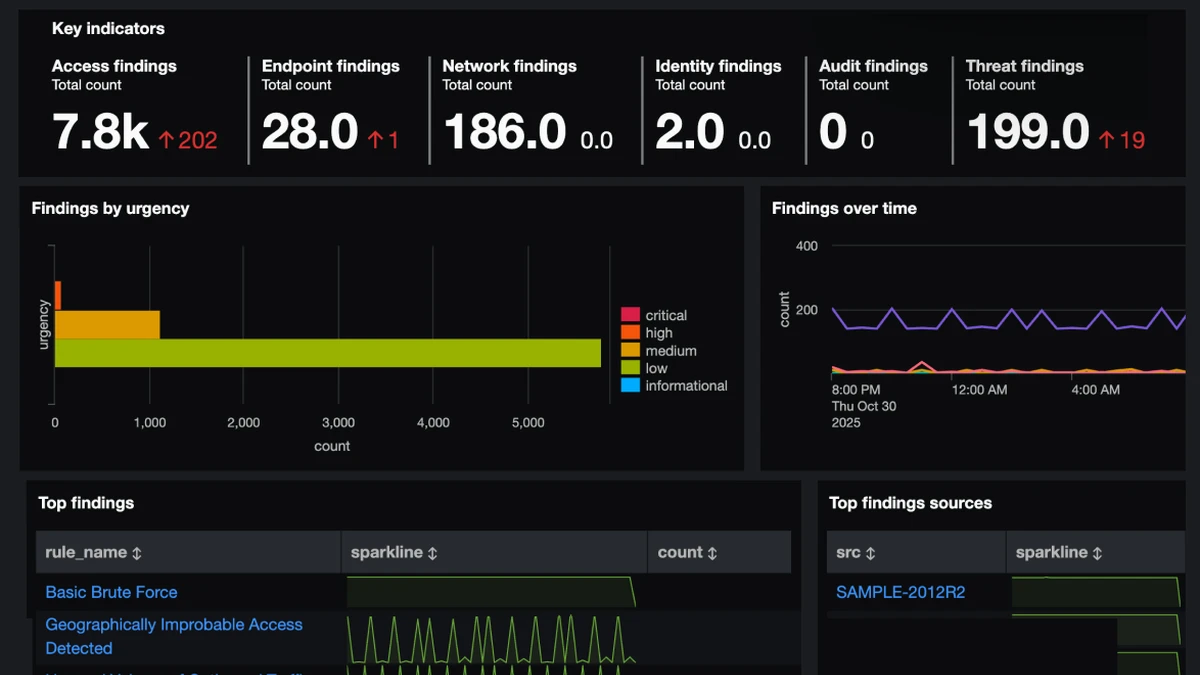
Splunk is a security information and event management platform that ingests machine-generated data at scale and correlates it into searchable, real-time security intelligence across an organization's entire log surface.
IBM QRadar sits opposite Splunk on the SIEM pricing model axis. Splunk meters customers on indexed data volume in gigabytes per day, while QRadar meters them on events per second. The two billing axes look interchangeable on a vendor slide. They behave very differently once a mid-market security team turns on real log sources, runs them for a quarter, and reconciles the invoice against the original procurement model.
That mismatch between licensing axis and traffic shape is what makes the Splunk vs IBM QRadar pricing analysis a procurement problem rather than a feature checklist. The breakeven point between the two SIEM pricing model families shifts with log source diversity, retention horizon, and the in-house engineering depth available to tune detection content.
How Splunk Prices Its SIEM Platform
Splunk meters its SIEM platform primarily on the volume of data indexed each day, expressed in gigabytes, with a secondary infrastructure-based option (workload pricing in compute units) for customers whose log ingestion volume swings unpredictably. The per-GB ingest cost is the figure most procurement teams anchor on, because it scales linearly with the data ingest rate and shows up cleanly on a forecasting spreadsheet. Splunk Cloud Platform list pricing starts in the region of $150 per GB per day at the 1 GB tier and slopes down at higher commitments, with negotiated discounts of 30 to 50 percent common at the mid-market band. Workload pricing trades the per-GB ingest cost for a compute-hour model that can be cheaper at high ingest, higher cardinality, or bursty workloads, but it requires capacity modeling most mid-market buyers do not have the data to perform at evaluation time.
The non-linear behavior that surprises buyers comes from log source proliferation. Endpoint agents, DNS, DHCP, and SaaS audit logs all generate high-cardinality, high-volume streams that inflate log ingestion volume without producing proportionally more detections. Splunk distinguishes raw log volume from normalized indexed volume, and the billing meter follows the indexed figure, which means inefficient parsing or verbose source types can drive a quote upward by 20 to 40 percent inside the first year. SaaS-heavy estates compound the effect; the How To Secure SaaS Applications At Scale guide covers the agent and audit-log expansion pattern that drives that growth.
Splunk Licensing Tiers
Three licensing tiers cover the bulk of Splunk deployments:
- Splunk Free. Caps daily ingest at 500 MB and disables enterprise features (no alerting, no role-based access control, no clustering), which makes it a lab tool only.
- Splunk Enterprise. The on-premises tier, sold as a perpetual license with annual maintenance or as a term subscription, underpins most regulated, air-gapped deployments.
- Splunk Cloud. The SaaS tier, available in predictable annual pricing or a flex pricing scheme metered on indexed volume.
Cisco's acquisition of Splunk in March 2024 has begun to influence negotiation behavior: Cisco security portfolio bundles (Duo, Umbrella, Cisco XDR) increasingly appear in Splunk SIEM renewals, which can shift the effective SIEM deployment cost in either direction depending on existing Cisco spend.
Hidden Cost Categories in Splunk Deployments
Four hidden cost categories routinely double the sticker price for organizations crossing 10 GB per day:
- Indexer infrastructure. CPU and RAM for self-hosted clusters is the largest line, with a typical three-node indexer cluster sized for 10 GB per day running well into five figures of annual compute spend.
- SmartStore S3 cold-tier offload. Lowers storage cost for retention beyond 90 days but introduces egress and retrieval charges that catch threat-hunting teams off guard.
- Premium apps. Splunk Enterprise Security, Splunk SOAR, and Splunk UBA are priced separately, and each typically adds 30 to 60 percent to the base license.
- Professional services for SPL query tuning. Recurs every time the detection content library changes; runaway search jobs are the operational symptom most teams underestimate.
Splunk's official pricing documentation covers the headline tiers; the hidden categories appear only on negotiated SOWs. Encrypted log archives intersect with this cost stack at the storage layer; see the Difference Between Encryption And Tokenization guide for the data-at-rest decision that drives long-retention key management.
How IBM QRadar Prices Its SIEM Platform
IBM QRadar prices its SIEM platform on events per second rather than ingested data volume, which inverts the cost calculus that drives a Splunk quote. Under QRadar licensing, every parsed event consumes one unit of the EPS pool, regardless of the byte size of the underlying log record, so a chatty firewall that emits short, repetitive deny entries consumes EPS at the same rate as a verbose endpoint detection record carrying a megabyte of process telemetry. That property makes the QRadar SIEM pricing model favorable for high-volume, low-cardinality estates where Splunk's per-GB ingest cost would compound quickly. The flip side is that bursty alert-heavy traffic (network sensors during a scan, dense authentication failures during a brute-force attempt) can push an EPS pool over its tier limit and force an unplanned upgrade.
Three deployment options structure most QRadar procurements. QRadar on-premises ships as either a physical appliance or a software-only build for customer-owned virtualization; QRadar on Cloud is the IBM-managed SaaS tier hosted on IBM Cloud; and the newer QRadar Suite, rebranded in 2023, is the cloud-native SaaS offering that now anchors IBM's roadmap. IBM has moved QRadar Suite licensing toward a user-seat and workload hybrid model as of recent reporting, which complicates migration cost projections for customers running on legacy appliance EPS contracts. Net flow data (NetFlow, J-Flow, IPFIX) is licensed as a separate EPS pool, a detail that surprises network-heavy deployments at renewal. Architecture context that often appears alongside SIEM procurement, including Zero Trust Network Architecture, drives the segmentation telemetry volume that shows up in the flow-EPS pool.
QRadar Licensing Tiers and EPS Buckets
QRadar licensing is packaged in fixed EPS buckets that scale up the platform's correlation capacity. Common starter pricing sits at the 1,000 EPS tier, with Standard, Advanced, and Enterprise tiers extending the pool to 5,000, 10,000, and 20,000 events per second respectively. Each tier carries a distinct list price and a defined ceiling for sustained ingest; brief peaks above the ceiling are buffered, but a sustained overrun forces a tier upgrade. The log management platform component (syslog, Windows event collection) and the network flow EPS pool are tracked separately. A mid-market customer with 5,000 EPS of syslog and 2,000 EPS of NetFlow needs to size the flow license independently rather than assume the headline EPS tier covers both, and that distinction often appears late in the procurement cycle.
Hidden Cost Categories in QRadar Deployments
Three categories drive most of the hidden SIEM deployment cost on the QRadar side:
- Appliance hardware or VM sizing. Scales with EPS and log retention horizon, and the published reference architectures tend to under-spec disk for any deployment retaining over 12 months of hot data.
- QRadar Advisor with Watson. The AI-assisted investigation add-on is separately licensed and priced per analyst seat, which can add a substantial line item for SOCs running a 24x7 shift pattern.
- Flow collector appliances and content-pack services. Network flow collectors for high-throughput segments and professional services for use-case content packs (PCI DSS, HIPAA, MITRE ATT&CK coverage) round out the picture.
IBM's QRadar SIEM product page publishes the headline tiers; the surrounding stack is what shifts security event correlation costs in practice. Cloud posture telemetry, often discussed alongside SIEM intake in regulated estates, is covered in Best CSPM Tools For AWS.
Pricing Model Comparison: Splunk vs IBM QRadar
The two SIEM pricing model families diverge on every dimension that matters once the procurement document leaves the vendor demo. The table below isolates the seven dimensions that decide most mid-market Splunk vs IBM QRadar selections, with figures grounded in recent reporting public list pricing and field-observed negotiated ranges.
| Dimension | Splunk | IBM QRadar |
|---|---|---|
| Licensing axis | Indexed data volume in GB per day, or workload compute units | Events per second (EPS), with separate pools for log and network flow |
| Entry-level cost | Splunk Cloud begins near $150 per GB per day at 1 GB list; Enterprise term licences negotiated | QRadar starter at the 1,000 EPS tier; entry SaaS pricing comparable on a per-analyst basis |
| Mid-market cost band | 50 GB per day list price land in the low six figures annually before negotiation | 10,000 EPS tier sits in a similar annual band, with flow EPS sold separately |
| Hidden infrastructure fees | Indexer cluster compute, SmartStore S3 egress, professional services for SPL tuning | Appliance or VM sizing, flow collector appliances, QRadar Advisor seats |
| Storage cost model | Hot, warm, cold tiers with SmartStore offload to S3 for cold retention | Flat retention storage on appliance; SaaS tiers include defined retention envelopes |
| SaaS vs on-prem differential | Splunk Cloud trades infrastructure ownership for capped predictability under bursty load | QRadar on Cloud removes appliance ownership; QRadar Suite shifts toward seat-based pricing |
| Add-on pricing for SOAR and UEBA | Splunk SOAR and Splunk UBA priced separately; each adds 30 to 60 percent to base license | IBM SOAR (formerly Resilient) and User Behavior Analytics are separately licensed modules |
The breakeven curve between the two platforms moves with traffic shape, not headline price. Organizations running a high-volume, low-cardinality log mix (firewall denies, DNS queries, DHCP leases) tend to hit Splunk's per-GB ingest cost ceiling well before they hit QRadar's events per second tier, because byte-heavy repetition inflates the GB meter while consuming EPS modestly. Organizations running a diverse, bursty event mix (active threat hunting, broad endpoint telemetry, dense authentication failure storms) tend to exceed a QRadar EPS tier first, because each parsed event consumes one unit regardless of size. For a typical 500-endpoint mid-market estate, the crossover sits in the 5 to 10 GB per day band: below that, the QRadar SIEM pricing model is usually cheaper at equivalent threat detection coverage; above 20 GB per day, Splunk's volume model and SPL flexibility typically justify the premium, provided the team has the SPL engineering capacity to operate it.
Total Cost of Ownership at Mid-Market Scale
A three-year total cost of ownership model for a 500-endpoint organization shows the four paths separating quickly. Splunk Enterprise self-hosted at roughly 10 GB per day, with Splunk Enterprise Security and Splunk SOAR licensed, typically lands in a mid-six-figure cumulative band once infrastructure and professional services are included. Splunk Cloud at the same ingest tier sits roughly 15 to 25 percent higher on subscription cost but removes the indexer infrastructure line. QRadar on-premises at the 5,000 EPS tier (equivalent log volume for that estate) tends to land 20 to 30 percent below the equivalent Splunk Enterprise stack on a three-year cumulative basis. QRadar on Cloud closes most of that gap. Negotiated pricing varies by 30 to 50 percent from list price for both vendors, which makes any single point estimate misleading; ranges are the honest unit. Regulated-data scope drives several of these decisions; Best Practices For Securing Regulated Data covers the framework-by-framework control patterns.
Cost vs Coverage Trade-Off
A more useful framing than headline cost is cost per detection SIEM use case. QRadar ships hundreds of out-of-the-box correlation rules, threat intelligence feeds, and compliance report templates that reduce time-to-value at the price of customization depth. Splunk Enterprise Security ships a leaner default content library and assumes the customer will build, tune, and maintain SPL detections, which delivers higher ceiling but a higher floor in SPL engineering labor. For a SOC with two security engineers and no dedicated detection content team, QRadar typically delivers more threat detection coverage per dollar in year one. For a SOC with a dedicated detection engineering function, Splunk's SPL flexibility tends to outproduce QRadar's rule library by year two. The federation patterns that underpin SOC operator access are covered in MFA vs SSO: A Comprehensive Comparison.
Feature Comparison: Threat Detection and Response Capabilities
Splunk Enterprise Security and IBM QRadar reach the same destination, security event correlation across heterogeneous log sources, through different engines. Splunk's SPL (Search Processing Language) is a flexible, late-binding query language that reads raw indexed events and lets engineers compose ad-hoc correlations across any field at search time. QRadar normalizes every incoming event through a Device Support Module (DSM) before it enters the pipeline, then runs a rule-based correlation engine over that normalized schema. The architectural difference shows up in operator experience: SPL gives a threat-hunter unbounded query freedom and a steep learning curve; QRadar's normalized model produces consistent, high-accuracy correlation on supported SIEM use case patterns at the cost of customization friction when a new source type appears.
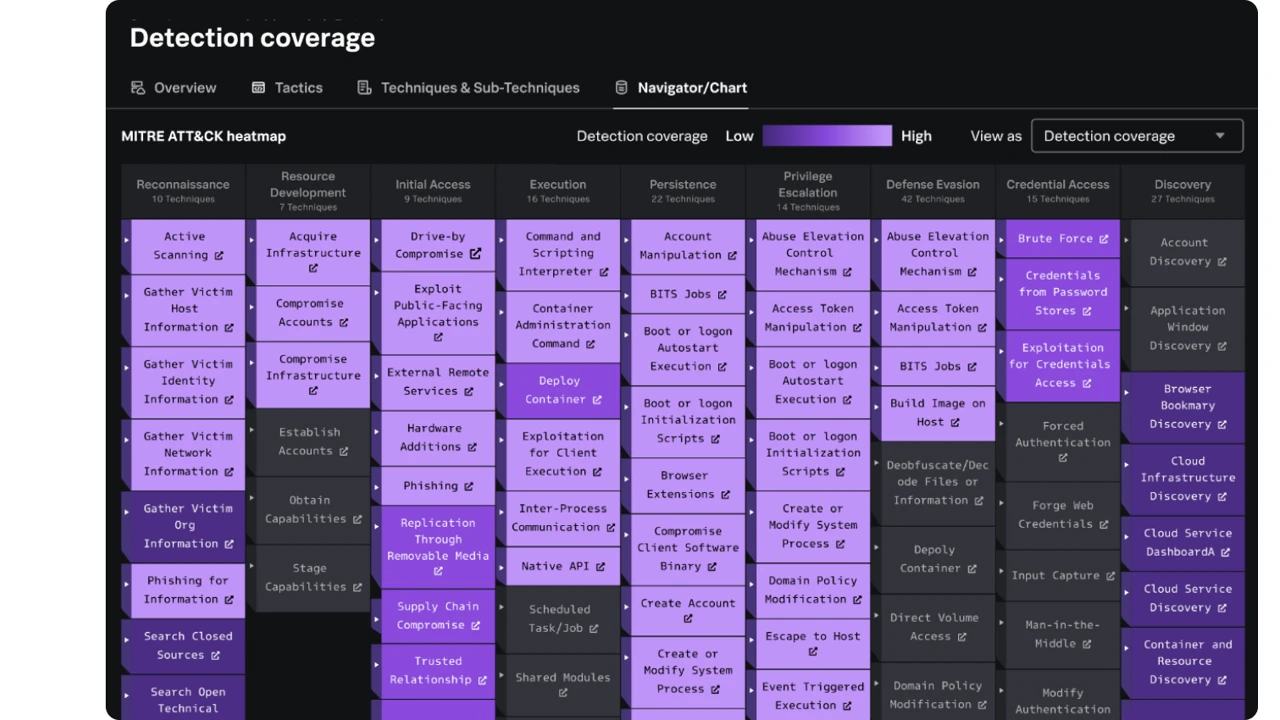
Native user and entity behavior analytics ship on both platforms (Splunk UBA, QRadar User Behavior Analytics) and both are separately licensed. The MITRE ATT&CK framework overlay is more turnkey in QRadar; Splunk requires the ES Content Update pack and SPL rule library configuration to reach equivalent coverage. Compliance reporting is one of QRadar's strongest defaults: out-of-the-box templates for PCI DSS, HIPAA, and SOX reduce setup time materially, while the equivalent Splunk experience depends on the Splunk Common Information Model and additional app configuration. On the incident response workflow side, Splunk SOAR (the Phantom acquisition) and IBM SOAR (the Resilient acquisition) are both mature and largely feature-equivalent for the playbook patterns most mid-market teams use.
Data Analysis and Log Management
The log management platform layer is where the two architectures diverge most. Splunk's indexing pipeline writes hot, warm, and cold buckets that can query raw, unstructured data without normalization, which gives threat hunters access to fields the parser never modeled. QRadar's normalized event pipeline rejects what the DSM cannot parse, which surfaces source-coverage gaps earlier but loses information that does not fit the schema. For estates dominated by well-known source types, the QRadar approach yields higher correlation accuracy with less engineering. For estates with custom applications, niche security tools, or fast-moving SaaS audit logs, Splunk's late-binding model often wins. The NIST SP 800-92 Guide to Computer Security Log Management is the underlying reference both vendors map their log-management primitives to.
Integration Ecosystem and API Surface
Splunkbase publishes more than 2,000 apps and add-ons, which makes Splunk the broader integration surface for niche source types and bespoke enrichment. IBM Security App Exchange is narrower but more tightly curated, with content packs vetted against the QRadar correlation schema. Both platforms expose REST APIs for SOAR integration, third-party threat intelligence ingestion, and ticketing handoffs. Cisco's acquisition of Splunk has begun to add native Splunk connectors for Cisco XDR, Duo, and Umbrella, which can tip the integration calculus for any organization already standardized on the Cisco security portfolio.
Which SIEM Platform Fits Your Budget and Threat Model
Splunk and IBM QRadar each anchor a defensible mid-market posture; the procurement decision turns on five concrete questions about traffic shape, engineering depth, and ecosystem fit. The order below reflects the sequence most security architects find useful when sizing a deployment against a real budget envelope.
- Match the licensing axis to traffic shape. High-volume, low-cardinality log estates (firewall, DNS, DHCP) usually favor QRadar's events per second model. Diverse, bursty estates with heavy endpoint and SaaS telemetry usually justify Splunk's volume model once the data ingest rate clears the breakeven band.
- Audit in-house SPL engineering capacity. Splunk's ceiling depends on engineers who can write, tune, and maintain SPL detections. QRadar substitutes that with DSM configuration expertise, which is a narrower skill but still non-trivial to staff.
- Weigh compliance mandate timing. QRadar's out-of-the-box PCI DSS, HIPAA, and SOX templates compress time-to-audit-readiness, which matters when a renewal date is six months out.
- Specify SaaS preference and data residency. Both vendors offer cloud-hosted tiers. QRadar on Cloud has stricter EU data residency options that some regulated estates require; Splunk Cloud Platform offers more granular regional deployment.
- Map vendor ecosystem lock-in tolerance and incident response workflow fit. Cisco's portfolio increasingly bundles with Splunk; IBM's portfolio (Guardium, MaaS360) bundles with QRadar. Standardizing on one stack reduces integration cost and tightens the SOAR-to-ticketing handoff that drives mean time to respond.
The mid-market crossover holds across most deployments: organizations ingesting under 10 GB per day with a compliance-first mandate typically find the QRadar SIEM pricing model cheaper and the time-to-detection faster. Organizations ingesting over 20 GB per day with a threat-hunting culture and SPL-competent staff find Splunk's flexibility justifies the premium SIEM deployment cost. The 10 to 20 GB band is the genuine gray zone where total cost of ownership modeling, not vendor preference, should drive the call. Long-retention log archives and key-management posture intersect with both choices; the Post-Quantum SaaS Migration Guide covers the cryptographic horizon for archived security telemetry, and Best Privacy Tools For Enterprises covers the surrounding enterprise privacy posture. Analyst context from the Gartner Magic Quadrant for Security Information and Event Management and the Forrester Wave for Security Analytics Platforms is worth pulling into the final selection brief.
Further reading
- Difference Between Encryption And Tokenization (hub article on data-at-rest controls that intersect with SIEM log retention)
- Role Of TLS/SSL In Data Protection (protocol-level data-in-transit coverage for SIEM collector channels)
- Best CSPM Tools For AWS (cloud posture telemetry that feeds into SIEM ingest pipelines)
- Best Password Managers For Business (credential controls that reduce authentication-event noise in the SIEM)
Frequently Asked Questions
Which SIEM is more cost-effective at mid-market scale: Splunk or IBM QRadar?
IBM QRadar is typically more cost-effective for mid-market organizations ingesting under 10 GB of log data per day, because its events-per-second licensing model does not penalize high-volume, low-cardinality sources the way Splunk's per-GB ingest pricing does. Splunk becomes the more economical choice at scale above 20 GB per day when an organization has in-house SPL engineers and requires flexible, ad-hoc threat hunting across unstructured log data. The crossover point depends on source diversity: a firewall-heavy environment with dense, repetitive log entries will reach Splunk's ingest cap far earlier than a Splunk-optimized environment with high-value, low-volume EDR telemetry.
What are the hidden costs in a Splunk deployment that vendor quotes do not itemize?
The largest hidden cost categories in Splunk deployments are premium app licenses (Splunk Enterprise Security, SOAR, and UEBA are all separately priced and each can add 30 to 60 percent to the base license cost), indexer infrastructure for self-hosted deployments (CPU and RAM sizing for 10 GB per day typically requires a 3-node cluster), SmartStore S3 storage fees for cold-tier data retention beyond 90 days, and SPL query engineering labor (tuning detection searches to avoid runaway job queues is a recurring operational cost that most organizations underestimate by 2x at initial deployment).
How does deployment topology change total cost of ownership for Splunk vs IBM QRadar?
Deployment topology shifts total cost by 30 to 60 percent in either direction. Splunk Cloud Platform shifts most infrastructure cost to the vendor but caps cost predictability under high-ingest workloads, while Splunk Enterprise on-prem keeps infrastructure cost variable and adds operational overhead that mid-market teams routinely under-budget. IBM QRadar SIEM offers SaaS on AWS for elasticity, an on-prem appliance for compliance-bound deployments, and managed-service options through IBM partners. The on-prem path for either vendor adds rack, power, and sustaining engineering cost that vendor quotes do not itemize; the SaaS path trades that for a tighter pricing curve once ingest crosses the tier thresholds. Account for a 3-year horizon and model both paths before signing.