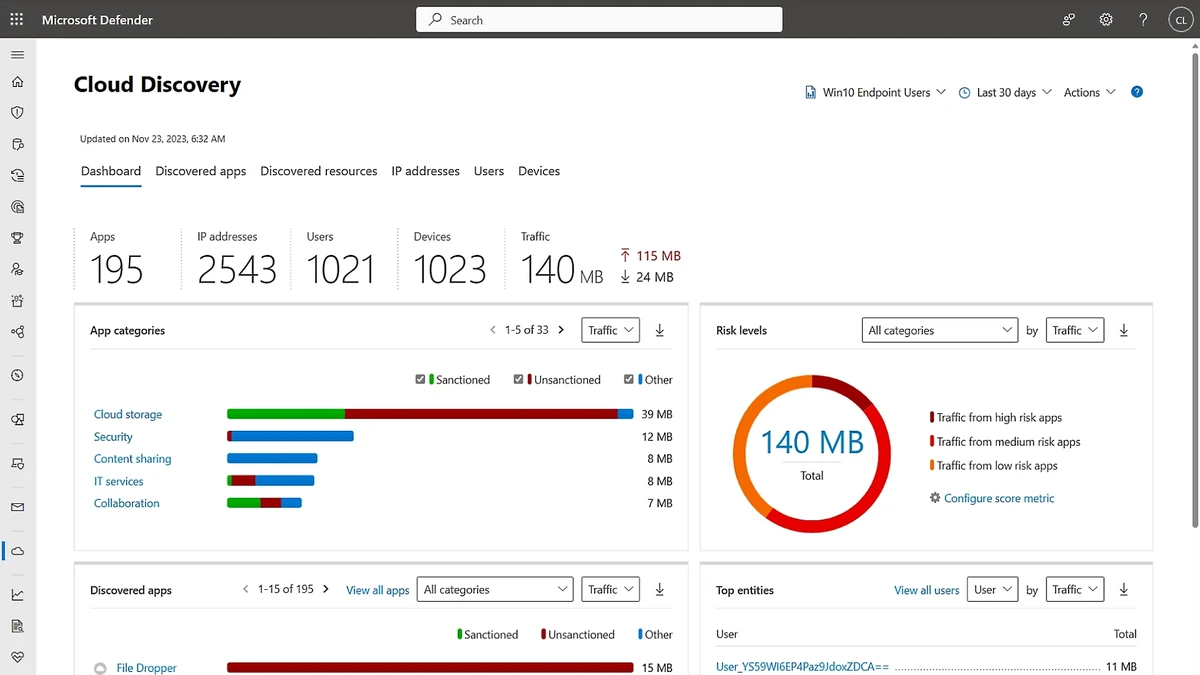
SaaS Security Posture Management (SSPM) is a security discipline that continuously monitors and enforces configuration, access, and compliance controls across an organization's SaaS application portfolio.
That definition sounds manageable at ten applications. At 100 SaaS tenants, the same discipline becomes an operational stress test. Configuration drift compounds across tenants, OAuth grants accumulate silently, and the shared responsibility model draws its line in a different place for every vendor. Security teams that relied on perimeter controls and quarterly audits find those tools stop working long before the tenant count reaches enterprise scale.
This guide covers the controls, tooling, and operational patterns that keep SaaS security posture defensible as tenant count grows. The framing is economic as much as technical: each control class has an inflection point where its per-tenant cost exceeds its marginal risk reduction. Knowing those inflection points is what separates a sustainable program from one that collapses under its own overhead.
Why SaaS Security Breaks at Scale
| Tool Category | Representative Vendors | Primary Control | Scales to 500+ SaaS Tenants | Approx Cost Signal |
|---|---|---|---|---|
| SSPM | Adaptive Shield, AppOmni, Obsidian Security | Configuration drift detection, misconfiguration detection, compliance monitoring | Yes (connector-count pricing) | $10 to $30 per user per month; volume tiers at 500+ seats |
| CASB (Cloud Access Security Broker) | Netskope, Microsoft Defender for Cloud Apps, Zscaler | Data-in-transit inspection, shadow IT discovery, DLP policy enforcement | Partial (user-count pricing diverges at scale) | $15 to $40 per user per month |
| DLP (Data Loss Prevention) | Varonis, Forcepoint, Symantec DLP | Data classification, exfiltration prevention, regulated-data tagging | Partial (requires per-app connector) | $20 to $50 per user per month |
| ASPM (Application Security Posture Management) | Aikido Security, Snyk, Semgrep | Code-level vulnerability detection in custom SaaS integrations and APIs | Yes (repository-count pricing) | $25 to $60 per developer per month |
| Identity and Access Management (IdP/IAM) | Okta, Microsoft Entra ID, Ping Identity | SSO federation, MFA enforcement, least-privilege access, OAuth 2.0 token management | Yes (user-count pricing, mature enterprise tiers) | $4 to $15 per user per month |
No single vendor covers all five categories. An architecture that combines an IdP (Okta or Entra ID) with an SSPM platform (Adaptive Shield or AppOmni) and a CASB (Netskope or Defender for Cloud Apps) covers the majority of the SaaS attack surface for most enterprises. Add ASPM when your engineering team builds custom integrations between SaaS platforms.
Okta's identity and access management documentation covers SSO and MFA configuration patterns for SAML 2.0 and OAuth 2.0 federation across major SaaS applications. Use it as a reference when configuring per-tenant authentication policies.
Challenges in Securing SaaS Applications
SSPM tooling surfaces problems; solving them requires addressing the structural challenges that generate those problems. Four challenge classes account for the majority of SaaS security failures at scale.
Overcoming Common Security Challenges
- OAuth permission sprawl. OAuth token scope creep is the fastest-growing attack surface in SaaS environments. Employees authorize third-party applications with broad scopes (read/write access to email, calendar, files) and then forget about them. A single compromised OAuth token with mail.read and files.readwrite scope gives an attacker access equivalent to the user's full account without touching authentication. Audit active OAuth grants quarterly. Revoke any grant that has not been used in 90 days. Enforce a policy requiring security team approval for OAuth grants requesting write or admin scopes. The OWASP API and OAuth attack surface documentation maps the specific token-abuse paths relevant to SaaS integrations.
- Shadow IT proliferation. Shadow IT discovery is a continuous process, not a one-time audit. Employees onboard SaaS tools outside procurement for legitimate productivity reasons. The security problem is not the adoption itself; it is the absence of a vendor risk assessment, a control-ownership review, and a data-classification decision. Establish a fast-track approval process (72-hour turnaround for low-risk tools) so employees have a viable alternative to bypassing procurement. Slow approval processes are the primary driver of shadow IT.
- Inconsistent multi-factor authentication enforcement. MFA adoption rates across SaaS tenants are never uniform. Legacy applications that predate modern identity providers lack SAML support and cannot participate in federated MFA. Those applications become the weakest link, and they are also the primary vector for privileged account sprawl because admin credentials sit outside the IdP's lifecycle automation. For applications that cannot federate, apply IP allowlisting to restrict access to corporate network egress points, require dedicated service accounts (not shared credentials), and flag them in your SaaS application inventory for replacement planning.
- Compliance scope fragmentation under the shared responsibility model. Each SaaS vendor draws those boundaries differently. Salesforce's responsibility for data encryption stops at the application layer; your team owns key management configuration. Google Workspace's data residency controls depend on your Workspace edition and region settings. AWS's responsibility boundary differs entirely from SaaS models. Mapping which controls your team owns versus the vendor owns, for each application in scope of a compliance framework (SOC 2, HIPAA, PCI DSS), is manual work that does not automate cleanly. Build a shared responsibility matrix for each Tier 1 application and review it annually or when the vendor publishes a terms-of-service update. Data loss prevention policies must account for these boundaries: a DLP rule that blocks file sharing within your network does nothing if the SaaS application's built-in sharing settings allow external access.
NIST SP 800-210 (General Access Control Guidance for Cloud Systems) provides the formal framework for mapping access control responsibilities across cloud service models. It is the reference standard for building shared responsibility matrices in regulated environments. For cryptographic controls in SaaS migrations, the post-quantum SaaS migration guide covers protocol-level decisions including key management transitions.
Further reading
- Post-Quantum SaaS Migration Guide (hub article: protocol-level controls for SaaS environments)
- Cloudflare Zero Trust: SaaS Application Access Policies (access policy configuration reference)
- NIST SP 800-210: General Access Control Guidance for Cloud Systems (shared responsibility model framework)
- CISA SCuBA Project: Secure Cloud Business Applications (configuration baselines for Microsoft 365 and Google Workspace)
- Best CrowdStrike Alternatives For Endpoint Detection: SentinelOne, Defender, Sophos, Elastic, Trellix
- Best Data Loss Prevention Tools For Hospitals: HIPAA-Ready DLP Compared
- How Businesses Prevent Zero-Day Attacks: A Defense-in-Depth Guide
Frequently Asked Questions
What are the best practices for securing SaaS applications?
Start with a complete SaaS application inventory across all business units, then enforce multi-factor authentication and SSO federation before layering SSPM tooling. Segment OAuth token scope to least-privilege access, schedule quarterly vendor risk assessments for Tier 1 applications, and run continuous compliance monitoring rather than point-in-time audits. Shadow IT discovery should run continuously through your CASB or SSPM platform so unauthorized applications surface within days, not quarters.
How do SaaS security tools compare?
SSPM platforms (Adaptive Shield, AppOmni) own configuration drift and continuous compliance monitoring across SaaS tenants. Cloud access security broker solutions (Netskope, Microsoft Defender for Cloud Apps) intercept data-in-transit and enforce data loss prevention policies. ASPM tools (Aikido, Snyk) address code-level vulnerabilities in custom SaaS integrations. Evaluate tools on tenant coverage depth, API connector library breadth, alert-to-ticket automation quality, and per-seat cost at your expected tenant count, since pricing models diverge sharply above 200 tenants.
What challenges are most common when securing SaaS applications at scale?
The four most common: OAuth permission sprawl (applications granted broad token scopes that accumulate and go unreviewed), shadow IT proliferation (unauthorized SaaS adopted outside procurement), inconsistent multi-factor authentication enforcement where legacy applications lack SAML federation support, and compliance scope fragmentation because each SaaS vendor draws control boundaries differently. Misconfiguration detection automation addresses the configuration side; identity governance processes address the access side.
How does SaaS application security differ from traditional on-premises security?
On-premises security assumes you control the runtime environment, the network perimeter, and the physical infrastructure. SaaS security operates entirely through APIs and administrative consoles with no server access. The threat model shifts from network intrusion to misconfiguration, identity compromise, and excessive OAuth delegation. Data residency and sovereignty controls depend on vendor-defined options and your SaaS application tier, not infrastructure choices your team makes.
What are effective strategies for remediating SaaS application vulnerabilities?
Run automated SSPM scans to surface misconfigurations against CIS SaaS Benchmarks and prioritize by blast radius: admin accounts and finance-adjacent integrations first. Revoke unused OAuth grants on a weekly automated schedule. For critical vendors, require SOC 2 Type II reports and review them annually. Integrate SSPM findings into your existing ticketing workflow (Jira, ServiceNow) so remediation SLAs are tracked and SaaS security posture improvements are measurable over time.