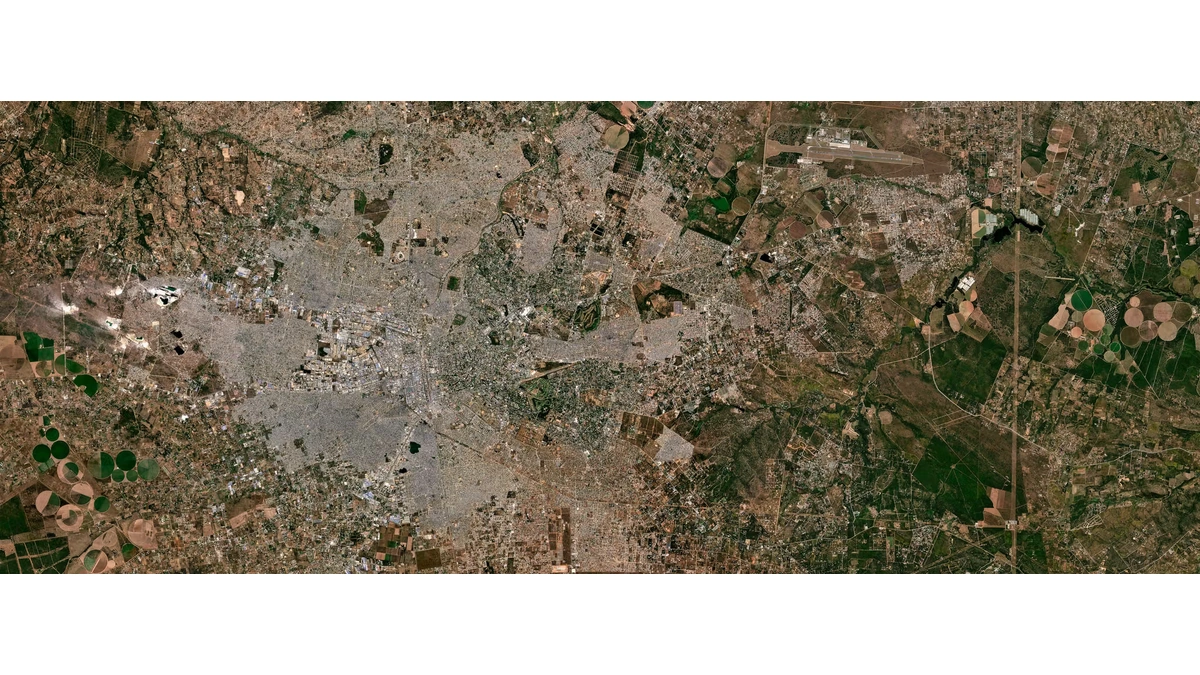
Planet Populace puts a number on how many people live in every 40-meter square of the planet's land, and the data is refreshed each quarter.
The map comes out of a collaboration that Planet started in early 2024 with the Institute for Health Metrics and Evaluation (IHME) at the University of Washington and Microsoft's AI for Good Lab. Planet calls the result the most up-to-date, highest-resolution and most accurate population dataset available anywhere, a claim that is the company's own and that the announcement does not back with a public benchmark. Each partner owns one stage. Planet's satellites image the entire land mass nearly every day, and from that archive the company builds cloud-free quarterly basemaps. Microsoft runs machine learning models over those basemaps to detect buildings and track how densely they cluster over time. IHME then combines that building signal with census, survey and administrative records plus dozens of other predictors to estimate how many people live in and around each structure.
The design matters because the weakest link in most population data is the census itself. Planet points out that counts are costly and infrequent, and in many places badly out of date, while cities in the Global South grow faster than anyone can enumerate them. Planet Populace sidesteps that by inferring people from rooftops and roads seen from orbit, so a settlement that appeared last quarter can show up in the next release. The company's examples include the growth of Lusaka, Zambia, between 2020 and 2026 and of the Umm Sangur refugee camp in Sudan over the same years.
Planet lists five uses for Planet Populace: targeting vaccination campaigns and clinics, planning roads and other infrastructure, helping national statistical offices prepare for the 2030 census round, speeding humanitarian response after an earthquake, flood or cyclone, and estimating how many people face a climate hazard before a crisis begins. For disasters, Planet suggests overlaying Planet Populace on Planet's post-disaster imagery and answer "how many people are affected" in hours instead of weeks. Christopher Murray, director of IHME, put the motive plainly: "We cannot address risks we cannot see."
Access is split by user type. Nonprofit organizations and academic researchers can download Planet Populace free of charge under noncommercial terms at populace.healthdata.org. Governments and private companies, from national agencies and development banks to insurers and infrastructure planners, get commercial-use terms and the more recent quarterly updates. The practical consequence is a two-speed release: researchers work from the data first, while paying customers receive the freshest quarters. Planet has not published pricing for the commercial tier.