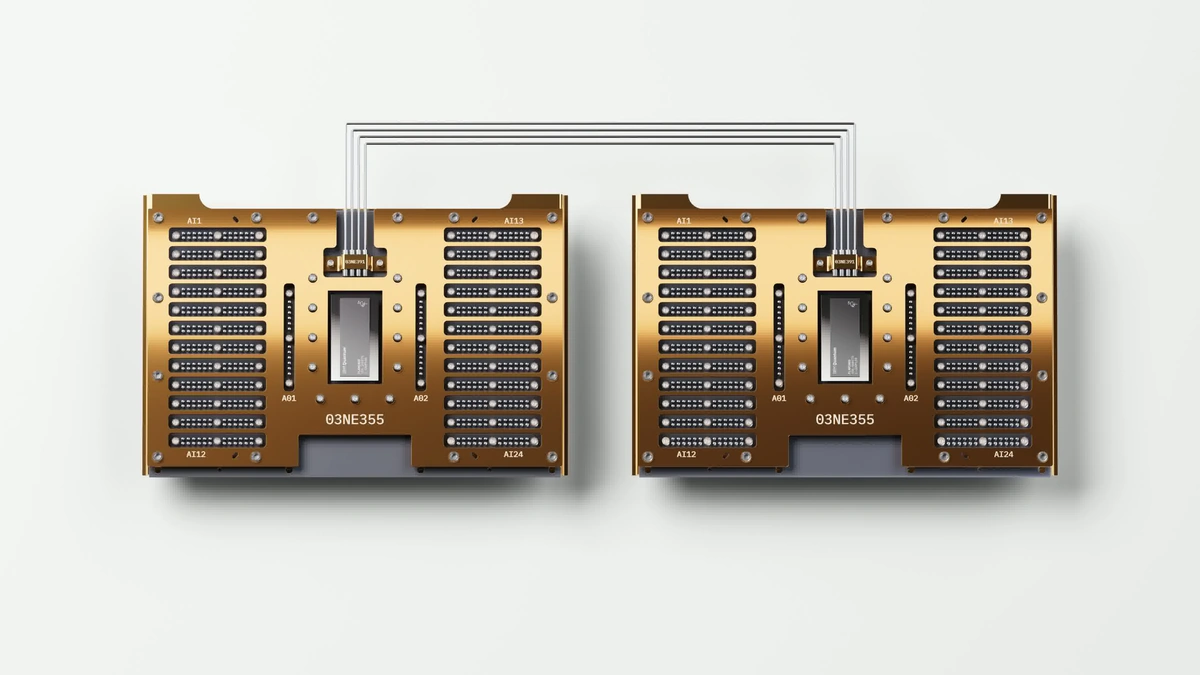
IBM l-couplers linked two IBM Quantum Nighthawk R1 processors inside one dilution refrigerator and moved quantum states between them at an average fidelity of 99%, and up to 99.3%. The test used four links, each built around an 80-centimeter aluminum cable.
Each IBM l-coupler pairs the cable with simplified l-qubits, tunable couplers and controllers. The l-couplers go in after the processors are mounted in the refrigerator. Both chips are complete Nighthawk processors, though the experiment wired out only a subset of their qubits.
The l-coupler modes reached internal quality factors of 940,000, in the range of 10^6 that IBM says suits superconducting quantum information. Distant CZ gates, built by transferring states across the two modules, scored 94.75% fidelity averaged over the four links, lower than the 99% transfer figure. IBM used them to generate entangled states shared between the modules, including two independent states from two l-couplers running at once.
IBM scopes its first-of-its-kind claim narrowly, to its own knowledge and to superconducting processors joined through multiple quantum channels at that average transfer fidelity. It calls earlier demonstrations from IBM and other labs high-quality proofs of concept, but says those approaches were not readily compatible with multiple connections between large superconducting processors.
The links are meant for the modular cryogenic platform that IBM joined and cooled as two modules, which together reached below 15 millikelvin. Each module's vacuum enclosure holds up to 12 times more wiring space than the most widely used IBM quantum systems. IBM plans to install Nighthawk processors in those modules before the end of 2026, and its 2027 goal is to use l-couplers to join multiple processors into a machine with at least 1,000 programmable qubits. IBM targets 2029 for IBM Quantum Starling, its fault-tolerant system, with each module expected to house thousands of qubits by then.