Apple Vision Pro is a spatial computing headset that runs visionOS and bridges augmented and virtual reality development on a single unified platform. The device collapses a distinction that the broader industry still treats as two separate disciplines, with separate SDKs, separate teams, and separate budget lines. Meta Quest Pro takes the opposite approach, leaning on the cross-vendor OpenXR 1.1 specification from the Khronos Group so the same binary can target hardware from Pico, HTC, and others. Picking between the two is now the first real architectural decision for any team building for a mixed reality headset.
The choice rarely hinges on hardware specs alone. It hinges on the developer toolchain, the rendering pipeline assumptions baked into each SDK, the enterprise VR deployment footprint a buyer already runs, and the ergonomic limits of sustained use. Each of those factors moves the total cost of ownership in different directions for different organizations.
AR vs VR Development: Core Technical Differences
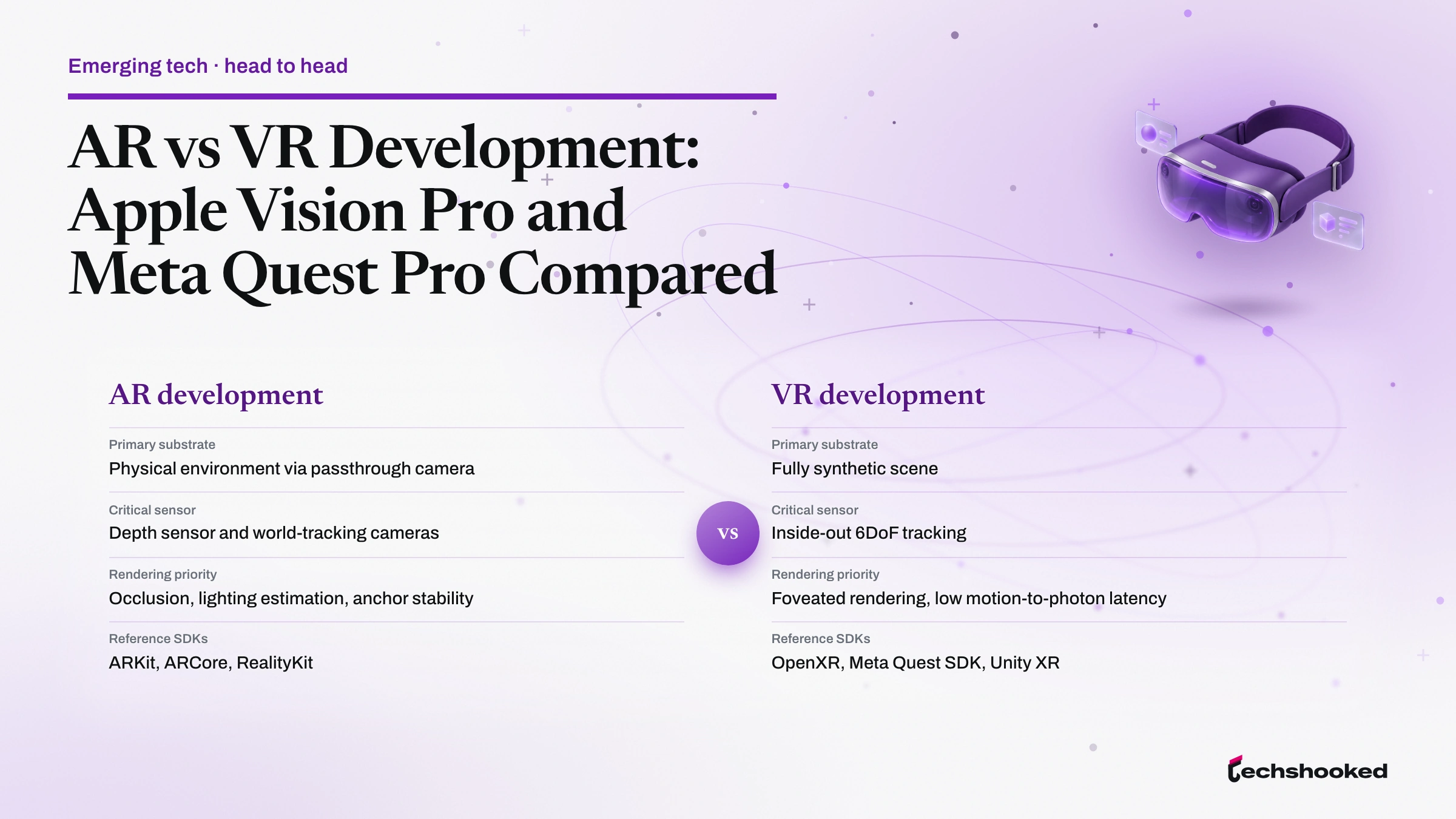
Apple Vision Pro sits at the intersection of augmented reality development and virtual reality development, but the two paradigms impose different constraints on developers from the rendering pipeline up. Augmented reality development assumes the real world is the substrate. Frameworks have to manage passthrough camera latency, plane detection, occlusion masks, and lighting estimation so digital objects sit convincingly inside a physical room. Virtual reality development assumes the headset replaces the world, which shifts the workload toward foveated rendering, low-latency 6DoF tracking, and tight motion-to-photon budgets to prevent cybersickness.
The rendering pipeline is where the split becomes operational. AR shaders run after a depth sensor pass that estimates real-world geometry, so material systems must respect occlusion from objects the developer never modeled. VR shaders own the entire scene graph and can pre-bake lighting more aggressively. Apple Vision Pro and Meta Quest Pro both ship with passthrough camera arrays capable of mixed reality output, yet the workflow to author for each remains distinct. The cross-vendor OpenXR 1.1 specification defines the API surface used by Meta Quest and other OpenXR-compliant headsets, providing a portable contract for input, swapchains, and tracking spaces.
For the broader deployment landscape these technical choices feed into, see the overview of AR and VR applications in education, health, and industry.
| Dimension | AR development | VR development |
|---|---|---|
| Primary substrate | Physical environment via passthrough camera | Fully synthetic scene |
| Critical sensor | Depth sensor and world-tracking cameras | Inside-out 6DoF tracking |
| Rendering priority | Occlusion, lighting estimation, anchor stability | Foveated rendering, low motion-to-photon latency |
| Reference SDKs | ARKit, ARCore, RealityKit | OpenXR, Meta Quest SDK, Unity XR |
| Typical session length | 2 to 10 minutes (handheld), longer for headsets | 15 to 30 minutes per ergonomic guidance |
visionOS SDK and RealityKit: Building for Apple Vision Pro
Apple Vision Pro runs visionOS, a spatial computing operating system whose developer stack centers on RealityKit, SwiftUI, and ARKit frameworks that treat physical space as a coordinate system. The visionOS developer toolchain is opinionated. RealityKit handles entity composition, physics, and rendering. SwiftUI provides the windowed and volumetric UI primitives. ARKit feeds world tracking, scene reconstruction, and spatial anchors back into the runtime. The Apple Developer documentation for visionOS is the authoritative reference for the current SDK surface, including the RealityKit entity component model and anchor APIs.
What makes the platform distinct is the persistent treatment of spatial anchors. An anchor in visionOS is a world-locked reference that survives session restarts, allowing applications to restore content to the same physical location across days. This persistence shifts authoring patterns away from per-session scene loads toward stable, location-aware experiences. Eye tracking is exposed as a high-level gesture primitive, so the SDK surfaces gaze as an input modality without forcing developers to handle raw sensor data.
- RealityKit
- Apple's entity-component renderer for visionOS, iOS, and macOS. Handles physics, materials, and the scene graph for spatial computing content.
- SwiftUI
- Declarative UI framework that on visionOS adds Window, Volume, and Immersive Space scene types for hybrid 2D and 3D layouts.
- ARKit on visionOS
- Provides world tracking, plane detection, scene reconstruction, hand tracking, and spatial anchors as the perception layer beneath RealityKit.
- Reality Composer Pro
- Authoring tool for assembling RealityKit scenes, configuring materials, and previewing content before integration into a Swift project.
Academic benchmarking of these stacks appears in the IEEE VR 2024 conference proceedings, which document spatial computing rendering performance across current-generation hardware. The practical implication for engineering leads is that visionOS commits a team to Swift, Xcode, and the Apple build toolchain. Cross-platform engines such as Unity ship visionOS targets, but native RealityKit work remains the path to the deepest platform integration.
OpenXR Standard and Meta Quest Pro Development

Apple Vision Pro uses a proprietary SDK, whereas Meta Quest Pro targets the OpenXR standard, a Khronos Group specification that enables cross-platform VR and mixed reality applications across headsets from multiple vendors. The OpenXR standard defines a runtime-loadable API for input, rendering, and reference spaces, which means a Meta Quest Pro build can, with engine support, deploy to HTC Vive XR Elite, Pico 4 Enterprise, and Varjo XR-4 without rewriting the core interaction layer. All three appear on the Khronos OpenXR conformant-products registry. Meta's own runtime extensions add hand tracking, mixed reality passthrough, and Movement SDK features on top of the base OpenXR contract.
For an enterprise VR deployment that needs to scale across heterogeneous hardware, the portability argument is the central reason to pick the OpenXR path. The tradeoff is feature lag: vendor-specific capabilities reach Meta Quest Pro through Meta SDK extensions before they appear in the Khronos OpenXR core specification, so cross-vendor portability often means writing against the lowest common denominator.
- Engine compatibility: Unity, Unreal, and Godot all ship first-class OpenXR backends, so existing render pipelines port with limited friction.
- Input model: OpenXR action sets abstract controllers, hand tracking, and eye tracking behind a remappable contract, simplifying multi-device support.
- Mixed reality: Meta Quest Pro's color passthrough is exposed through the XR_FB_passthrough extension on top of the base OpenXR API.
- Deployment: Meta Quest for Business handles MDM, kiosk mode, and remote provisioning for fleet rollouts.
- Toolchain breadth: Android Studio, Meta Quest Developer Hub, and standard adb workflows cover device management and debugging.
Long-Term Use of VR Headsets: Health and Ergonomics
Apple Vision Pro and other mixed reality headsets introduce ergonomic and physiological considerations that developers and enterprise buyers must account for when planning sustained deployment. Vergence-accommodation conflict, where the eyes converge on a virtual object at one apparent distance while focusing on a display panel at another, drives much of the eye strain reported in extended sessions. Cybersickness arises when visual motion cues conflict with vestibular input, and head-locked UI elements during locomotion are a common trigger. Peer-reviewed work in the IEEE Transactions on Visualization and Computer Graphics documents the human factors thresholds that should bound any deployment plan.
- Cap initial sessions for unacclimatized users at 20 to 30 minutes, then extend gradually as tolerance develops.
- Build in mandatory breaks every 25 minutes for sustained training scenarios, with seated rest at minimum.
- Calibrate eye tracking and IPD on each headset before deployment to reduce vergence-accommodation strain.
- Avoid head-locked menus during virtual locomotion to mitigate vestibulo-ocular reflex disruption.
- Document weight distribution and counterweight options; both headsets exceed 600 grams with default straps.
- Provide a clear opt-out path for users who report nausea, dizziness, or persistent eye strain.
Enterprise Cost-Benefit Analysis: Apple Vision Pro vs Meta Quest Pro
Apple Vision Pro carries a higher total cost of ownership than Meta Quest Pro, and the enterprise ROI case depends on whether visionOS spatial computing capabilities justify the price differential for specific deployment scenarios. Total cost of ownership (TCO) in this category is not just hardware unit price. It folds in device management licensing, content authoring labor, headset replacement cycles, accessory refresh, IT support volume, and the cost of training users to a competent baseline. IDC's Worldwide Augmented and Virtual Reality Spending Guide tracks AR/VR spending by use case, technology, industry, and geography; it is a market-sizing source rather than a per-seat TCO benchmark.
The crossover point most teams find is around fleet size. Below roughly 50 devices, where deployments cluster in design, executive briefing, or specialist clinical use, Apple Vision Pro's integration with existing Apple device management and its high-fidelity passthrough can produce stronger ROI per seat. Above that fleet size, where training, field service, and frontline operations dominate, Meta Quest Pro's lower per-unit cost and OpenXR portability typically produce better TCO at scale.
| Cost dimension | Apple Vision Pro | Meta Quest Pro |
|---|---|---|
| Hardware price band | Premium tier, multiple thousands per unit | Mid tier, roughly one third of Vision Pro |
| Device management | Apple Business Manager, Jamf, Mosyle | Meta Quest for Business, Arborxr, ManageXR |
| Content authoring | Swift, RealityKit, Reality Composer Pro | Unity, Unreal, OpenXR engines |
| Cross-vendor portability | None; visionOS only | OpenXR portable across compliant headsets |
| Best fit fleet size | Below 50 devices, specialist use cases | 50+ devices, training and frontline |
Which Platform Should Developers Choose?
Apple Vision Pro is the stronger choice for organizations already in the Apple ecosystem building spatial computing applications with high-fidelity passthrough; Meta Quest Pro suits teams that need OpenXR portability and a lower total cost of ownership across a larger device fleet. The decision rests on three readable inputs: the existing developer toolchain investment, the headset fleet size, and the use case fidelity requirement. Teams that need precise text legibility, persistent spatial anchors tied to office locations, and integration with macOS and iOS workflows benefit from the visionOS stack and RealityKit content pipeline.
Teams running enterprise VR deployment for training, simulation, or field operations across many users tend to land on Meta Quest Pro and the OpenXR standard, where Unity or Unreal portability and lower per-seat hardware spend matter more than peak fidelity. For practical deployment patterns, see Implementing VR Training in Enterprises, and for engine selection guidance review Unity vs Unreal Engine for VR Games.
- Audit the existing developer toolchain. A Swift and Xcode shop has a shorter on-ramp to visionOS; a Unity or Unreal team has a shorter on-ramp to Meta Quest Pro via OpenXR.
- Project the fleet size over three years. Below 50 units, fidelity wins; above 50, per-seat economics typically win (the crossover threshold tracks the per-seat TCO curves IDC and Forrester report in their enterprise XR coverage).
- Score the use case on passthrough fidelity, persistent spatial anchors, and text legibility requirements. Vision Pro leads on all three.
- Score the use case on cross-vendor portability, MDM maturity, and content authoring speed. Meta Quest Pro and OpenXR lead on those.
- Pilot both with the actual end users for at least four weeks before committing to a fleet contract.
Further reading
Frequently Asked Questions
What are the main differences between AR and VR development?
AR development layers digital content over the real world using passthrough cameras or optical see-through displays, while VR development creates fully immersive digital environments that replace physical surroundings. The SDK choice, rendering pipeline, and hardware constraints diverge significantly: AR frameworks like ARKit and ARCore manage real-world anchoring and occlusion; VR SDKs prioritize low-latency 6DoF tracking and foveated rendering for full-immersion scenes.
Is Apple Vision Pro worth the investment for enterprise deployments?
Apple Vision Pro justifies its higher total cost of ownership for enterprises that need spatial computing with high-fidelity passthrough and deep integration with existing Apple infrastructure. For teams requiring broad headset fleet scalability, Meta Quest Pro's lower per-unit cost and OpenXR portability typically produce better TCO at scale beyond 50 devices.
How does long-term VR headset use affect developer and end-user health?
Extended VR headset use can induce cybersickness, eye strain from vergence-accommodation conflict, and posture fatigue from headset weight. IEEE research recommends session caps of 20 to 30 minutes for unacclimatized users, mandatory breaks, and ergonomic mounting adjustments. Apple Vision Pro and Meta Quest Pro both include usage-duration prompts in their operating systems.