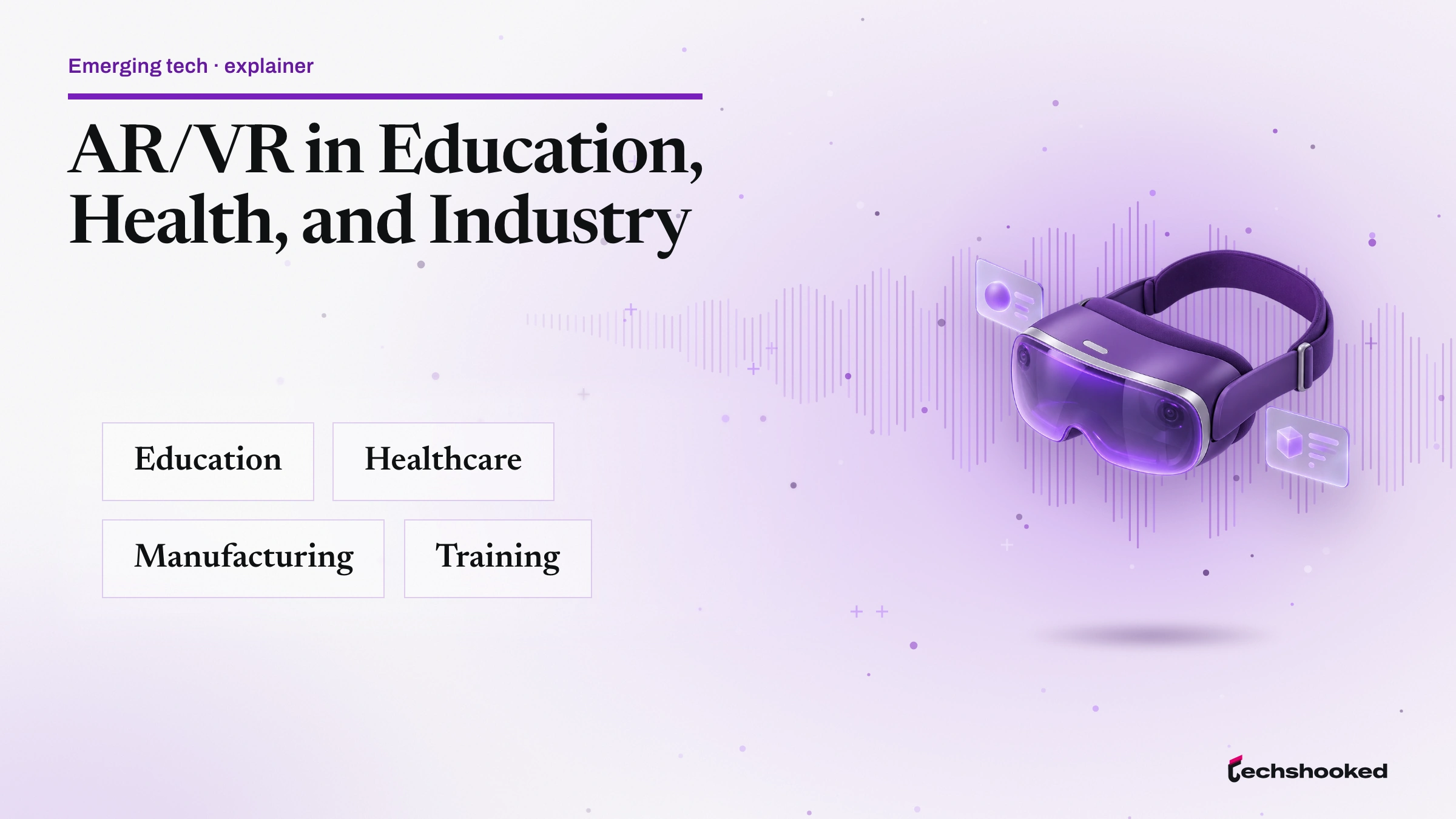
Augmented and virtual reality is a paired technology stack that overlays or replaces physical environments to deliver training, simulation, and visualization capabilities across education, healthcare, and industrial operations. AR/VR, the shorthand covering both modalities, has moved beyond proof-of-concept deployments: peer-reviewed outcome studies now document measurable gains in procedural competency, retention, and operational efficiency across all three sectors. The applied map looks different in each vertical, and the friction points a practitioner encounters in a hospital differ substantially from those in a university lab or a manufacturing plant.
AR vs VR: What Each Technology Actually Does
Augmented and virtual reality differ in how they overlay or replace physical space, and the engineering split shapes every deployment downstream.
AR/VR describes two distinct technologies that share a common trait: both modify how a user perceives and interacts with an environment. Augmented reality (AR) superimposes digital objects onto a live physical view through a camera-equipped device or optical see-through lens; the user retains full environmental awareness. An augmented reality overlay appears anchored to a real surface, readable while the user moves through a physical space. Virtual reality (VR) replaces the physical environment entirely via a head-mounted display, generating a simulated world the user inhabits with no real-world elements visible.
Extended reality (XR) functions as the umbrella term covering AR, VR, and mixed reality (MR) as a combined category. Spatial computing, a related framing popularized by Apple and Microsoft, refers to systems that map and reason about three-dimensional space in real time, enabling persistent digital objects that respond to physical geometry. The distinction between AR and MR is subtle but procurement-relevant: AR overlays are generally non-interactive with the physical environment, while MR objects can sit on a real table, cast virtual shadows, and respond to physical occlusion.
Concrete hardware anchors each category. Microsoft HoloLens 2 is the most widely deployed optical see-through AR and MR device in industrial and surgical contexts. Meta Quest 3 is the leading standalone VR headset for training and simulation workloads. Apple Vision Pro represents a spatial computing bridge between AR and VR, capable of both full immersion and see-through modes.
- Augmented Reality (AR)
- Overlays digital content onto a live physical environment through a camera feed or optical see-through lens. The user retains real-world vision and moves freely through physical space. Primary hardware: Microsoft HoloLens 2, mobile phones, tablet cameras.
- Virtual Reality (VR)
- Replaces the physical environment entirely with a computer-generated simulation delivered through a head-mounted display. No real-world elements are visible during use. Primary hardware: Meta Quest 3, Valve Index, Varjo XR-4.
- Mixed Reality (MR)
- A specific point on the reality-virtuality continuum where digital objects are anchored to and interact with real-world surfaces, not simply floating over them. MR requires environmental mapping sensors. Primary hardware: Microsoft HoloLens 2 (dual-use AR/MR), Magic Leap 2.
- Extended Reality (XR)
- Umbrella term covering AR, VR, and MR as a single technology family. Used in procurement, standards, and regulatory contexts to avoid modality-specific language when the full spectrum applies.
- Spatial Computing
- Systems that map three-dimensional physical space in real time and render persistent digital objects that respond to geometry and occlusion. Spatial computing encompasses XR hardware and the software stacks that power scene understanding, plane detection, and real-time anchoring.
AR/VR in Education: From Classroom Engagement to Remote Labs
Augmented and virtual reality have moved past classroom novelty into measurable instructional outcomes.
AR/VR's educational applications divide across three tiers that differ by learner age, institutional infrastructure, and required fidelity. A meta-analysis of 35 studies, Effectiveness of immersive virtual reality using head-mounted displays on learning performance: A meta-analysis (British Journal of Educational Technology, 2020), found immersive VR more effective than non-immersive approaches with a small overall effect, and a greater impact on K-12 learners, in science education and in developing specific skills.
- K-12 engagement and object visualization. AR overlays on printed textbooks and physical markers let students inspect 3D anatomical models, historical artifacts, and molecular structures without laboratory equipment. The Merge Cube platform places a manipulable AR object in a student's hand via a smartphone or tablet camera. Studies cite improved spatial reasoning scores when geometric concepts are taught with AR visualization versus static diagrams. Retention in this tier benefits from the novelty effect, though institutions report that sustained engagement requires curricular integration rather than standalone device sessions.
- Higher-education laboratory simulation. Virtual chemistry and biology labs remove reagent costs, safety constraints, and scheduling bottlenecks. Labster's platform allows students to run titration, PCR, and genetics experiments in a photorealistic virtual simulation training environment before handling live materials. Labster virtual laboratory efficacy research reports learning outcome parity with physical labs in controlled trials. The immersive learning environment offered by simulation-based training also enables repeat attempts without material cost, which is structurally impossible in a physical lab.
- Professional certification and procedural training. Aviation and medical certification programs have adopted simulation-based training at the accreditation level. FAA-approved flight simulators meet currency requirements for instrument procedures; residency programs increasingly use VR procedural training for surgical skill acquisition before cadaveric or live-patient practice. The immersive learning environment here is a fidelity requirement, not a preference: regulatory bodies accept simulation hours only when the simulator meets defined performance criteria for instrument response and scenario branching.
The remote learning dimension cuts across all three tiers. AR/VR tools allow synchronous lab work regardless of geography, a pattern that accelerated during the COVID-19 period and has remained adopted at many institutions post-reopening. For deployment guidance specific to organizational training contexts rather than academic programs, see enterprise VR training implementation.
Tools Used in Educational AR/VR
The vendor landscape for educational AR/VR includes both simulation-first platforms and content-authoring environments. Labster focuses on higher-education STEM lab simulation with curriculum-mapped modules. Merge Cube targets K-12 with low-cost AR object visualization requiring only a mobile device. ImmersiveVR Education's Engage platform supports virtual field trips and synchronous multi-user classroom sessions. Unity-based custom courseware builders give institutions control over scenario design, though they require technical staff for content production. Each platform produces a distinct form of immersive learning environment, and selection depends on whether the priority is catalog breadth, authoring flexibility, or multi-user collaboration.
AR/VR in Healthcare: Surgical Training, Therapy, and Patient Education
Augmented and virtual reality are now embedded across surgical training, therapy, and patient education pipelines.
AR/VR's healthcare applications carry the highest stakes of any sector covered here, and the evidence base reflects that weight. A JMIR meta-analysis of VR simulation effectiveness in healthcare training, covering 31 studies across health professions, found consistent improvements in procedural competency when VR-based simulation preceded live-patient practice. Three application categories account for most deployed systems.
| Application type | Technology layer | Example platform | Measured outcome |
|---|---|---|---|
| Surgical simulation | VR with haptic feedback | Osso VR, Fundamental Surgery | Reduced procedural error rates; improved competency scores vs. traditional residency cadence |
| Intraoperative AR guidance | Augmented reality overlay via optical see-through optics | Microsoft HoloLens 2 (orthopedic workflows) | Surgeon maintains gaze on operative field while viewing CT-registered bone geometry |
| Rehabilitation and motor therapy | VR environment with motion tracking | MindMaze, XRHealth | Stroke patient rehabilitation motor recovery acceleration vs. conventional physiotherapy in controlled trials |
| Pain management | Full-immersion VR | SnowWorld (DoD-approved) | Reduced analgesic requirement during wound care in burn patients |
| Patient education | AR model visualization | Custom oncology AR tools | Improved informed-consent quality; patients report higher comprehension of tumor location relative to surrounding anatomy |
Surgical simulation credibility depends on haptic feedback fidelity. Force-feedback gloves or stylus-based resistance systems replicate tissue compliance, needle insertion resistance, and instrument torque during virtual simulation training. Without this tactile layer, a VR surgical scenario trains visual recognition and motor sequencing but not the tactile discrimination a surgeon must develop for safe tissue handling. The RSNA study on AR/VR in radiology education documents simulation-based training protocols where haptic feedback contributed to measurable skill transfer in image-guided procedures.
Patient rehabilitation via VR uses game-like environments to drive repetitive motor tasks that would be monotonous in conventional physiotherapy. MindMaze and XRHealth both provide clinical-grade platforms with outcome tracking integrated into rehabilitation reporting. SnowWorld, developed at the University of Washington and approved for DoD use, reduces analgesic requirements during wound care for burn patients by replacing the pain-dominant sensory environment with an immersive cold landscape.
Regulatory and Integration Considerations
Healthcare AR/VR deployments face friction that other sectors do not. Software that analyzes or influences clinical decisions may require FDA 510(k) clearance as a Software as a Medical Device (SaMD). Patient imaging loaded into VR environments must comply with HIPAA: encrypted transmission and role-based access controls are non-negotiable. EHR integration for real-time augmented reality overlay pulling from live patient records adds system interoperability requirements that most hospital IT stacks have not standardized, a challenge examined in detail in the context of AI integration in clinical workflows. High-fidelity surgical simulation hardware with haptic feedback typically prices between $50,000 and $150,000 per unit, confining early adoption to well-funded academic medical centers.
AR/VR in Industry: Maintenance, Assembly, and Remote Assistance
Augmented and virtual reality have reshaped industrial maintenance, assembly, and remote-expert workflows.
AR/VR's industrial applications have the clearest ROI measurement framework of any sector because throughput, defect rate, and mean time to repair are directly quantifiable. Three clusters account for the majority of enterprise deployments.
- Maintenance and inspection with assembly line guidance. Technicians wearing AR headsets receive assembly line guidance overlaid directly onto physical machinery. Spatial-computing software from PTC Vuforia and Scope AR renders step-by-step repair sequences on the live equipment view, eliminating the need to consult paper manuals or move between the machine and a workstation. PTC Vuforia industrial AR deployment case studies document reductions in mean time to repair and first-time fix rate improvements across manufacturing clients. NIST guidance on augmented reality in manufacturing formally recognizes augmented reality overlay as a validated approach to assembly line guidance and quality inspection. A second assembly line guidance deployment pattern pairs AR with computer vision to flag errors in real time before a component advances to the next station.
- Digital twin integration for real-time sensor overlay. An AR headset connected to a digital twin of a physical asset lets a technician see live sensor readings, temperature gradients, and maintenance history overlaid on the actual machine component. Siemens and GE Digital have documented digital twin and AR integrations where field technicians resolve anomalies faster than teams relying on SCADA screens alone. The digital twin layer turns passive inspection into a data-rich procedural training exercise: the technician sees the asset's current state relative to its expected operational envelope. A second digital twin application extends this to predictive maintenance, where the display highlights components approaching failure thresholds before they interrupt production.
- Remote assistance for field operations. An expert located anywhere can view a field worker's camera feed through platforms such as TeamViewer Assist AR or ServiceMax Field Service, annotating the live view with guidance markers visible to the technician on-site. Remote assistance expanded sharply during the period of international travel restrictions and has remained standard practice because it reduces expert travel costs and response latency. Simulation-based training for hazardous procedures follows a parallel logic: VR environments allow workers to rehearse emergency evacuation, chemical handling, and equipment lockout procedures without exposure to real risk, mapping directly to OSHA-recognized hazard simulation protocols.
Industrial AR applications in this article cover maintenance and production environments. For AR deployments in customer-facing contexts, see AR applications in customer-facing retail environments.
Comparing AR/VR Adoption Barriers Across Sectors
Augmented and virtual reality face different procurement barriers depending on the deploying sector.
AR/VR's sector-specific adoption profiles diverge sharply once you move past the hardware layer. The table below maps the decision variables a practitioner must evaluate before committing to a vertical-specific deployment. For broader context on extended reality within emerging technology adoption frameworks, the hub article covers cross-technology strategic evaluation.
| Dimension | Education | Healthcare | Industry |
|---|---|---|---|
| Primary cost driver | Content authoring and LMS integration | Surgical simulation hardware; SaMD certification | Head-mounted display fleet management; ERP integration |
| Regulatory constraint | Accreditation acceptance of simulation hours | FDA SaMD 510(k); HIPAA data handling | OSHA compliance for safety simulation; sector-specific safety standards |
| Hardware requirement | Mobile devices to standalone VR headset depending on fidelity tier | High-fidelity haptic feedback system; optical see-through AR for intraoperative use | Industrial-grade head-mounted display; spatial computing anchor software |
| Proof-of-value metric | Retention scores; competency exam pass rates | Procedural error reduction; patient rehabilitation recovery velocity | Mean time to repair; first-time fix rate; defect rate per assembly line |
| Maturity level | Fastest-growing; most implementation-fragmented | Strongest clinical evidence base; slowest regulatory clearance cycle | Highest adoption maturity; clearest ROI measurement |
Industrial AR has the most mature adoption posture because throughput and defect metrics provide immediate, quantifiable feedback on deployment value. Healthcare VR carries the strongest peer-reviewed clinical evidence base, but regulatory clearance timelines and haptic response hardware costs slow deployment relative to industrial contexts. Educational AR/VR is growing faster than either, driven by lower hardware thresholds (mobile AR requires no specialized equipment) and increasing platform vendor competition, but implementation remains fragmented: institutions frequently pilot one platform without integrating it into curriculum assessment, which limits outcome measurement and repeat adoption. Practitioners evaluating spatial computing deployments should treat sector maturity as a proxy for risk: industrial is lower risk with faster ROI; healthcare is higher regulatory risk with stronger outcome data once cleared.
Further reading
- Enterprise VR Training Implementation , deployment methodology for organizational training programs
- AI Integration in Clinical Workflows , parallel integration challenges for AI-adjacent technologies in healthcare IT
- Effectiveness of immersive virtual reality using head-mounted displays on learning performance: A meta-analysis (Wu, Yu and Gu, 2020): pooled learning outcomes from 35 studies across K-12 and post-secondary education
- VR Headset Comparison: Meta Quest, PlayStation VR2, and Apple Vision Pro
- What Is Web3? The Internet Of Ownership Explained
Frequently Asked Questions
What is the difference between AR and VR?
Augmented reality (AR) overlays digital content onto a live physical environment, leaving the user's view of the real world intact. Virtual reality (VR) replaces the physical environment entirely with a computer-generated simulation delivered through a head-mounted display. A surgeon using AR sees the operating field with a CT augmented reality overlay projected onto it; a surgical trainee using VR for surgical simulation sees a fully simulated operating room with no real-world elements visible.
What challenges exist in implementing AR/VR in healthcare?
The primary barriers are regulatory and integration-based. Software that analyzes or influences clinical decisions may require FDA 510(k) clearance as a Software as a Medical Device (SaMD). Patient imaging data loaded into VR environments must comply with HIPAA, requiring encrypted transmission and access controls. EHR integration for real-time AR overlays adds interoperability requirements that most hospital IT stacks have not standardized. High-fidelity tactile feedback hardware for surgical training simulator typically prices between $50,000 and $150,000 per unit, restricting deployment to well-funded academic medical centers.
What is the difference between AR/VR and mixed reality?
Mixed reality (MR) is a specific point on the reality-virtuality continuum where digital objects are anchored to and interact with real-world surfaces rather than floating over them. AR overlays are generally non-interactive with the physical environment; MR objects can sit on a real table, cast virtual shadows, and respond to physical occlusion. Microsoft HoloLens 2 is the most widely deployed MR device in industrial and surgical settings. Extended reality (XR) covers AR, VR, and MR as a combined category used in procurement and standards contexts.