Web3 is a decentralized internet architecture that transfers data ownership and platform control from centralized intermediaries back to individual users through cryptographic verification and blockchain infrastructure.
Web1 gave users read access. Web2 gave them profiles, feeds, and social graphs, while quietly concentrating ownership of that data inside a handful of platform companies. Web3 reorganizes the ownership layer so that assets, identity credentials, and transaction history are held by the user directly, not custodied by an intermediary. That shift is architectural, not cosmetic, and understanding it requires looking at where data actually lives at each layer of the stack.
Web1, Web2, and Web3: The Architecture Shift
Web3 did not emerge from a single protocol decision; it is the structural response to two decades of centralization pressure that accumulated during the Web2 era. Each generation of the web reorganized where data control resided and who captured the economic value of user activity.
| Generation | Data Location | Ownership Model | Monetization Mechanism | Representative Technology |
|---|---|---|---|---|
| Web1 (1991-2004) | Publisher servers | Publisher retains all content; users read only | Banner advertising; subscription fees | Static HTML pages, FTP, early HTTP |
| Web2 (2004-present) | Platform cloud infrastructure | Platform owns user-generated data and graph | Behavioral advertising; data licensing; SaaS subscriptions | Social networks, app stores, REST APIs |
| Web3 (emerging) | Distributed ledger nodes; user-controlled wallets | User holds cryptographic keys; assets on-chain | Token-based ownership; protocol fees; DAO governance | Ethereum, Solana, IPFS, smart contracts |
The read-only web of the early internet required no login and stored nothing about visitors. Web2 reversed that model entirely: platform intermediaries collect behavioral data as a condition of participation, then monetize it through advertising and data licensing. Web3 removes the intermediary from the data custody chain. The ownership layer shifts from the platform to the user, enforced by cryptographic keys rather than platform account policies. A user who holds the private key to a wallet holds the asset, period; no corporate decision can revoke it.
Core Principles of Web3
Web3 is built on five structural principles that together define what makes a decentralized web application different from a conventional web service.
- Decentralization
- No single server or organization controls the network state. Nodes across a peer-to-peer network each hold a copy of the shared state, so no single point of failure can corrupt or censor the record.
- User Data Sovereignty
- User data sovereignty means individuals control their own data through cryptographic key pairs rather than through platform account policies. The platform cannot delete, modify, or monetize user-owned assets without the user's private key signature.
- Permissionless Access
- Any developer or user can interact with a public blockchain without approval from a gatekeeper. An Ethereum address costs nothing to create and grants the same protocol-level access as any other participant.
- Trustless Execution
- Smart contracts encode business logic on-chain and execute deterministically without requiring either party to trust the other or to trust a mediating institution. The code is the counterparty.
- Interoperability Protocol
- An interoperability protocol enables assets and identity credentials minted on one chain to move to, or be verified by, another chain or application. Cross-chain bridges and the W3C Decentralized Identifiers specification are two active expressions of this principle (W3C Web of Things Architecture).
User data sovereignty and permissionless access reinforce each other: ownership means little if participation requires approval from the entity you are trying to bypass. Together, these five principles define the architectural contract that differentiates a decentralized web stack from a conventional client-server model.
How Web3 Works: Blockchain, Consensus, and Smart Contracts
Web3 relies on blockchain infrastructure to replace the trusted server with a shared ledger maintained by a distributed network. The mechanics are clearest when traced through a single transaction from initiation to finality.
The IETF's CBOR standard (RFC 8949) governs the binary encoding layer used by decentralized storage networks such as IPFS, which store the off-chain data that many dApps reference on-chain (IETF RFC 8949).
- User initiates a transaction. A wallet (MetaMask, Phantom, or a hardware device) signs the transaction with the user's private key and broadcasts it to the network.
- Broadcast to the peer-to-peer network. The signed transaction propagates across the peer-to-peer network of nodes, each of which validates the signature format before relaying it further.
- Validators apply the consensus mechanism. The network's consensus mechanism (proof-of-stake on Ethereum post-Merge, proof-of-history on Solana) determines which validator adds the next block. Validators stake collateral; dishonest behavior results in slashing that collateral.
- Smart contracts execute deterministically. If the transaction calls a smart contract, the Ethereum Virtual Machine (EVM) or equivalent runtime executes the contract bytecode. Every node runs the same code on the same input and produces the same output. See the implementation guide for deployment details.
- State written to the distributed ledger. The validated outcome is appended to the distributed ledger. Every full node updates its copy; the record is immutable and publicly auditable.
- User retains proof via cryptographic key. The transaction hash and any resulting token or credential are controlled exclusively by the user's private key. No platform custodies the outcome.
The consensus mechanism is the central trust mechanism of this stack. Without it, any node could submit fraudulent state updates and the peer-to-peer network would have no way to adjudicate conflicts. The shift from energy-intensive proof-of-work to proof-of-stake reduced Ethereum's energy draw by roughly 99.95 percent according to the Ethereum Foundation, while preserving the same transaction finality guarantees. For a deeper look at the blockchain concepts underlying this lifecycle, see the blockchain fundamentals primer.
Web3 Use Cases: DeFi, NFTs, and Self-Sovereign Identity
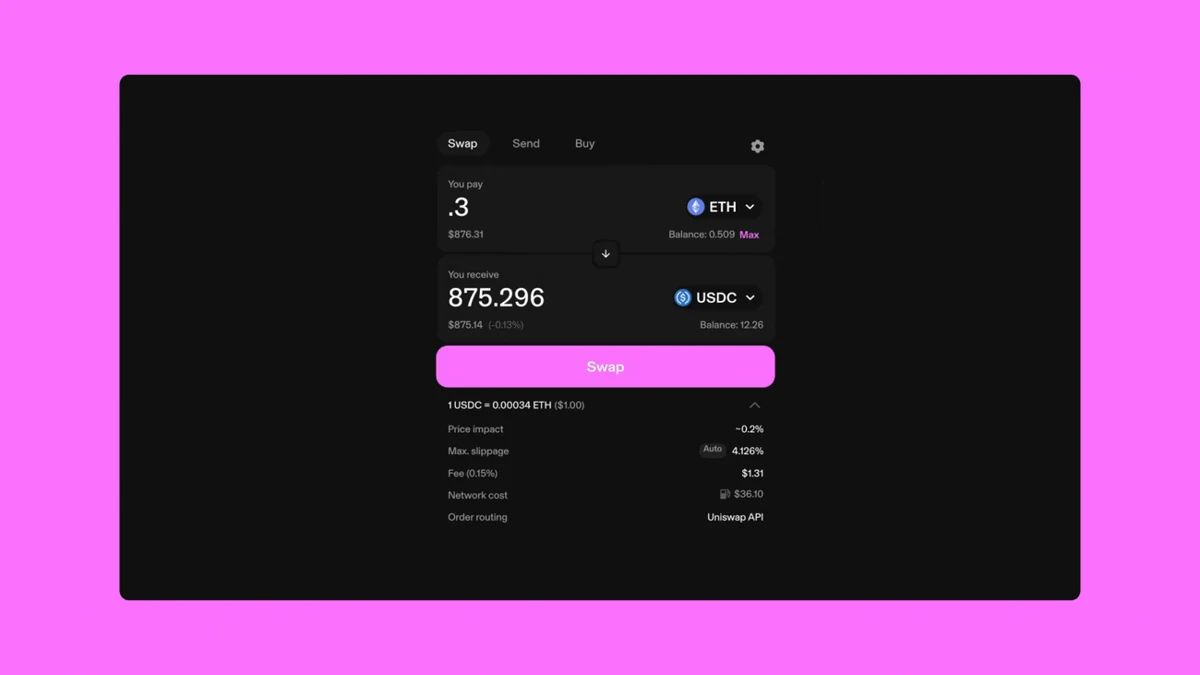
Web3 delivers practical value through three use-case clusters: decentralized finance, digital asset provenance, and self-sovereign identity. Each cluster applies blockchain infrastructure to a domain previously controlled by centralized gatekeepers.
- Decentralized Finance (DeFi). Decentralized finance replaces bank intermediaries with smart contracts that execute lending, borrowing, and trading directly between wallet addresses. Uniswap routes token swaps through automated market-maker pools. Aave and Compound manage collateralized lending positions in code rather than via loan officers. DeFi protocols settle trades 24 hours a day without account applications, credit checks, or geographic restrictions. For a comparison of leading DeFi lending protocols, see Uniswap vs Compound vs Aave.
- Non-Fungible Tokens (NFTs). Non-fungible tokens (NFTs) apply token-based ownership to digital assets by recording provenance on-chain. Each NFT is a unique on-chain record linking an asset hash to an owner address. Token-based ownership means creators can encode royalty logic directly into the NFT contract, receiving a percentage of every secondary sale without relying on a marketplace to honor that commitment voluntarily. NFTs also serve as access credentials: a wallet holding a specific token can unlock gated content or community membership. For a breakdown of NFT marketplace platforms, see OpenSea vs Rarible vs Foundation.
- Self-Sovereign Identity (SSI). Self-sovereign identity (SSI) removes the platform from the identity verification chain. The W3C Decentralized Identifiers (DIDs) v1.0 specification defines an interoperability protocol by which a user can create a globally unique identifier anchored to a blockchain, then attach verifiable credentials to it without requiring a centralized registry (W3C DID Core). An SSI wallet can prove age, employment, or professional certification to a third party without revealing the underlying data or delegating control to a platform. User data sovereignty in identity means the credential issuer, not the platform, controls the attestation.
Decentralized applications (dApps) surface across all three clusters. A DeFi protocol, an NFT marketplace, and an SSI wallet are each a dApp: a front-end that connects to on-chain logic deployed on blockchain infrastructure rather than to a company's backend servers.
Developer Entry Points: Building on Web3
Web3 development shares surface-level tooling with conventional web engineering, but the mental model differs substantially. Decentralized applications communicate with on-chain state rather than with a database your company controls.
- Write and deploy smart contracts on Ethereum. Solidity is the primary language for Ethereum on-chain contracts. The Ethereum development guide covers the compile-deploy-verify cycle using Hardhat and Foundry. The Ethereum Virtual Machine is the canonical runtime target; any EVM-compatible chain (Polygon, Arbitrum, Optimism) accepts the same compiled bytecode.
- Choose a chain based on throughput and cost profile. Ethereum offers the deepest liquidity and tooling but carries higher transaction fees under congestion. Solana processes roughly 65,000 transactions per second at sub-cent fees, making it better suited for high-frequency consumer dApps. The Ethereum vs Solana comparison maps the tradeoffs by use case and team size.
- Connect front-ends via Web3.js or ethers.js. These JavaScript libraries handle wallet connection, transaction signing, and event listening. A React front-end calls
ethers.getContractAt()to read on-chain state the same way a conventional app calls a REST endpoint. The data source is the distributed ledger, not a company database, so read latency and write finality behave differently than HTTP responses. - Integrate wallet authentication for SSI. Sign-in with Ethereum (SIWE) replaces username and password flows with a wallet signature challenge. Users prove address ownership without surrendering a password or email to your server. SSI extends this further, allowing verifiable credentials to accompany the signature via an interoperability protocol compatible with the W3C DID specification.
Decentralized applications built on this stack inherit the permissionless and censorship-resistant properties of the underlying blockchain infrastructure. The tradeoff is that self-executing contracts are immutable once deployed, making pre-deployment auditing and formal verification a non-negotiable part of the release cycle.
Limitations and Open Problems in Web3
Web3 carries genuine constraints that practitioners need to weigh before committing to a decentralized architecture. IEEE Spectrum's technical analysis documents the gap between the ownership layer promised in theory and the realities of current deployment (IEEE Spectrum).
- Scalability trilemma. A distributed ledger cannot simultaneously maximize security, decentralization, and transaction throughput. Ethereum's mainnet processes roughly 15-30 transactions per second under its current consensus mechanism without layer-2 assistance. Layer-2 rollups (Optimism, Arbitrum, zkSync) address throughput without sacrificing security, but they introduce their own bridge trust assumptions.
- User experience friction. Private key custody is the hardest onboarding problem in Web3. A lost seed phrase means permanent loss of assets, with no account recovery option. Gas fees add unpredictable transaction costs that break conventional UX assumptions. Account-abstraction proposals (ERC-4337) are reducing this friction, but the gap between Web2 convenience and Web3 self-custody remains wide.
- Regulatory uncertainty. Securities regulators in multiple jurisdictions disagree on whether protocol tokens constitute securities or commodities. The classification affects token issuance, exchange listing, and developer liability. No global framework has resolved the question, and enforcement actions have created significant compliance ambiguity for teams building consumer-facing DeFi and NFT platforms.
- Energy consumption of proof-of-work chains. Bitcoin's proof-of-work consensus mechanism draws substantial energy because mining requires continuous computation to win block rewards. Ethereum migrated to proof-of-stake, resolving this concern for EVM-compatible chains. Chains still relying on proof-of-work carry measurable environmental cost, which affects institutional adoption decisions.
- Front-end centralization risk. Most dApps serve their front-end from conventional cloud infrastructure. If a company's web server goes offline, users cannot access the on-chain interface even though the shared ledger state remains intact. Decentralizing the front-end via IPFS or Filecoin is technically possible but adds operational complexity.
The proof-of-stake migration and the layer-2 ecosystem represent the most active engineering responses to the trilemma. Developers building on Web3 today are operating on a stack that is still resolving these constraints in production, which makes chain selection, contract auditing, and key management strategy the highest-use architectural decisions available.
Further reading
- Ethereum Contract Development Guide
- Ethereum vs Solana: Chain Comparison for Developers
- Uniswap vs Compound vs Aave: DeFi Protocol Comparison
- NFT Marketplaces Compared: OpenSea vs Rarible vs Foundation
- What Is Blockchain? A Technical Primer
- AR vs VR Development: Apple Vision Pro and Meta Quest Pro Compared