An NFT marketplace is a blockchain-based trading platform that connects digital asset creators with buyers by managing listings, enforcing royalties, and collecting transaction fees. Non-fungible token (NFT) platforms monetize through layered cost structures that affect sellers, buyers, and creators differently. OpenSea and Rarible remain the two most active general-purpose NFT marketplaces; Foundation, once a prominent curated competitor, is offline indefinitely. Understanding how each platform fee is calculated before listing a digital asset can prevent significant cost surprises at settlement.
How NFT Marketplace Fees Work
OpenSea charges a 1% seller fee on secondary sales, a 10% fee for minting in a primary drop, and 0% on swaps, per its current support documentation. The seller pays the platform fee; buyers do not pay a separate service charge on top of the listing price. Creator earnings (royalties) on OpenSea are optional for sellers on secondary sales: the platform removed mandatory royalty enforcement in late 2023 and now lets sellers choose whether to honor the creator royalty at checkout. All fee figures are sourced from the OpenSea Help Center fee article; check that page directly for any updates since the last revision.
OpenSea's Seaport protocol, the smart contract layer underlying listings, reduces gas fee costs compared to older marketplace contracts by batching order fulfillments. The protocol also supports multi-token swaps at 0% platform fee, per OpenSea's learn page on selling NFTs. Lazy minting (deferring on-chain token creation until the moment of purchase) is available on Ethereum and Polygon, eliminating upfront gas fee costs for creators who list without an immediate sale. The developer fee documentation is available at OpenSea's developer docs.
| Transaction Type | Platform Fee | Who Pays | Creator Royalty Enforced? |
|---|---|---|---|
| Secondary sale | 1% of sale price | Seller | Optional (seller's choice) |
| Primary drop mint | 10% of sale price | Seller | N/A (first sale) |
| Swap | 0% | Neither | No |
Source: OpenSea Help Center. Verify against the platform's current fee schedule before listing.
Rarible Fee Structure
Rarible uses a regressive fee structure where both buyer and seller pay a percentage that decreases as transaction value rises, per Rarible's official help documentation. Unlike OpenSea's single-sided seller fee, Rarible splits the service fee between the two parties. Full tiered figures are published at the Rarible Help Center royalties and service fees article; check the platform's current fee schedule directly, as tiers can change. The structure means a buyer and seller each pay the applicable percentage, so the combined transaction fee burden is double the per-side rate at any given tier.
On creator royalties, Rarible lets creators set a royalty of up to 50% with decimal precision, per its official documentation. The royalties are enforced on all native Rarible listings and on Rarible-powered community marketplace deployments. Rarible has also taken an explicit stance on royalty aggregation: it enforces royalties on its own smart contract infrastructure and routes them to creators automatically on secondary sale, per the Rarible royalty policy blog post. Users who lock $RARI tokens (Rarible's native governance token) can eliminate service fees entirely while retaining the full creator royalty structure, making the regressive fee structure effectively zero-cost for high-volume participants who hold sufficient tokens.
| Transaction Value | Service Fee per Side | Who Pays | Creator Royalty |
|---|---|---|---|
| Under $100 | Up to 7.5% per side | Buyer + Seller | Up to 50%, enforced |
| $100 to $4,000 | Regressive (decreases with value) | Buyer + Seller | Up to 50%, enforced |
| Above $4,000 | 0.5% per side | Buyer + Seller | Up to 50%, enforced |
| $RARI token lock | 0% (waived) | N/A | Up to 50%, enforced |
Source: Rarible Help Center. Verify against the platform's current fee schedule before listing. Third-party summaries citing a flat 2.5% rate do not reflect the full tiered regressive fee structure.
Foundation: Status and Fee History
Foundation built its reputation as an invite-only curated NFT marketplace, but its platform is offline indefinitely as of the most recent notice on its website. The platform served a selective creator community and positioned itself above the open-submission model of OpenSea and Rarible. Its historical fee model and the non-custodial asset model are documented here for reference; no active fee benchmark should be drawn from Foundation's prior schedule, as the platform is not accepting new listings. The offline status is confirmed at foundation.app.
Three aspects of Foundation's model remain relevant for context:
- Non-custodial architecture. Foundation was built as a non-custodial system: creators retained control of their digital assets in their own wallets at all times, and existing NFTs minted through Foundation remain accessible in those wallets. The offline status does not lock or forfeit previously minted assets.
- Curated admission model. Access required an invitation from an existing creator, producing a smaller but higher-average-sale-price catalog than open-admission NFT marketplaces. The curation model also simplified royalty policy since all participants opted into Foundation's smart contract terms.
- Historical secondary sale fee. Foundation historically charged a 5% platform fee on secondary sales, a higher rate than OpenSea's current 1%, funded in part by the platform's moderation and curation costs. This figure is historical and should not be treated as a live benchmark.
Side-by-Side Fee Comparison
The three platforms differ sharply in fee model, royalty enforcement, and blockchain support, making a direct like-for-like comparison essential before choosing where to list. The table below captures the key structural differences across active and inactive platforms. All figures should be verified against each platform's current fee schedule before committing to a listing strategy.
| Feature | OpenSea | Rarible | Foundation |
|---|---|---|---|
| Platform fee model | Flat rate by transaction type | Regressive per-side schedule | Flat (historical only) |
| Secondary sale platform fee | 1% (seller only) | Per tiered schedule, per side | 5% (historical) |
| Primary drop fee | 10% | Per tiered schedule | N/A (offline) |
| Creator royalty enforcement | Optional (seller's choice) | Enforced on native listings | Enforced (historical) |
| Max creator royalty | Seller-configured | Up to 50% | 10% (historical) |
| Lazy minting | Yes (Ethereum, Polygon) | Yes | N/A (offline) |
| Fee waiver mechanism | None | $RARI token lock | None (historical) |
| Platform status | Active | Active | Offline indefinitely |
Sources: OpenSea Help Center; Rarible Help Center; foundation.app. Foundation figures are historical and not active benchmarks.
The comparison shows two fundamentally different pricing philosophies. OpenSea charges a low, predictable flat transaction fee per transaction type, with royalty optionality shifting toward sellers. Rarible charges both sides but rewards high-volume and high-value sellers through the regressive fee structure, and it preserves enforced creator royalties as a core policy. Gas fee costs on secondary sale remain a variable outside either platform's control and depend entirely on the blockchain the NFT was minted on.
Choosing the Right NFT Marketplace
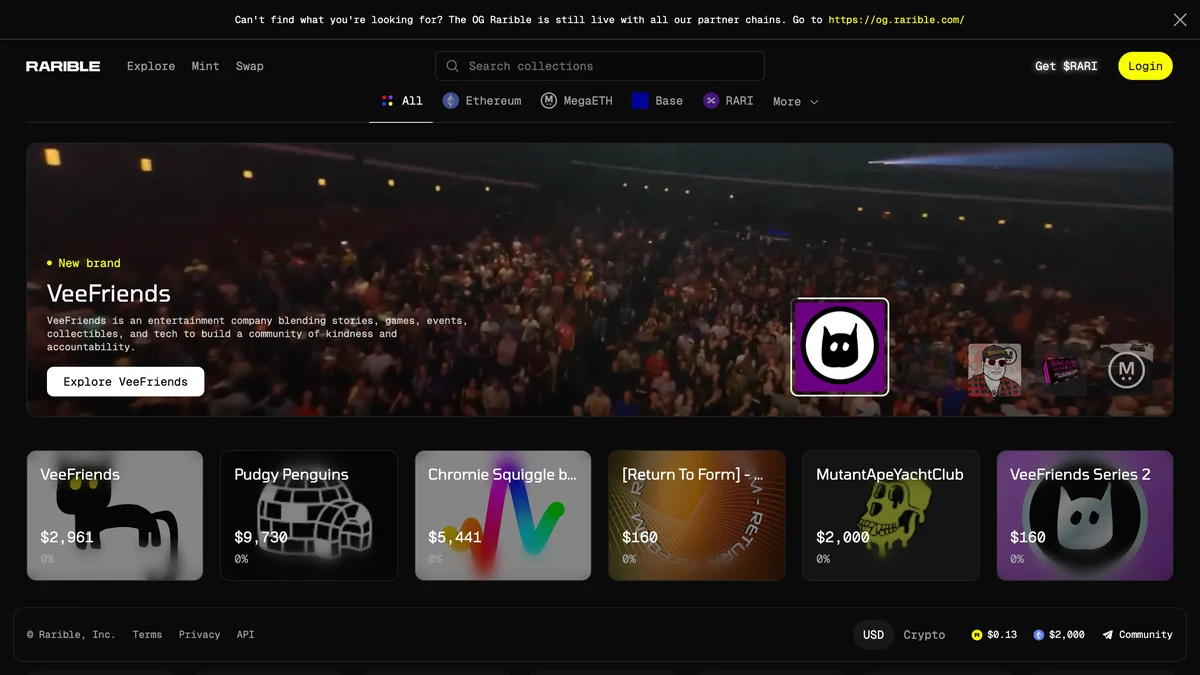
Selecting an NFT marketplace depends on three factors: expected transaction size (which determines effective fee rate), the importance of enforced creator royalties, and the blockchain networks you want to reach. Neither OpenSea nor Rarible is uniformly cheaper; the lower-cost platform depends on average transaction value and whether the creator needs guaranteed royalty distribution on secondary sale.
- High-value transactions ($4,000+). Rarible's regressive fee structure drops to 0.5% per side at this tier, per the Rarible Help Center. For a $5,000 digital asset sale, the total combined fee is 1% of transaction value, split between buyer and seller. OpenSea charges 1% from the seller alone on secondary sale, making fees nearly equivalent at this tier. The deciding factor becomes royalty enforcement: Rarible enforces creator royalties automatically; OpenSea leaves it optional.
- Low-value transactions (under $100). OpenSea's flat 1% seller fee is far less expensive than Rarible's per-side schedule at sub-$100 transaction values. A creator selling a $50 digital asset on OpenSea pays $0.50 in platform fees; on Rarible, both buyer and seller pay up to 7.5% each. High gas fee relative to transaction value is also a concern at this price point on Ethereum; lazy minting on OpenSea avoids the upfront gas fee burden for creators who are uncertain about immediate demand.
- Smart contract and royalty priority. Creators whose primary revenue stream depends on secondary sale royalties should weigh Rarible's enforced creator royalty policy heavily. OpenSea's decision to make royalties optional on secondary sale means the creator has no guarantee of receiving earnings after the initial sale. Rarible's smart contract architecture encodes and distributes royalties without relying on buyer or seller cooperation.
- Blockchain reach. OpenSea supports multiple networks including Ethereum, Polygon, Solana, and others; the full list is available on the platform. Rarible also supports multiple chains. The choice of blockchain affects gas fee levels on every secondary sale and the audience of potential buyers accustomed to each network's wallets and tokens.
For creators and collectors operating across DeFi ecosystems alongside NFT trading, the Uniswap vs Compound vs Aave DeFi protocol comparison covers fee and liquidity mechanics on those adjacent protocols. For teams evaluating whether on-chain storage fits their broader infrastructure requirements, the blockchain vs traditional databases for enterprise use cases article examines the architectural tradeoffs in detail.
References
- OpenSea Help Center: What fees do I pay on OpenSea?
- OpenSea Developer Docs: OpenSea Fees
- OpenSea Learn: How to Sell NFTs
- Rarible Help Center: What are royalties and service fees on Rarible?
- Rarible Blog: Get Royalties
- Foundation.app homepage
Further reading
Frequently Asked Questions
Which NFT marketplace charges the lowest transaction fee?
OpenSea charges a 1% seller fee for secondary sales per its help center, making it the lowest flat-rate option among active platforms. Rarible uses a regressive schedule where the fee drops to 0.5% per side on transactions above $4,000, but rises to 7.5% per side on transactions under $100. Foundation is offline indefinitely and does not accept listings.
Can I set creator royalties on Rarible?
Yes, Rarible lets creators set royalties up to 50% with decimal precision, per its official documentation. Royalties are enforced on all native Rarible listings and Rarible-powered community marketplaces. Users who lock $RARI tokens can eliminate service fees entirely while retaining the royalty structure.
Is Foundation still accepting NFT listings?
No, Foundation's platform is offline indefinitely as of its most recent statement. The platform was built as a non-custodial system, so existing assets remain in users' wallets and under their control, but new listings cannot be created through Foundation at this time.