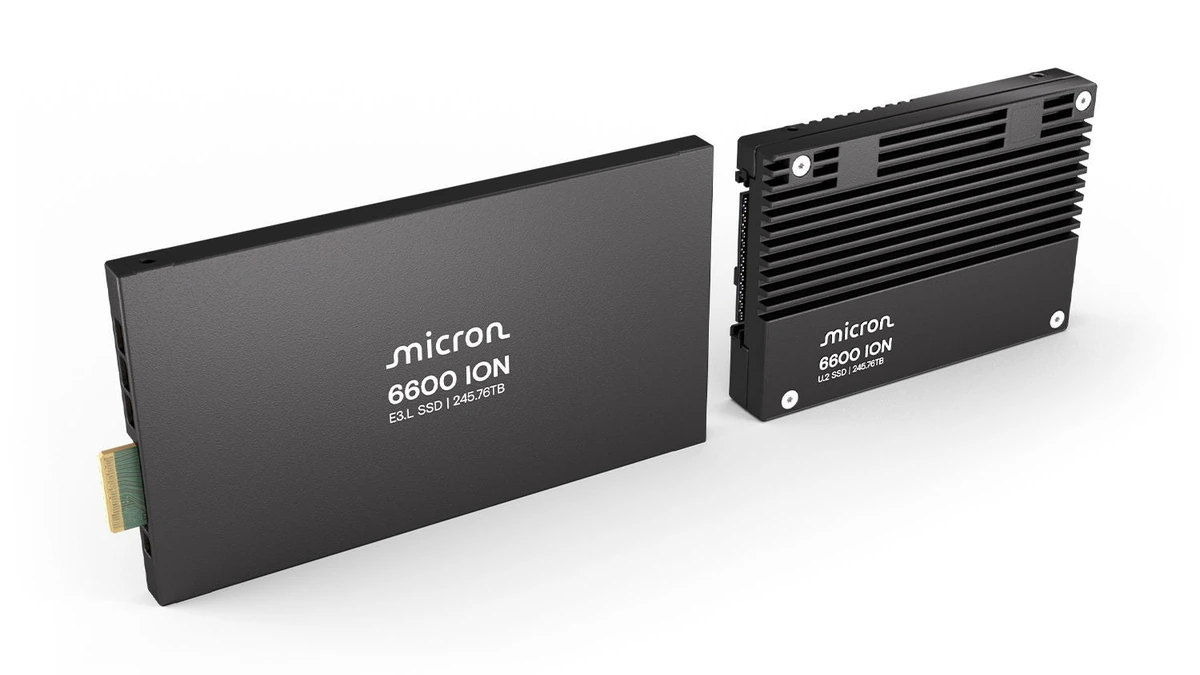
245.76 terabytes, in a single drive, is the number Micron is shipping now with the 6600 ION, which it calls the highest-capacity enterprise data center SSD available today. That single spec understates the more interesting claim underneath it: Micron says an E3.L rack built entirely from these drives can hold up to 176.9 petabytes, against roughly 31.7 petabytes for a rack of the highest-capacity hard drives on the market, a gap of more than five and a half times in the same physical footprint.
That density gap is the whole pitch. Micron argues that at one-exabyte scale, a hard-drive-based architecture can require nearly six times more racks than a build using 245TB SSDs, which cascades into more real estate, more power distribution, and more cooling infrastructure before anyone even measures performance. The 6600 ION is built on Micron's G9 QLC NAND across a six-plane architecture designed to increase internal parallelism, running over PCIe Gen5 NVMe for fast sequential and random access, in E3.L and U.2 form factors aimed at AI, cloud, and hyperscale workloads that generate and query data far faster than traditional scale-out storage was built to handle.
What Micron is really selling here is a total-cost-of-ownership argument rather than a pure capacity record. Adding more drives, more servers, and more racks has been the default answer to storage growth for years, but Micron's framing treats that approach as breaking down under AI-driven data growth, where the real constraint has shifted from raw compute to how efficiently a data center can store, move, and access massive datasets. Fewer, denser drives mean fewer components to deploy, monitor, and eventually replace, an operational simplification that matters as much to a hyperscaler's staffing costs as it does to its power bill.
None of this is neutral testimony. Micron's own workload engineering team ran the comparisons that produced the rack-density and exabyte-scale numbers, and a company selling SSDs has an obvious interest in a metric that makes hard drives look inefficient by comparison. The underlying physics, though, are not in dispute: QLC NAND SSDs genuinely pack more data per cubic inch than spinning platters can, and that gap widens as capacities climb into the hundreds of terabytes. The open question is not whether SSDs are denser, but whether their cost per terabyte has fallen far enough for hyperscalers to justify replacing bulk hard-drive tiers wholesale rather than keeping SSDs for hot data and HDDs for cold archival storage, which remains the more common split today.
Solidigm and Western Digital are both chasing similar capacity ceilings from opposite directions, Solidigm on the SSD side and WD on hard drives, which suggests the industry has not settled on where the line between the two technologies should sit for exabyte-scale deployments. Micron shipping a 245TB drive now, rather than promising one for later, at least puts a concrete number on one side of that argument.