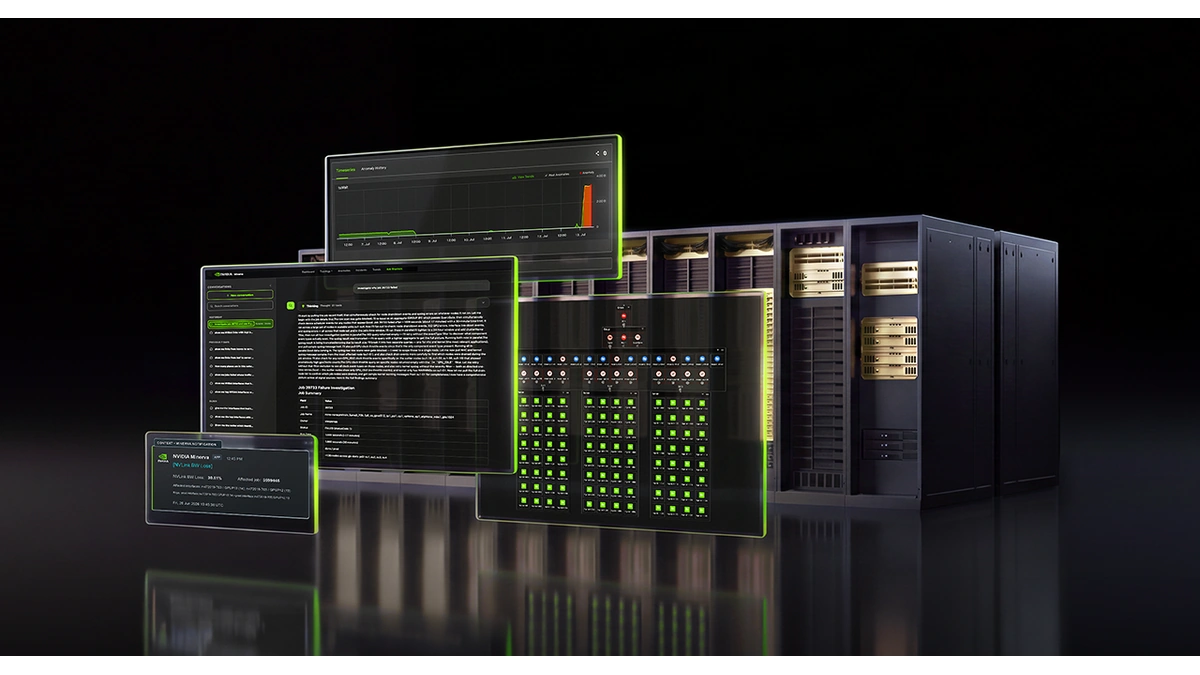
NVIDIA Minerva maps an AI factory's GPUs, SuperNICs, switches and cables against the jobs running on them, which lets an operator trace a slow training run to the component affecting it. NVIDIA calls it an AIOps platform: it gathers infrastructure and workload telemetry and turns it into alerts and recommended fixes.
NVIDIA built Minerva to help teams find problems earlier in AI factories, where a single degraded component can slow an entire job. Early signs can be subtle, the company says, such as a GPU that runs hotter than its peers or an NVMe drive that loses performance under load. The company measures the payoff as AI factory yield: the useful work infrastructure produces, counted in GPU hours, goodput, cluster uptime and token production.
Minerva builds a knowledge graph of the hardware and the workloads on it, then runs supervised and unsupervised machine learning over billions of data points per hour. It learns normal behavior, flags anomalies it has not seen before, predicts emerging failures and can group an event storm into a single incident with a likely root cause. A built-in assistant called Sherlock answers questions in natural language from live telemetry, and an MCP server connects outside agent tools. A person can apply the recommended fix by hand, or Minerva can be wired to automation through infrastructure APIs.
Cloud provider IREN is among the NVIDIA partners using it. Chief technology officer Denis Skrinnikoff said Minerva gives his operations team one view across the network, the GPUs and the jobs on them, so the team spends more time on proactive maintenance than on troubleshooting. Aolani, Bitdeer AI, IBM, Jio, Lambda, Quake AI and Tesla plan to deploy it. Dell Technologies, Lenovo and Supermicro will offer Minerva within their AI factory operations portfolios.
Minerva can run on premises or as SaaS from NVIDIA's cloud, NVIDIA says. It takes in telemetry through standards including OpenTelemetry, gNMI, syslog, DCGM, Slurm and JSON, and integrates with tools such as Slack, Microsoft Teams, PagerDuty and ServiceNow. Buyers choose among three modes: a data collector that feeds external tools such as Grafana, that collector plus Minerva's anomaly detection and correlation feeding back into those tools, or the full turnkey platform with the built-in agent. NVIDIA calls Minerva the primary network observability tool for AI factories built on its stack, including Vera Rubin and Blackwell, and says key capabilities, starting with the Minerva Collector, will be open sourced in DSX OS.