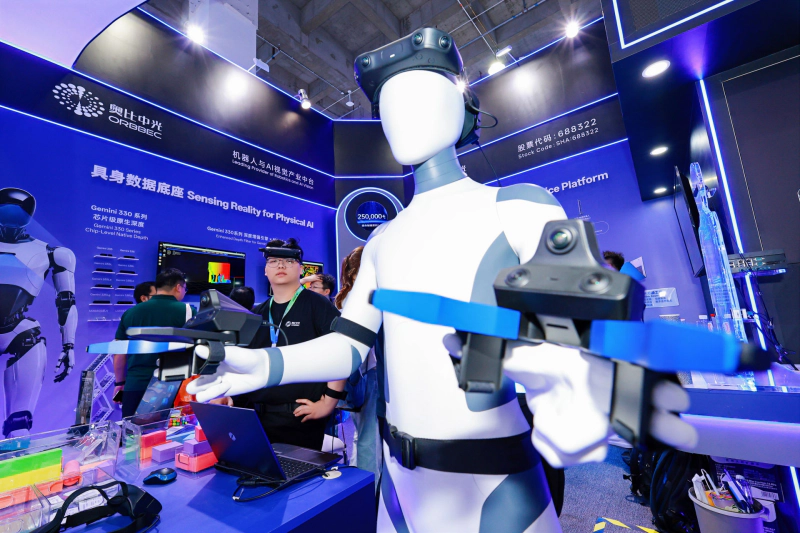
Orbbec opened the 2026 World Robot Conference in Beijing with two product lines: the first complete display of its Robot-Free Data Collection Hardware Platform, launched in July, and the official debut of the Physis series robotics vision cameras.
The platform's four product forms were shown at the conference, per Orbbec in the data collection lineup: EGO for first-person vision capture, UMI for handheld manipulation capture, WristCam for wrist-level near-field interaction, and Hub for central connection. Orbbec defines the capabilities the platform must deliver as Real, Reliable, Rich, and Ready, and its production-line testing recorded continuous operation for more than 37 hours at 1600 by 1200 at 30 fps in H.264, zero dropped frames across RGB and IMU streams, more than 100 million frames captured in total, camera-to-IMU frame interval variation within 30 microseconds, and hardware-level multi-camera synchronization error below 1 millisecond.
The first Physis models are the 257g Human-IPD RGB stereo camera and the more compact 157g monocular camera, which Orbbec says give robots what the company describes as more human-like visual perception. The 257g uses a 63-millimeter stereo baseline close to human interpupillary distance, a low-distortion 120-degree horizontal by 90-degree vertical field of view, and dual real-time 1920 by 1200 streams at 60 fps. A global shutter and onboard ISP keep color and texture consistent across the stereo pair; depth sensing spans 0.1 meters to beyond 10 meters with typical accuracy of 1.6 percent at 2 meters. The camera carries IP67 protection, operates from minus 30 to 65 degrees Celsius, and uses a GMSL2 interface rated for walking, obstacle traversal, and jumping robotic platforms.
Orbbec also launched the Gemini 338Le and Gemini 338Lg stereo 3D cameras with enhanced resistance to ambient-light interference, the former on an industrial-grade Gigabit Ethernet interface and the latter on high-speed GMSL2/FAKRA for industrial and logistics environments. An Orbbec product lead said the company sees itself as a hardware gateway connecting upstream core components to downstream model developers and robot manufacturers, moving physical AI from the laboratory toward deployment at scale.