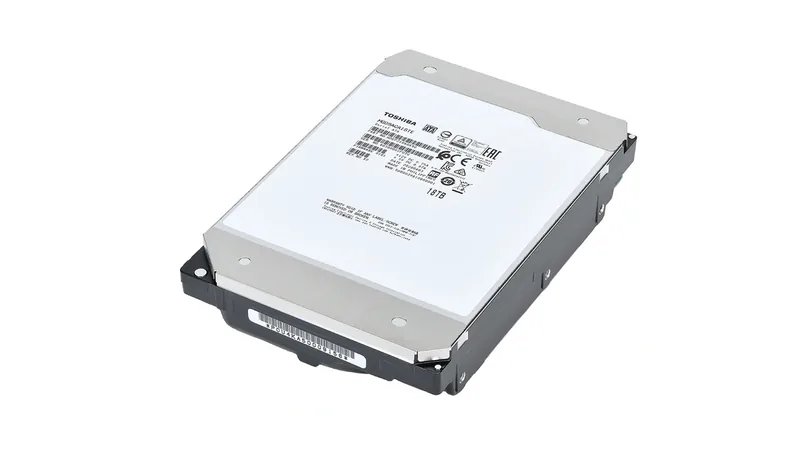
Seagate is now shipping 32TB hard drives across three separate product lines at once, a capacity jump the company is framing less as a spec bump than as a response to how fast enterprise storage demand is outpacing what conventional recording technology can deliver. The Exos, SkyHawk AI and IronWolf Pro drives all hit 32 terabytes using conventional magnetic recording (CMR), the mature, widely deployed technology that most data centers and NAS boxes already run on, rather than the newer heat-assisted recording Seagate has reserved for its highest-capacity Mozaic drives.
The three drives are built for different jobs. Exos 32TB targets enterprise and cloud data centers, where Seagate says the drive's areal density lets operators store more data per unit without adding power draw per terabyte, rated for up to 2.5 million hours mean time between failures. SkyHawk AI 32TB is aimed at network video recorders running GPU-based analytics alongside continuous 24/7 video capture, a workload Seagate says now needs three times the durability of a standard surveillance drive. IronWolf Pro 32TB is built for multi-bay NAS systems, with vibration tolerance for RAID arrays and a 550-terabyte-per-year workload rating backed by a five-year warranty.
Seagate is citing its own IDC-commissioned survey to make its case: 66% of enterprise leaders expect moderate or significant storage growth over the next two years because of generative AI, but only about a third say their infrastructure is fully optimized for it. That gap between expected growth and actual readiness is the company's central argument for why capacity increases at the drive level matter more now than they did a few years ago, when storage growth was comparatively predictable. It is also, worth noting, a convenient argument for a hard drive maker to make about hard drives, and Seagate's own commercial interest in the number should temper how much weight it carries as an industry-wide fact rather than a sales pitch.
What is more concrete is the engineering choice underneath the announcement. Seagate is treating CMR and its HAMR-based Mozaic platform as complementary rather than sequential, keeping 32TB CMR as the workhorse tier for customers who do not need the roughly 40TB-plus capacities that HAMR unlocks, while reserving the newer, less mature recording technology for hyperscale deployments already comfortable with it. That is a more conservative rollout than pushing HAMR into every tier at once, and it reflects how cautious drive makers still are about handing unproven recording technology to NAS and surveillance customers who cannot easily tolerate early failures.
The open question is how long 32TB CMR holds as a meaningful ceiling against rivals like Western Digital and Toshiba, both of which are running similar dual-track strategies across CMR and their own HAMR-style platforms. Seagate's own roadmap points toward HAMR drives scaling from today's four-plus terabytes per platter toward ten terabytes per platter, which would put 100TB single drives within reach later this decade. For now, the three 32TB drives give Seagate a capacity story across Exos, SkyHawk AI and IronWolf Pro at once, from data center to NAS to security camera, without betting the whole portfolio on a recording technology still working through its early hyperscale deployments.