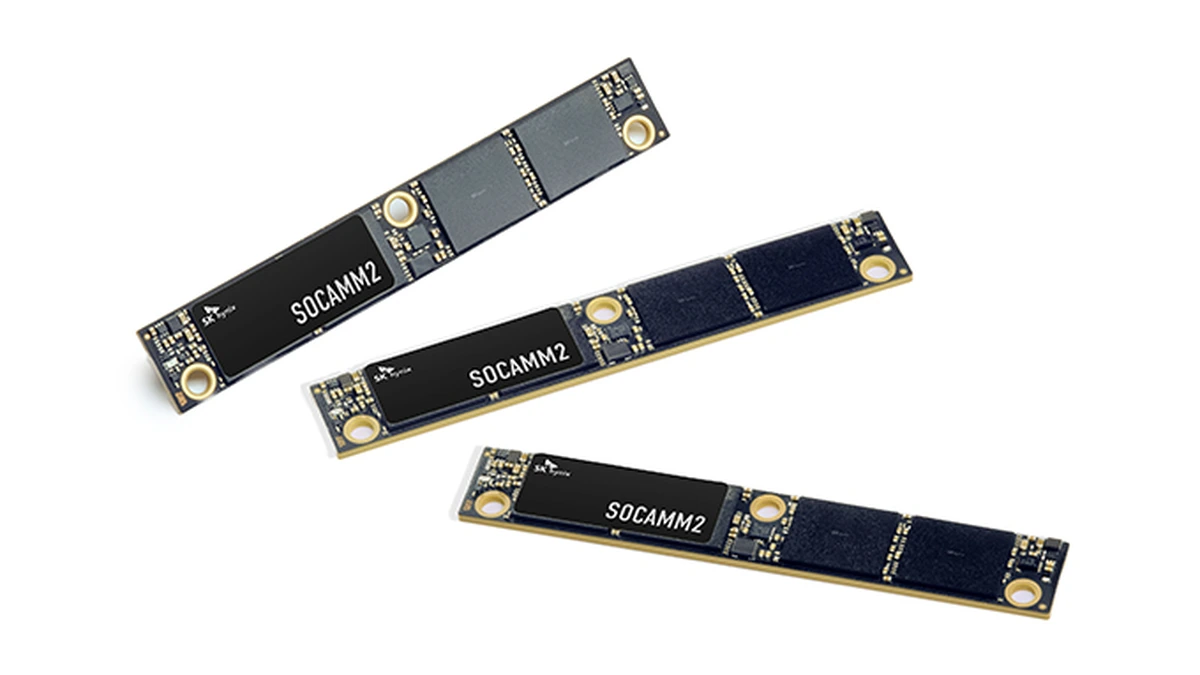
SK hynix has begun mass-producing a 192GB memory module called SOCAMM2, built by adapting LPDDR5X, the low-power DRAM standard normally found in smartphones, for use in AI servers instead. The module is built on the company's 1c process, its sixth-generation 10-nanometer-class node, and SK hynix says it delivers more than double the bandwidth of a conventional RDIMM, the register-buffered module type that has been the default server memory format for years, along with a 75% improvement in power efficiency.
The mechanics of why mobile-style memory works better here come down to power and packaging rather than raw speed. LPDDR was designed from the start to sip power in battery-constrained phones, and SOCAMM2 carries that efficiency into a data center rack where every watt spent on memory is a watt not available for GPU compute, a tradeoff that matters more as AI training clusters grow into tens of thousands of accelerators. SK hynix says the module is designed specifically for NVIDIA's upcoming Vera Rubin platform, and frames it as a fix for the memory bottleneck that shows up when training or running inference on large language models with hundreds of billions of parameters, where the GPU itself is rarely the slowest part of the system.
"By supplying the 192GB SOCAMM2, SK hynix has established a new standard for AI memory performance," said Justin Kim, the company's president and head of AI infrastructure, a claim that reflects the company's own commercial position as much as an independent assessment. What is less disputable is the shift in industry attention SK hynix is describing: as AI workloads move from mostly running inference on already-trained models toward heavier training runs, memory bandwidth per watt becomes the harder constraint to solve, and a mobile-memory-derived format built around low power rather than raw capacity is a specific bet on where that bottleneck sits next.