
DDR5 is the current-generation DRAM standard that delivers higher memory bandwidth and lower operating voltage than DDR4, with the tradeoff that the newer standard requires a compatible motherboard and CPU platform.
For builders planning a new system from scratch, the choice between the two generations is settled by platform selection before any module is purchased. For anyone sitting on an existing DDR4 build, the arithmetic is different: the modules themselves cannot cross over, so a memory upgrade means a platform upgrade. Knowing where the two standards actually diverge makes that decision concrete rather than speculative.
What DDR5 and DDR4 Are
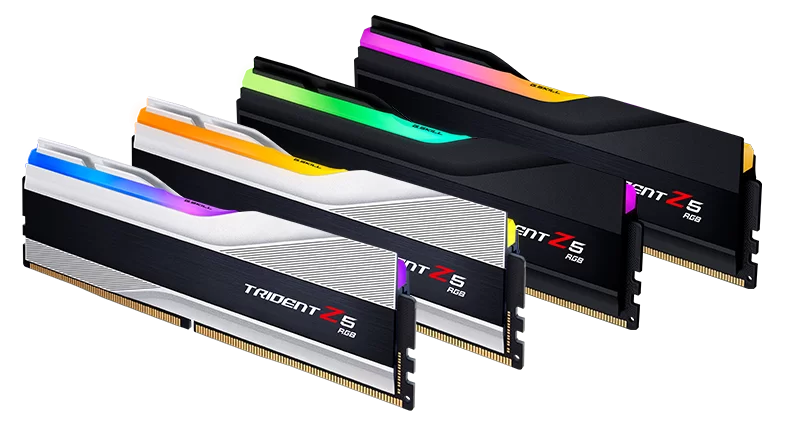
These two memory technologies are successive generations of the Double Data Rate SDRAM standard, each defined by JEDEC specifications that set minimum data rates, operating voltages, and physical slot geometry. JEDEC, the semiconductor engineering standards body, publishes these as formal documents: JESD79-4 governs DDR4 behavior and JESD79-5 governs the newer generation. The two standards share the same underlying double data rate principle, transferring data on both the rising and falling edge of the clock signal, but they differ in how that principle is implemented at the circuit and architecture level.
- DDR4 (JESD79-4)
- The previous-generation standard. Per the JEDEC JESD79-4 publication, the standard covers a per-pin data rate range from 1600 MT/s to 3200 MT/s at 1.2 V operating voltage. Uses an 8n prefetch architecture. Widely deployed in consumer and server platforms.
- DDR5 (JESD79-5)
- The current-generation standard. Per the JEDEC JESD79-5 publication, the standard spans a data rate range from 4800 MT/s to 8800 MT/s at 1.1 V operating voltage. Introduced 16n prefetch depth, mandatory on-die ECC, and a two-sub-channel-per-module topology.
- JEDEC
- Joint Electron Device Engineering Council. The industry body that publishes DRAM standards and maintains backward-compatibility rules between generations. Each standard revision extends performance ceilings and adds security or reliability features without breaking the base specification.
DDR5 vs DDR4: Specification Comparison

The two standards differ across four measurable dimensions: data rate range, operating voltage, prefetch depth, and on-chip error correction. According to JEDEC's published press releases for both JESD79-4 and JESD79-5, DDR4 covers a per-pin data rate range of 1600 MT/s to 3200 MT/s, while the newer standard spans 4800 MT/s to 8800 MT/s in its current revision, with the specification window open for higher-speed profiles (JEDEC JESD79-5 announcement; JEDEC JESD79-4 announcement). Operating voltage dropped from 1.2 V on DDR4 to 1.1 V on the new generation, reducing idle and active power draw at the module level. These figures represent the JEDEC-defined specification range, not guaranteed application throughput under a given workload.
The table below summarizes the architectural differences side by side. For a broader look at how system memory interacts with storage and platform, see the guide on how RAM, SSDs, and motherboards affect system performance.
| Specification | DDR4 (JESD79-4) | DDR5 (JESD79-5) | Practical Impact |
|---|---|---|---|
| Data rate range | 1600 to 3200 MT/s | 4800 to 8800 MT/s | Higher peak memory bandwidth available to the CPU |
| Operating voltage (Vdd) | 1.2 V | 1.1 V | Lower idle and load power at the module |
| Prefetch architecture | 8n | 16n | Wider internal bus fetch; supports higher burst throughput |
| On-die ECC | Not required by spec | Mandatory per JESD79-5 | In-module error detection before data leaves the DRAM die |
| Channel topology | One wide channel per module (64-bit) | Two narrow sub-channels per module (32-bit each) | More granular burst scheduling; reduced latency on sub-channel transfers |
| Slot compatibility | 288-pin slot (DDR4 key notch) | 288-pin slot (DDR5 key notch, different position) | Physical incompatibility; modules cannot cross platforms |
Real-World Performance: What the Numbers Mean in Practice
Raw data rate specifications do not translate one-to-one to application performance, and the new generation's bandwidth advantage is most visible in workloads that saturate the memory controller. The memory subsystem is one bottleneck among several; processor cache hierarchy, storage throughput, and thread count all interact with how much benefit a faster memory bus can deliver.
Across common use cases, the performance picture breaks down as follows:
- Gaming frame rates: For most titles at 1080p and above, systems on the newer standard produce frame rates within a few percent of equivalent DDR4 configurations at the same module capacity. GPU throughput and CPU core frequency are the dominant constraints in the majority of game engines; system memory bandwidth is rarely the limiting factor at moderate resolutions.
- Video encoding and rendering: Workloads that process large sequential data buffers, such as software-based video transcoding or 3D rendering, show a more consistent gap. A wider memory bus allows the CPU to sustain throughput across longer work segments without stalling on data delivery.
- Large dataset analytics and scientific computing: Applications that stream through datasets larger than the CPU's last-level cache benefit directly from higher memory bandwidth. This is where the DDR5 vs DDR4 gap is most reproducible across test runs.
- Latency-sensitive applications: Early modules on the new standard showed higher access latency than tuned DDR4 kits at comparable speeds. As the newer XMP and EXPO profiles have matured, this gap has narrowed, but DDR4 retains a latency advantage at any given clock frequency in workloads that depend on random-access patterns rather than streaming throughput.
- Office and productivity software: Everyday tasks such as email, document editing, and web browsing place minimal demands on memory bandwidth. Neither standard provides a perceptible advantage here.
Platform Compatibility and Upgrade Path
The two standards are physically and electrically incompatible: a newer module will not seat in a DDR4 slot, and the memory controller on a DDR4 platform cannot drive the newer signaling. The slot keying positions differ between generations, and the power delivery architecture on a current-generation motherboard moves the voltage regulator onto the module itself rather than the board, which is another reason the standards cannot coexist in the same socket. This physical and electrical incompatibility is the root of every DDR5 vs DDR4 platform compatibility question buyers run into.
Platform compatibility between the two standards is organized around CPU socket families. Understanding the distinctions matters before any purchase decision on a memory upgrade:
- Intel LGA1700 (12th Gen Core, 13th Gen Core, 14th Gen Core): These platforms offered motherboards in both DDR4 and DDR5 variants on the same socket. Builders purchasing a 600-series or 700-series chipset board had to choose one standard at the time of motherboard purchase; the CPU itself supports both, but a given board supports only one. Mixing is not possible after the fact.
- Intel LGA1851 (recent Intel desktop platforms): Exclusively the newer standard. No DDR4 support on this socket family. Builders targeting this platform are committed to the new generation from the moment the motherboard is chosen.
- AMD AM4 socket (older AMD platforms): DDR4 only. AM4 has no support for the newer standard. Upgrades within this ecosystem stay on DDR4.
- AMD AM5 socket (current AMD platforms): Newer standard only. AMD's decision to commit AM5 to a single memory standard simplifies platform selection. Every AM5 board uses the new generation; no DDR4 option exists on this socket.
- Laptop and mobile platforms: OEM-soldered memory on most thin-and-light designs locks the DDR generation at the point of system purchase. User-upgradeable SODIMM slots on certain notebook platforms follow the same socket-generation rules as desktop.
For context on how platform generation affects overall system capability, the CPU selection guide for productivity and gaming covers processor generations in detail. A side-by-side look at platform architecture is available in the Intel vs AMD platform performance comparison.
DDR5 vs DDR4: When Each Makes Sense
The right choice between the two standards is determined almost entirely by platform: if your motherboard shipped with DDR4 support, there is no memory-only upgrade path to the newer generation. The decision tree is less about which standard is superior in the abstract and more about which scenario applies to the build in question.
- Building a new system on an AM5 platform or a current-generation Intel board: The newer standard is the correct choice. Both AMD AM5 and the current Intel socket families are committed to it. There is no DDR4 option on these platforms, and retail module pricing for the new generation has converged toward DDR4 pricing over successive product cycles.
- Upgrading RAM in an existing DDR4 system: Adding capacity or speed-binned DDR4 kits to an existing AM4 or older Intel LGA1700 DDR4 board is the practical path. A memory upgrade here stays within DDR4. Moving up a generation would require replacing the motherboard and potentially the CPU, making it a full platform upgrade rather than a memory swap.
- On an Intel LGA1700 board with the new standard from launch: The system is already on the current generation. A memory upgrade at this point means adding capacity or selecting higher-speed kits within the same ecosystem.
- Price-per-gigabyte sensitivity: DDR4 modules carry a lower cost per gigabyte at retail. For workloads where memory capacity matters more than peak bandwidth, a DDR4 platform still delivers a favorable cost-to-capacity ratio. The newer standard's price premium has narrowed but has not fully disappeared.
- Content creation and professional workloads on a new build: These use cases benefit from the higher memory bandwidth and from the larger per-module capacities the newer spec supports. Workstations handling large video timelines or multi-track audio sessions see more consistent gains than gaming-only configurations.
Architectural Improvements in DDR5
Beyond raw speed, DDR5 introduced structural changes to the DRAM architecture that improve reliability and allow the internal core clock to scale without proportionally increasing heat. Several of these changes were absent from the DDR4 specification entirely and required new manufacturing processes on the DRAM die itself.
- On-die ECC (error-correcting code): DDR5 mandates on-die ECC across all compliant modules. The correction logic sits inside the DRAM die and addresses single-bit errors before data leaves the chip, before any motherboard or CPU error-correction layer sees it. This is distinct from registered ECC (RDIMM) memory used in servers, which corrects errors at a buffer chip on the module. On-die ECC is transparent to the operating system and does not require ECC-capable CPUs or chipsets to function. Micron's DDR5 component documentation confirms this per-die implementation as a standard feature (Micron DDR5 SDRAM).
- 16n prefetch architecture: DDR4 used an 8n prefetch, fetching 8 bits of data from the internal array per external access. DDR5 doubles this to 16n, widening the internal data path. The same external data rate can therefore be sustained at a lower internal core clock frequency, reducing heat from the DRAM array and leaving headroom for the external interface to scale further.
- Per-Row Activation Counting (PRAC): Introduced in the JESD79-5C revision, PRAC is a rowhammer mitigation mechanism built into the DRAM specification itself. Rowhammer is an attack class in which repeated access to adjacent DRAM rows induces bit errors in neighboring rows. PRAC tracks activation counts per row and triggers a targeted refresh before the threshold for bit corruption is reached. JEDEC's April 2024 announcement on JESD79-5C confirms PRAC as a mandatory security feature in the updated standard (JEDEC JESD79-5C update).
- On-module power management (PMIC): DDR5 moves the power management integrated circuit onto the module rather than the motherboard. This allows the module to regulate its own supply voltages with finer granularity, simplifies motherboard power delivery design, and reduces noise coupling between the power rail and the signal lines. DDR4 modules relied on the motherboard's voltage regulators, which varied in quality across the product stack.
- Two sub-channels per DIMM: Each DDR5 DIMM presents two independent 32-bit channels to the memory controller rather than a single 64-bit channel. The controller can address each sub-channel separately, enabling finer-grained interleaving and reducing idle cycles when workloads access smaller data blocks.
References
- JEDEC: Publication of JESD79-5 DDR5 SDRAM Standard
- JEDEC: JESD79-5C DDR5 SDRAM Standard Update (PRAC, April 2024)
- JEDEC: Publication of DDR4 Standard (JESD79-4)
- Micron Technology: DDR5 SDRAM Product Page
Further reading
Frequently Asked Questions
Can I install DDR5 RAM in a motherboard that uses DDR4?
No. The two standards are physically and electrically incompatible: the slot notch positions differ, and the signaling voltages do not match. Upgrading to the newer generation requires a new motherboard with a matching memory controller and a compatible CPU platform, such as an Intel Core 12th generation or later chip on a 600-series or newer chipset, or a current AMD platform on the AM5 socket.
Is DDR5 noticeably faster than DDR4 for everyday desktop use?
For most everyday tasks, such as web browsing, office productivity, and light multitasking, real-world gains are modest and often imperceptible. DDR5's higher bandwidth advantage becomes measurable in workloads that saturate memory throughput, such as large dataset analysis, video encoding, and certain game engines. Gaming frame rates on DDR5 systems are typically within a few percent of equivalent DDR4 configurations at matched capacities.
Is it worth staying on DDR4 if your current platform supports it well?
Yes, if your motherboard and CPU were released before the DDR5 generation, sticking with DDR4 is the rational choice. DDR4 modules remain widely available, are less expensive per gigabyte, and the performance ceiling of a mature DDR4 platform is sufficient for gaming, content creation, and professional workloads at current software demands. The meaningful reason to move to DDR5 is a full platform upgrade, not a memory-only swap.