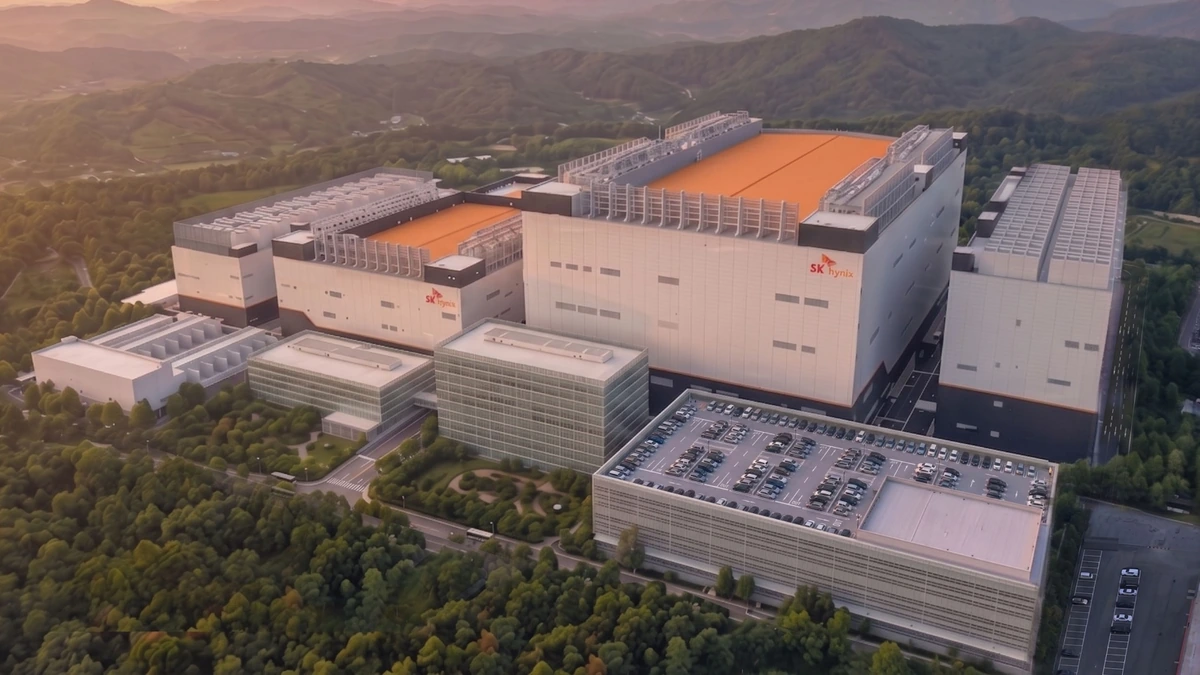
SK hynix approved a combined 54 trillion won (approximately $38 billion) investment in two new semiconductor fabs, a commitment sized to expand the company's output of high-bandwidth memory and enterprise NAND before the end of the decade.
Per SK hynix, the board-approved decision allocates 35.2 trillion won to a new DRAM facility at its Yongin Semiconductor Cluster (designated Y2) and 19.1 trillion won to a NAND fab at its Cheongju campus (designated M17). M17 is scheduled for its first cleanroom opening in December 2028 and Y2 in June 2029, with construction at each site set to begin early next year.
Y2 is the second of four fabs SK hynix plans to complete at the Yongin cluster, on a timeline the company pulled forward twelve years from the original 2045 target to a 2033 completion date. The decision commits capital to Y2 before Y1, the first Yongin fab, has even reached its initial cleanroom milestone (targeted for February 2027). That sequencing limits the feedback loop between production data and the next investment step, but SK hynix frames it as deliberate: securing supply capability ahead of demand peaks rather than in reaction to them.
The Cheongju M17 choice reflects a different set of constraints. SK hynix selected Cheongju because three existing fabs on that campus share substantial power and water infrastructure, compressing the construction timeline relative to a greenfield site. The NAND capacity addresses two demand pulls: conventional enterprise SSDs and, more specifically, key-value (KV) cache storage required for AI inference workloads. KV cache stores previously computed vectors during inference to reduce redundant calculations, and SK hynix identifies this as a growing category of NAND demand that will expand as AI services operate at scale.
Market research firm Omdia projects DRAM and NAND demand will each grow at a compound annual rate of 19% through 2030. SK hynix is treating that trajectory as a structural shift rather than a temporary supercycle, and the two-fab commitment represents the execution of a master plan calling for 600 trillion won across the full Yongin cluster and 100 trillion won at Cheongju. The 54 trillion won now approved advances both tracks simultaneously, with investment periods running through April 2031 at Cheongju and October 2031 at Yongin.