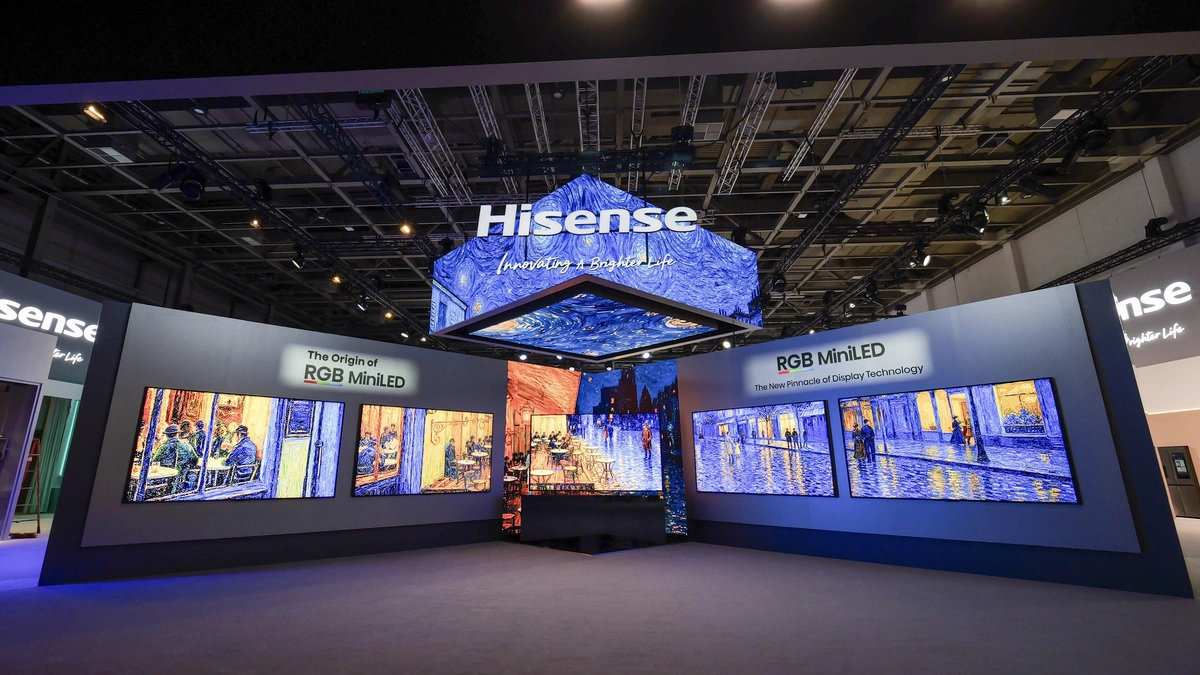
Hisense has put a four-color MiniLED backlight on a 116-inch television and brought that set to Europe. The 116UXS, making its European debut at IFA 2026 in Berlin, adds a dedicated cyan emitter to the usual red, green, and blue array. That is the change Hisense is selling, not another white MiniLED panel with a quantum-dot film.
Hisense says the stack, branded Chromagic 2.0, reaches 110 percent of the BT.2020 color space, a 10,000-nit peak brightness, and both Pantone Validated RGB MiniLED and Pantone Color certifications. The set also uses an Obsidian Panel and the company's Hi-View AI Engine RGB processor. Those figures are Hisense's own. The company did not publish independent lab measurements, a European price, or an on-sale date.
The more concrete product decision is where the eye-comfort paperwork lands. The 116UXS carries TÜV Rheinland Low Blue Light (Hardware Solution) certification, and Hisense says the whole 2026 RGB MiniLED range, including the UR9S and UR8S, now carries TÜV Rheinland Eye Comfort rather than keeping that mark on the flagship alone. "This certification from TÜV Rheinland objectively validates that Hisense RGB MiniLED TVs deliver a more comfortable viewing experience," said Sonny Ming, general manager of TV product marketing at Hisense Global Commercial Center.
Alongside the MiniLED flagship, Hisense described a separate LCD path it calls Field Sequential Display. Instead of a color filter, the panel presents red, green, and blue image components in sequence over time. Hisense says that approach can raise brightness, cut energy use, and reach refresh rates up to 360Hz compared with a conventional LCD. It is a show-floor architecture claim, not a named shipping SKU with a price.
The rest of the IFA floor is a surround package. The UX1 soundbar uses 11.2.6-channel sound, Dolby Atmos, DTS, and Hi-Concerto pairing with selected Hisense TVs, and it won an IFA Innovation Award. Hisense also brought the Laser Projector XR10, Laser Cinema PX4 Pro, Laser TV L9Q Pro, and 5.5-gram HiClips open-ear earbuds; several of those laser models carry the same TÜV Eye Comfort mark. What is still missing is the number European buyers will actually pay for the 116UXS, and when they can.