What is a stablecoin?
A stablecoin is a blockchain-based token that holds a steady value, usually one US dollar, because its issuer keeps reserve assets and promises to redeem each token at face value. Approved customers can swap tokens for dollars with the issuer, and that exit door is what keeps the market price near the dollar peg. This guide is education, not investment advice.
Volatile coins such as Bitcoin and Ether can move several percent in a day, which makes them awkward for pricing goods or settling trades. Stablecoins fill that gap as the price-stable money inside the broader ownership-based web where tokens like these circulate. Circle issues USDC, Tether issues USDT, and exchanges such as Binance and Coinbase list both as trading pairs. A fiat-backed stablecoin of this kind is the most common design, but not the only one.
- Stablecoin
- A token designed to track an outside value, most often the United States dollar.
- Peg
- The target price, such as $1, that the token is meant to hold.
- Issuer
- The company or protocol that creates and retires tokens, such as Circle for USDC or Tether for USDT.
- Reserve assets
- Assets, such as cash, bank deposits and short-term government debt, that the issuer holds against tokens in circulation.
- Redemption
- Returning tokens to the issuer in exchange for dollars.
- Attestation
- An accountant's report on stated facts, such as reserve balances, at a set date.
How stablecoins keep their peg
A stablecoin holds its dollar peg through a mint-and-redeem loop that rewards traders for closing price gaps. The loop runs in four steps.
- An approved customer sends dollars to the issuer, and the issuer mints the same number of tokens.
- The issuer places those dollars in reserve assets, such as cash, bank deposits and Treasury bills.
- A holder with direct issuer access returns tokens and receives dollars. The tokens are retired. This is redemption at par.
- Arbitrage does the rest. If the secondary market price falls below $1, a trader can buy cheap tokens and redeem at par for a profit, which removes supply. If it rises above $1, minting new tokens adds supply and pushes the price back.
The caveat is access. Only parties with a direct relationship with the issuer redeem at par, so everyone else buys and sells on venues such as Kraken, Uniswap and Curve Finance, where the quoted price is set by supply and demand. That gap is where de-peg risk lives.
What backs the loop is the issuer's own statement. Circle says USDC reserves are held in cash and cash equivalents, with the majority in the Circle Reserve Fund (USDXX), an SEC-registered Rule 2a-7 government money market fund, and the remainder in cash at banks, according to Circle's transparency page. Tether publishes its own backing description at its transparency page, covered in the comparison below.
Types of stablecoins
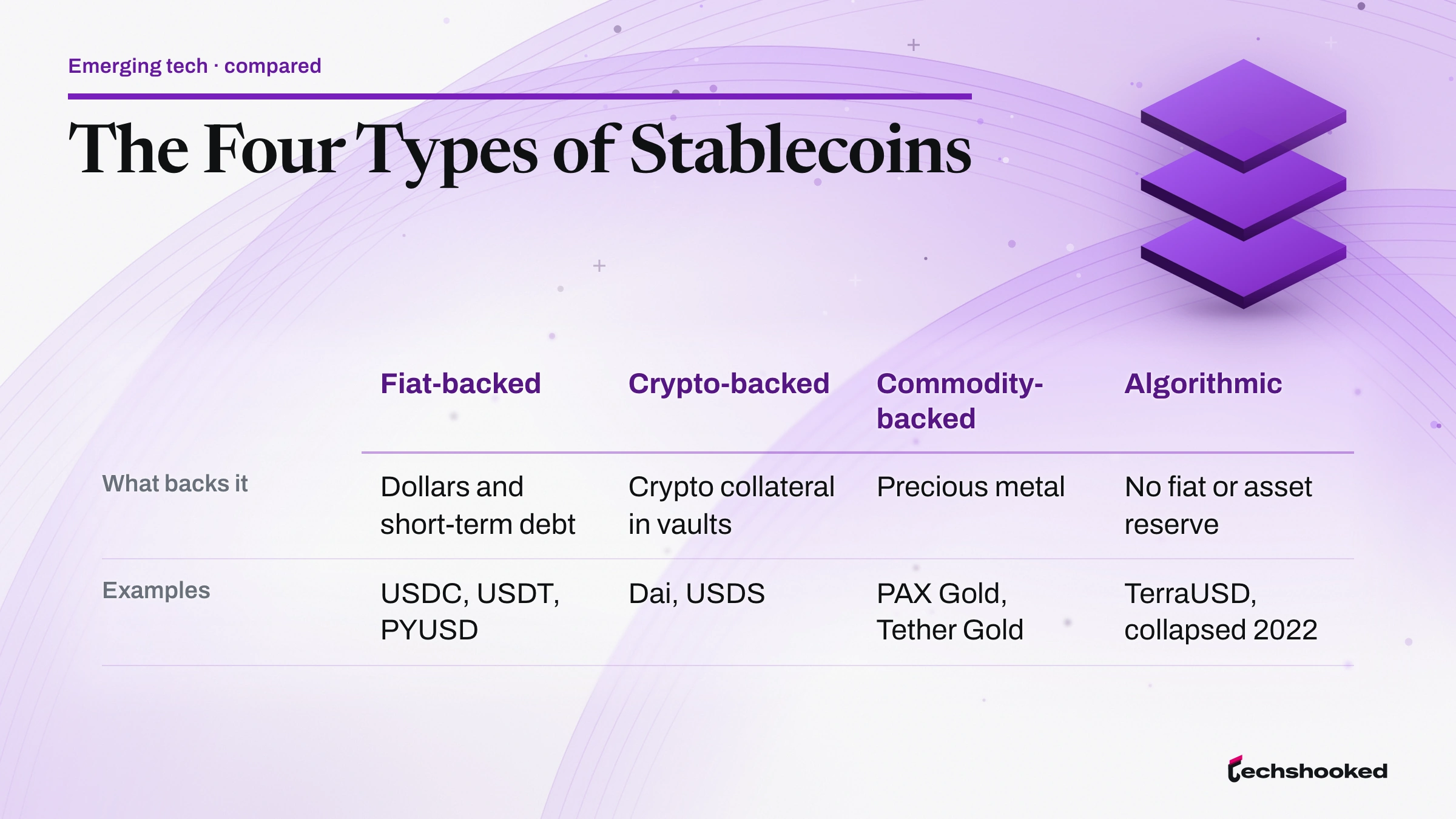
Stablecoins differ in what stands behind the peg. The structure at ethereum.org sorts them into fiat-backed, crypto-backed, precious-metal and algorithmic designs. A fiat-backed stablecoin is redeemable one-to-one with its issuer. A crypto-backed stablecoin replaces the issuer's bank account with collateral locked in smart contracts.
| Type | What backs it | Examples | Main weakness |
|---|---|---|---|
| Fiat-backed | Dollars and short-term debt held by an issuer | USDC, USDT, PYUSD | Depends on the issuer and on who can redeem |
| Crypto-backed | Crypto collateral locked in vaults | Dai, USDS (Sky, formerly MakerDAO) | A sharp collateral drop forces liquidations |
| Commodity-backed | Precious metal | PAX Gold, Tether Gold | Price follows the metal, not the dollar |
| Algorithmic | No fiat or asset reserve behind the peg | TerraUSD (collapsed in 2022) | Peg rests on market confidence alone |
Crypto-backed designs are enforced by smart contracts: collateral sits in vaults and is liquidated if it falls too far. Tokens like these follow standards such as ERC-20, written in Solidity for the Ethereum Virtual Machine, and how token contracts are written on Ethereum covers that layer.
The algorithmic stablecoin is the weakest category on the record. Terraform Labs' TerraUSD was one, and the Bank for International Settlements wrote in Chapter III of its Annual Economic Report 2022 that the implosion of TerraUSD and its twin coin Luna underscored the weakness of a system sustained by selling coins for speculation. No real-world collateral stood behind the peg, so once confidence went, the run could not be stopped.
USDC, USDT and other major stablecoins compared
Among stablecoins, USDT and USDC are the largest dollar tokens by market value, per the live table on ethereum.org; each issuer publishes its own circulation, and the figures change daily, so none are reproduced here. The table keeps each issuer's backing description in its own words.
| Coin | Issuer | Backing, per the issuer | Where to verify |
|---|---|---|---|
| USDC | Regulated affiliates of Circle | Circle says reserves are cash and cash equivalents, mostly in USDXX | circle.com/usdc, transparency |
| USDT | Tether | Tether says tokens are pegged 1-to-1 and backed 100% by Tether's Reserves | tether.to transparency |
| PYUSD | Paxos, for PayPal | Paxos says reserves are held 100% in US dollar deposits, US Treasuries and cash equivalents | paxos.com/pyusd |
| Dai, USDS | Sky protocol | Crypto collateral in smart-contract vaults | ethereum.org |
USDC is issued by Circle through regulated affiliates, per Circle's USDC page. Coinbase is a venue, not an issuer. Institutions often reach USDC through a regulated exchange, and the guide to custody and trading built for institutional investors covers Coinbase on that side of the line. Circle also says it discloses reserve holdings weekly and that a Big Four firm gives monthly assurance that reserves exceed USDC in circulation.
Two terms matter when reading such reports. An attestation checks specified facts at a date, while an audit is a full opinion on financial statements. A proof of reserves attestation therefore tells a reader less than an audit does, but more than a press statement. For a fiat-backed stablecoin, check the date on the latest report. A crypto-backed stablecoin such as Dai works differently: its vault positions sit in public smart contracts anyone can inspect, but part of its backing is USDC held in Sky's peg stability modules, per the Sky protocol documentation, so Circle's reports still matter.
What people use stablecoins for
Stablecoins serve a handful of jobs that need a dollar-priced token on a blockchain.
- Trading pair and settlement asset. Exchanges such as Binance, Kraken and Coinbase quote many coins against dollar tokens.
- Cross-border transfers. A sender can move dollars between wallets without routing through SWIFT correspondent banks.
- DeFi collateral and lending. Protocols such as Aave, Compound and Uniswap treat dollar tokens as the base unit, as laid out in the comparison of stablecoins as the base asset in DeFi lending and trading.
- Holding dollars in volatile-currency economies. Anyone with a wallet such as MetaMask can hold a dollar-priced balance.
How a stablecoin transfer settles compared with a bank wire
The mechanics differ from a bank transfer, and how blockchains record and settle transfers explains the ledger side. In outline:
- The sender signs a transaction from a wallet.
- Validators or miners include it in a block on Ethereum, Solana, Tron or another chain.
- The block reaches finality, meaning the network treats it as settled.
- The recipient's wallet shows the balance.
A cross-border wire over SWIFT can pass through correspondent banks, and bank payment systems such as Fedwire run on operating hours with cut-off times. That does not make stablecoins faster or cheaper in every case: fees and finality depend on the chain, and fees on a busy network can rise sharply.
Risks: de-pegs, reserves and issuers
Are stable coins still risky? Yes, though differently from volatile coins: a stablecoin's steady value is a promise that depends on the issuer, the reserves and the redemption terms. The Bank for International Settlements said in Chapter III of its Annual Economic Report 2026 that current stablecoin designs fall short on foundational properties of money, listing deviations from par value in secondary markets and limits to elasticity and interoperability.
- De-peg. De-peg risk is a gap between the secondary market price and the dollar peg, and it widens when holders doubt the reserves or cannot reach redemption.
- Reserve quality and liquidity. Reserve assets can lose value or be hard to sell quickly.
- Issuer and counterparty risk. Holders carry a claim on a private company, and a stale proof of reserves attestation says little about the issuer's current balance sheet.
- Redemption limits. Fees, minimums and account checks decide who can redeem.
- Freeze and sanctions risk. Issuers can freeze tokens, including to comply with sanctions.
- Design failure. An algorithmic stablecoin has no real-world collateral behind it, as the Terra case in the types section showed.
Deposit insurance is also absent: under Public Law 119-27, the GENIUS Act, a payment stablecoin is not backed by the full faith and credit of the United States and is not subject to FDIC deposit insurance. The Financial Stability Board set out its 2023 high-level recommendations for global stablecoin arrangements to address risks of this kind across borders.
Stablecoin regulation in the US and EU
Rules as of October 2026. Stablecoin regulation here covers two texts: the US GENIUS Act and the EU Markets in Crypto-Assets Regulation (MiCA). Every status below is as of October 2026, per the official page cited beside it.
The GENIUS Act is Public Law 119-27, signed July 18, 2025. Its term for the dollar-pegged tokens it regulates is payment stablecoin. Permitted issuers must hold identifiable reserves of at least 1 to 1, such as US currency, insured-bank deposits and Treasury bills with a remaining maturity of 93 days or less. They must publicly disclose a redemption policy with procedures for timely redemption and publish their monthly reserve composition on their websites. The Act bars issuers from paying holders interest or yield solely for holding, using or retaining the coin.
On timing, the Act takes effect on the earlier of 18 months after enactment (January 18, 2027) or 120 days after final implementing regulations, per Public Law 119-27. Three years after enactment (July 18, 2028), digital asset service providers may not offer or sell a payment stablecoin to a person in the US unless a permitted issuer issued it. On implementation, the OCC proposed a rule to carry out the GENIUS Act on February 25, 2026, per OCC news release 2026-9. On August 19, 2026, Comptroller Jonathan Gould said the OCC expects a final rule by November, per OCC news release 2026-69. As of October 2026 the rule was proposed, not final.
| Regime | Reserve and redemption | Interest | Status, as of October 2026 | Where to read |
|---|---|---|---|---|
| US GENIUS Act | Reserves at least 1 to 1; disclosed redemption policy; monthly reserve composition | No interest or yield solely for holding | Effective on the earlier of January 18, 2027 or 120 days after final rules; OCC rule proposed | Public Law 119-27 |
| EU MiCA | Claim on issuer; redemption at par, any time, free of fee | No interest granted | Titles III and IV applied from June 30, 2024; the rest from December 30, 2024 | Regulation (EU) 2023/1114 |
The EU rules sit in Regulation (EU) 2023/1114, known as MiCA. Titles III and IV, covering asset-referenced tokens and e-money tokens, apply from June 30, 2024, and the rest from December 30, 2024 (Article 149). Under Article 48, an e-money token may be offered to the public in the Union by its issuer only if the issuer is authorized as a credit institution or an electronic money institution and has published a crypto-asset white paper; other firms, such as exchanges, may offer it with the issuer's written consent. Article 49 gives holders a claim on the issuer and the right to request redemption at par at any time, free of fee, while Article 50 prohibits interest.
ESMA keeps an interim register of authorized issuers and service providers under the Markets in Crypto-Assets framework on its MiCA page, and the EBA explains the token rules on its asset-referenced and e-money tokens page. Check the register for any specific coin rather than relying on a list in an article.
How to get and hold a stablecoin
Getting a stablecoin takes six decisions, in this order.
- Choose the issuer and read its redemption terms.
- Pick a regulated venue available in your country, such as Coinbase, Kraken or Binance, or an issuer service such as Circle Mint where you qualify.
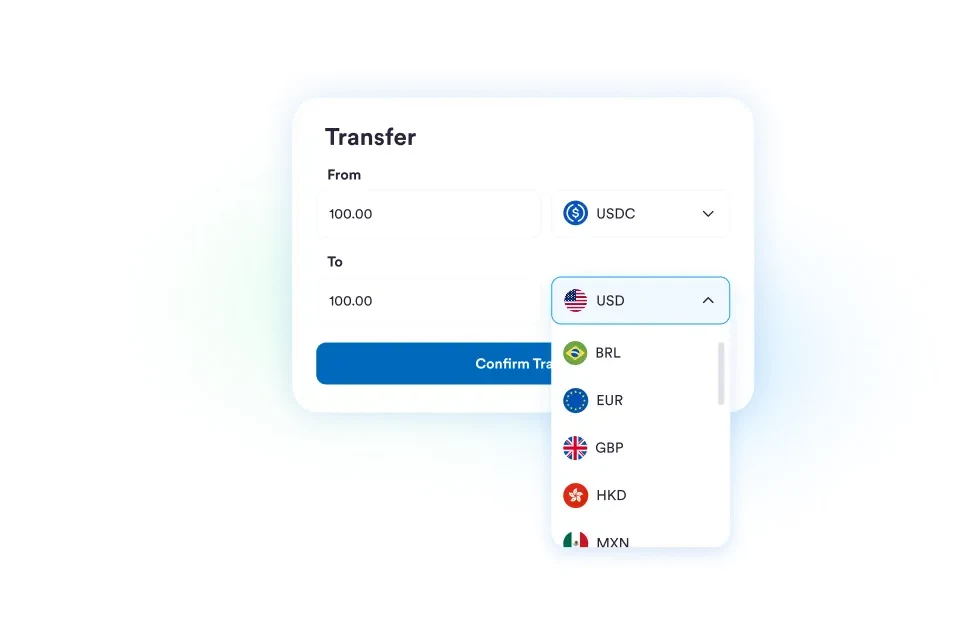
- Buy or convert, for example from a bank balance or PayPal.
- Select the right network. A token sent on the wrong chain, such as Ethereum, Solana, Tron or Base, can be lost.
- For self-custody, move the balance to a wallet you control, such as MetaMask, Ledger or Trezor; choosing a wallet to hold stablecoins compares the options.
- Send a small test transfer before any large one.
There is no single best stablecoin. The right one depends on the issuer, its reserve disclosure, its legal status where you live and where you need to use it, and this guide ranks none. Holders also do not earn interest from the issuer under MiCA Article 50, and the GENIUS Act bars it once the Act takes effect, so any yield comes from lending or DeFi platforms and carries its own risk, as the questions below explain.
Frequently Asked Questions
Are stable coins still risky?
Yes, but the risk differs from a volatile coin: a stablecoin's steady value is a promise that depends on its issuer, its reserves and its redemption terms. The Bank for International Settlements lists deviations from par value in secondary markets among the shortcomings of current designs. A fiat-backed coin with disclosed, liquid reserves is a different bet from an algorithmic coin with no reserve, and under US law a payment stablecoin is not covered by FDIC deposit insurance.
How do stablecoins make you money?
Holding a stablecoin does not pay you interest from the issuer. The US GENIUS Act bars permitted issuers from paying holders interest or yield solely for holding the coin, and EU MiCA Article 50 bars interest on e-money tokens. Any yield you see usually comes from a lending service or a DeFi protocol that uses your coins, and that adds platform and smart-contract risk. Issuers earn on the reserves behind the coins.
What's the best stablecoin to buy?
No single stablecoin is best for everyone, and this guide does not recommend one. Compare issuer, reserve disclosure, redemption terms, regulatory status where you live and which networks and platforms you need. Read the issuer's own transparency page, such as Circle's for USDC or Tether's for USDT, and check the date on the latest report before you decide.
Can you redeem USDC or USDT for dollars directly?
Usually only customers who have an account and pass checks with the issuer can redeem directly at par, so most holders sell on an exchange instead. That is why the price on the market can drift slightly from $1 even when the reserves are sound. Read the redemption terms, fees and minimums on the issuer's own site before relying on direct redemption.
Is a stablecoin the same as a bank deposit or a CBDC?
No. A bank deposit is a claim on a bank and may carry deposit insurance, while a payment stablecoin under the GENIUS Act is not backed by the full faith and credit of the United States and is not federally insured. A central bank digital currency (CBDC) would be issued by a central bank, whereas USDC and USDT are issued by private companies.