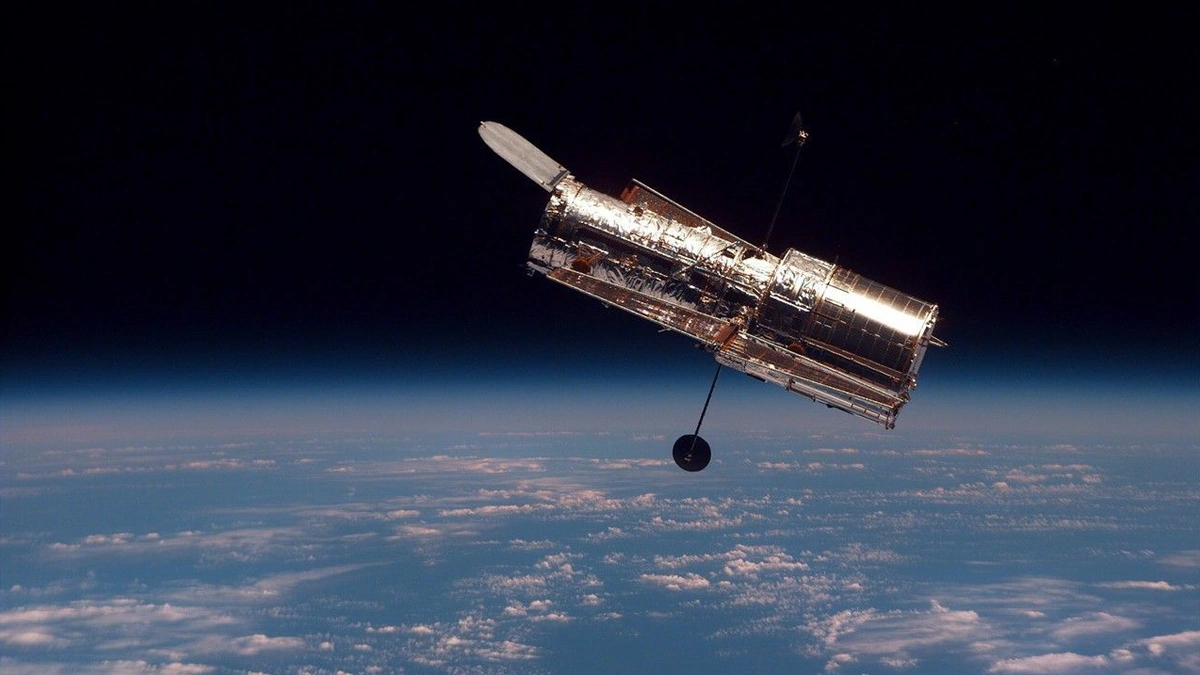
The Hubble Space Telescope has no propulsion system to maintain its own orbit, and NASA now wants to hear what companies could do about that. The agency is asking industry how it would lift the telescope to a higher altitude, upgrade it, or bring it down safely when its mission ends.
NASA issued the Request for Information on Oct. 29. It names three possible jobs: a mission to boost Hubble and extend its science lifetime, a servicing mission to add capabilities, or a controlled re-entry or orbital disposal at the end of the mission. Nicky Fox, associate administrator of NASA's Science Mission Directorate, said commercial industry has developed new capabilities for in-space satellite capture and servicing in recent years, and that NASA wants to explore ways to boost Hubble to a higher orbit while it develops the flagship mission to follow.
Fox tied the timing to Hubble's expected re-entry. According to NASA, the telescope, like every spacecraft in low Earth orbit, is slowly losing altitude to atmospheric drag, and the agency's analysis predicts it is likely to re-enter the atmosphere in the 2033 to 2034 timeframe. NASA anticipates that a mission would need to take place by 2032.
Hubble launched on April 24, 1990, and astronauts last worked on it in May 2009, during the fifth servicing visit. On that visit they installed the Cosmic Origins Spectrograph and Wide Field Camera 3, and made the first on-orbit repairs of two failed instruments, the Space Telescope Imaging Spectrograph and the Advanced Camera for Surveys.
A separate NASA catalog lists in-space servicing hardware that already exists. The 2026 ISAM State of Play, compiled by a team at NASA's Langley Research Center with input from other NASA centers, runs 368 pages across 11 functional areas of in-space servicing, assembly and manufacturing. To be listed, hardware must physically exist as a ground prototype or an in-flight demonstration; a concept presentation does not qualify. Its cover shows astronaut F. Story Musgrave on the shuttle's robotic arm during Hubble's first servicing mission in 1993.
NASA Administrator Jared Isaacman said Hubble "still has important science ahead of it" and that NASA "should be looking at every reasonable opportunity to keep it delivering for as long as possible." Companies have until 3 p.m. EST on Monday, Nov. 30 to respond.