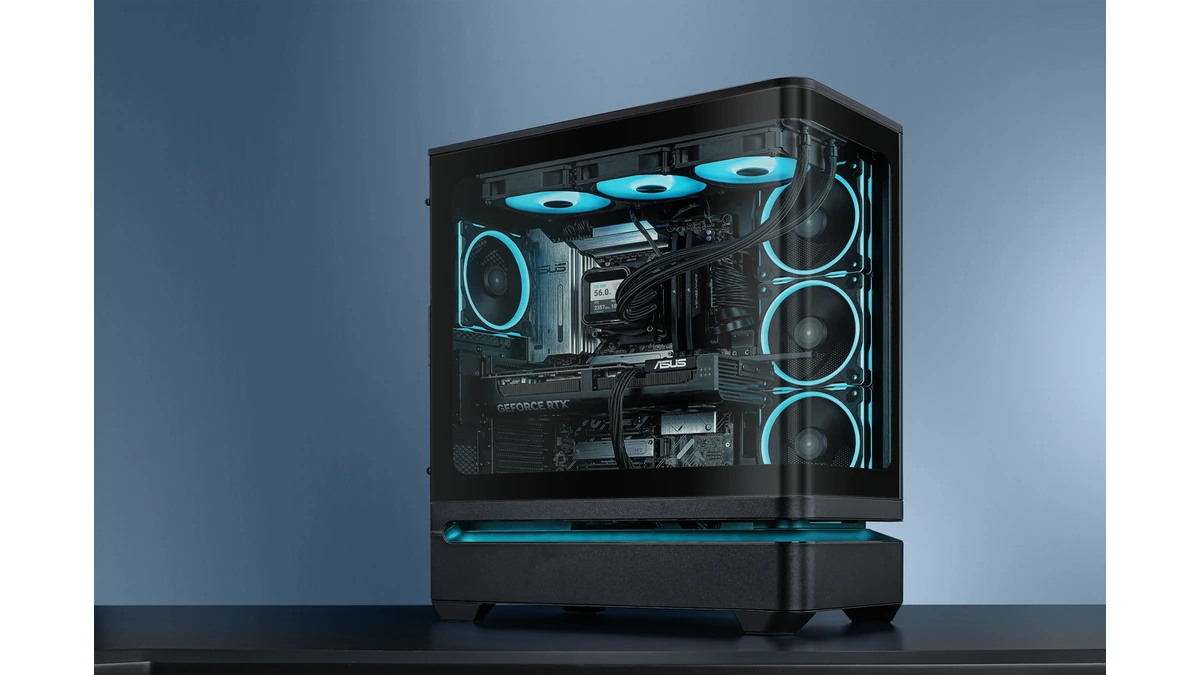
ASUS Prime AP304 wraps a curved tempered-glass panel from the front to the side of the chassis for a panoramic view of the build inside.
ASUS says the case supports graphics cards up to 420mm long and radiators up to 360mm long. A reinforced bracket rated for cards between 300mm and 360mm long mounts with screws to reduce sagging and movement, and a separate patented slot clamp is built for tool-free installation. A patented slot vent uses a three-sided ventilation structure at the bottom of the case to cool the graphics card.
ASUS Prime AP304's curved-glass panel goes through a five-stage manufacturing process, including a tempering step, that approaches aerospace-industry standards for strength and durability, ASUS says. An easy-detach rail lets the glass come off and reattach without tools. An integrated ARGB light band syncs with Aura Sync, and the Prime AP304 ARGB variant adds four pre-installed ARGB fans for additional cooling.
The ASUS Prime AP304's top I/O panel carries a USB Type-C port rated for transfer speeds up to 20Gbps, and a 33mm cable-management channel runs behind the motherboard tray to keep wiring out of sight. The case ships in black or white, each paired with matching internal I/O cable colors.
The panoramic-glass design puts the ASUS Prime AP304 alongside a run of recent ATX cases built to put components on display rather than hide them behind opaque panels, a shift that tracks with how much builders now spend on visible graphics cards, coolers, and RGB lighting. At 420mm, the case's graphics card allowance covers the length of most current flagship cards.