Cloud security is a discipline of technical controls and shared-responsibility policies that govern how organizations protect data, workloads, and infrastructure operating in public-cloud, on-premises, and hybrid environments.
The architecture comparison between cloud and on-prem deployments is rarely a feature checklist. It is a question of which controls physically move from the operator to the provider, which controls stay with the operator regardless of where the workload runs, and which dimensions a regulated organization cannot delegate at all. The shared responsibility model is the lens that makes this boundary legible, and the operator-retained set inside that model is identical across IaaS, PaaS, and SaaS even when the provider absorbs everything below it.
How the Shared Responsibility Model Redraws the Security Boundary
Cloud security under the shared responsibility model splits accountability between the provider, who owns the infrastructure substrate, and the operator, who owns the configuration above it. On-premises security has no such split: the operator owns every layer from physical access controls and network segmentation through identity and access management (IAM) policy authoring and application-layer authentication. In cloud, the provider absorbs hypervisor isolation, hardware maintenance, regional facility security, and managed-service patching, while the operator retains accountability for IAM configuration, data classification, runtime configuration, application authentication, and key custody for sovereign workloads.
The three deployment service models change where the boundary sits, but they do not change the control families that the operator never delegates. The definitions below set the vocabulary used through the rest of this comparison.
- Infrastructure as a Service (IaaS)
- The provider operates physical data centers, networking underlay, and the hypervisor. The operator owns the guest operating system, middleware, application code, data classification, IAM configuration, and runtime patch management for the OS and above.
- Platform as a Service (PaaS)
- The provider additionally operates the operating system and middleware runtime. The operator owns the application code, data classification, IAM, and application-layer authentication. Patch management for the platform layer transfers to the provider.
- Software as a Service (SaaS)
- The provider operates the full stack including the application. The operator still owns IAM policy authoring, data classification, configuration of tenant-side controls, and key management decisions for any customer-managed key option the SaaS exposes.
- Shared responsibility model
- The contractual and architectural framework that allocates each control domain to either the provider or the operator across IaaS, PaaS, and SaaS. Defined by each major cloud vendor against the same NIST SP 800-53 control families that govern on-premises systems.
The control cataloge underneath the shared responsibility model is NIST SP 800-53 Rev 5, which applies deployment-agnostically: control families AC (Access Control), IA (Identification and Authentication), SC (System and Communications Protection), and SI (System and Information Integrity) impose the same policy obligations on cloud and on-prem implementations. The mechanism choices underneath those policies, including the cipher decision covered in the difference between encryption and tokenization, are where the deployment models diverge in implementation detail.
What Cloud Transfers to the Provider and What Stays With You
Cloud security shifts physical, hypervisor, and managed-service layers to the provider, but ten control domains continue to move with the operator across every service tier. Encryption at rest using customer-managed keys is the mechanism that lets operators retain cryptographic sovereignty over data stored in cloud services: the provider hosts the key management service (AWS KMS, Azure Key Vault, Google Cloud KMS), but the operator authorizes key creation, rotation policy, and access grants, and the provider cannot read the data without an operator-issued grant.
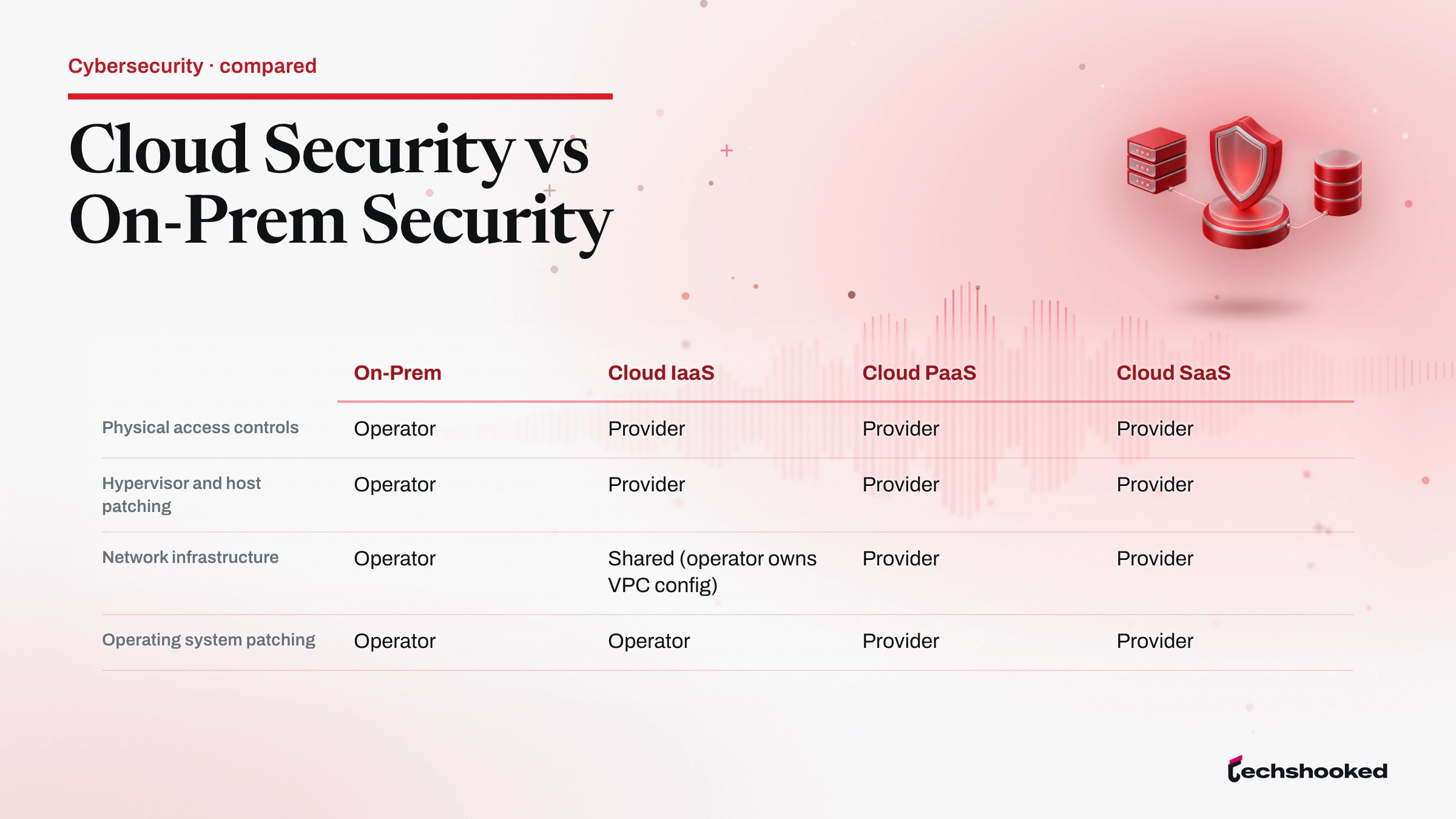
The table below maps each control domain to the responsible party across on-prem and the three cloud service tiers. IAM, data inventory tagging, application-layer authentication, and security monitoring configuration sit on the operator side in every column.
| Control Domain | On-Prem | Cloud IaaS | Cloud PaaS | Cloud SaaS |
|---|---|---|---|---|
| Physical access controls | Operator | Provider | Provider | Provider |
| Hypervisor and host patching | Operator | Provider | Provider | Provider |
| Network infrastructure | Operator | Shared (operator owns VPC config) | Provider | Provider |
| Operating system patching | Operator | Operator | Provider | Provider |
| Identity and access management | Operator | Operator | Operator | Operator |
| Classification labeling | Operator | Operator | Operator | Operator |
| Encryption at rest | Operator | Operator (CMK or provider key) | Operator (CMK option) | Provider default; CMK where exposed |
| Key management | Operator | Operator via KMS | Operator via KMS | Provider; limited CMK options |
| Application-layer authentication | Operator | Operator | Operator | Operator |
| Security monitoring configuration | Operator | Operator | Operator | Operator (via API) |
The provider-side commitments are documented at the source. The AWS Documentation defines the responsibility split as security of the cloud (provider) versus security in the cloud (operator), and the Microsoft Azure Documentation publishes a parallel matrix that allocates each layer across IaaS, PaaS, and SaaS with greater granularity for the platform tier. The transport-encryption layer that operators configure regardless of deployment is covered in the role of TLS/SSL in data protection, and the SaaS-tier operator responsibilities for IAM and configuration drift in vendor consoles are covered in how to secure SaaS applications at scale.
Where Cloud Security Has the Structural Advantage
Cloud security delivers structural advantages over on-premises security on five axes that are difficult or impossible to replicate at on-prem scale without a budget and headcount that few organizations carry. Each item below describes a dimension where the provider absorbs operational work that an on-prem team would otherwise own end-to-end.
- Continuous patch management at the infrastructure layer. Cloud providers patch physical hosts, hypervisors, and managed-service firmware on a continuous release cadence with rollback capability. On-prem patch management for the same layers routinely lags vendor release by weeks because of internal change-management cycles, maintenance windows, and the absence of automated rollback for firmware updates.
- Attack surface visibility at scale. Cloud-native tooling, including CSPM platforms, provider security advisories, and cloud-native SIEM integrations, gives operators programmatic visibility into configuration drift across thousands of resources. On-prem attack surface monitoring requires equivalent tooling investment without the managed-service baseline that cloud providers ship by default.
- Multi-region failover and availability. Cloud providers offer cross-region redundancy with automated failover that is economically unfeasible for most on-prem deployments below large-enterprise scale. The same failover capability supports a recovery posture that satisfies CISA CPG availability targets without dedicated DR infrastructure.
- Elastic capacity without physical security tradeoffs. On-prem capacity expansion requires physical equipment installation with associated supply-chain and physical-access security considerations. Cloud scaling is API-driven, and the provider's physical security posture remains unchanged regardless of how many instances the operator launches.
- Managed security services as default primitives. Cloud providers ship native WAF, DDoS protection, secrets management, and certificate management as managed services. On-prem operators typically deploy and maintain commercial equivalents independently, and the resulting security posture is harder to keep consistent across environments.
The CSPM tooling layer that operationalizes cloud-side configuration monitoring is covered in the best CSPM tools for AWS. CISA Cross-Sector Cybersecurity Performance Goals publish the baseline thresholds for patching cadence (CPG 1.E), IAM (CPG 2.A), and vulnerability management (CPG 7.A) that cloud-native managed services help operators meet without bespoke tooling. The Google Cloud Documentation extends the standard responsibility framing with a shared fate model, in which the provider publishes opinionated landing-zone blueprints that help operators implement their retained controls correctly from day one.
Where On-Prem Security Has the Structural Advantage
Cloud security's shared responsibility model has no equivalent in on-premises security deployments, where operators retain full-stack control and gain structural advantages in five areas that no public-cloud IaaS offering matches. These advantages are concentrated in workloads with classification, isolation, or hardware-trust requirements that the cloud management plane cannot satisfy at the infrastructure layer.
- True network isolation. Air-gapped or private-network deployments are physically impossible in cloud, where the provider maintains a management-plane connection to every resource. On-prem network segmentation can deliver true isolation for classified or highly sensitive workloads, with VLAN and firewall topology that the operator controls end-to-end.
- Deterministic data residency. On-prem guarantees the physical storage location of every byte. Cloud data residency depends on region selection and cross-region replication settings, both of which require active configuration and ongoing verification against drift.
- No shared-tenancy risk at the hypervisor layer. Speculative-execution vulnerabilities such as Specter and Meltdown affect shared cloud hosts. On-prem dedicated hardware eliminates the cross-tenant attack vector at the infrastructure layer, which is a non-negotiable requirement for some classified workloads.
- Direct hardware-trust control. Cryptographic hardware including HSMs and TPM chips can be physically provisioned, sealed, and audited by the operator. Cloud HSM offerings such as AWS CloudHSM and Azure Dedicated HSM give the operator dedicated hardware, but the device physically resides in the provider's facility and is administered through the provider control plane.
- Long-term cost structure for stable workloads. For workloads with predictable resource requirements and long hardware amortization cycles, on-prem total cost of ownership at the infrastructure layer can undercut equivalent cloud spend. The calculation excludes operational labor for patching, physical security, and redundancy, which usually moves the comparison back toward cloud for any workload with variable scale.
The access-control pattern that mitigates lateral-movement risk in either deployment model is covered in how to implement zero trust network architecture, and zero-trust principles apply identically to cloud and on-prem segmentation boundaries.
Sovereignty, Data Residency, and the Regulated-Industry Hybrid Stance
Public-cloud-side security posture posture strategy in regulated industries hinges on a distinction that often gets collapsed in vendor marketing: data residency and data sovereignty are different problems with different controls. Regional data placement is the physical location of stored data, addressable through cloud region selection, storage replication policy, and provider transparency reports. Data sovereignty is the legal question of which government has jurisdiction over the data and can compel disclosure regardless of physical location, addressable through legal entity structure, contractual data-processing agreements, and in some cases technical controls such as customer-managed encryption keys held outside the provider's jurisdiction.
Four regulated-industry scenarios continue to retain a hybrid deployment stance rather than committing to a full cloud migration:
- Financial services under EU DORA and national banking supervision. Some central bank frameworks require systemically important data to be stored within national borders on infrastructure the institution directly controls. Sovereign cloud offerings (AWS European Sovereign Cloud, Microsoft Sovereign) are emerging, but they are not universally accepted as equivalent to on-prem for every regulatory purpose.
- Healthcare under HIPAA and EU health-data regulations. PHI must be processed under BAA-covered infrastructure, which most major cloud providers offer for in-scope services. Many healthcare systems still retain on-prem footprints for legacy clinical systems where the migration risk exceeds the security benefit, with newer workloads on cloud and a hybrid deployment bridging the two.
- Government classified workloads. Classified networks (US SIPR, EU classified systems) require certified on-prem or government-dedicated cloud environments such as AWS GovCloud at IL5 and IL6 classifications. No commercial public-cloud IaaS is approved for the highest classification levels, and the on-prem retention is mandated rather than chosen.
- Cross-border data transfer constraints under GDPR Chapter V. Restrictions on personal-data transfers to third countries without adequacy decisions create a residency constraint that cloud region selection partially addresses but may not fully satisfy when the provider's parent company is in a non-adequate jurisdiction. The post-Privacy Shield environment leaves US-headquartered providers exposed to onward-transfer challenges that EU-headquartered providers do not face.
The compliance framework layer that supports sovereignty and residency assessment at the program level is the NIST Cybersecurity Framework 2.0, whose GOVERN function covers organizational context, risk strategy, and supply-chain risk management. The cross-framework control deduplication methodology that regulated organizations use to satisfy multiple residency-and-compliance frameworks simultaneously is covered in best practices for securing regulated data.
Choosing Between Cloud, On-Prem, and Hybrid
Cloud-native security strategy converges on three deployment patterns: lean cloud, lean on-prem, and a hybrid deployment that splits workloads by sensitivity and operational profile. The decision factors below map organizational characteristics against the recommended deployment, and most enterprises arrive at a hybrid stance because few real-world portfolios sit cleanly on either extreme.
| Decision Factor | Lean Cloud | Lean On-Prem | Hybrid Approach |
|---|---|---|---|
| Workload type | Stateless, API-driven, variable-scale | Legacy monolith, classified, air-gap required | Cloud-native new builds, on-prem retained legacy |
| Data sovereignty requirement | None or addressable via region | Strict national or classified mandate | Sensitive data on-prem, public data in cloud |
| Patching operational capacity | Provider manages infrastructure layer | In-house patching team for all layers | Bifurcated patching by layer and environment |
| Compliance framework | FedRAMP-authorized services; NIST SP 800-53 via cloud-native controls | Full operator control of implementation | Unified control set across both environments |
| Security monitoring investment | Cloud-native SIEM and CSPM available | Full tooling investment required | Federated monitoring across both planes |
| IAM architecture | Provider-hosted (AWS IAM, Microsoft Entra ID) | On-prem directory (AD, LDAP) | Federated identity across both |
The application-layer security verification standard that applies identically across all three deployment patterns is the OWASP Application Security Verification Standard; ASVS requirements for authentication (V2), session management (V3), and access control (V4) are operator obligations regardless of where the workload runs. NIST SP 800-53 Rev 5 control families apply identically too: the control objective is deployment-agnostic, and only the implementation mechanism changes between cloud and on-prem. The CSPM tooling layer for the cloud monitoring row is covered in the best CSPM tools for AWS, and the unified control set approach that supports the hybrid compliance framework row is covered in best practices for securing regulated data.
Further reading
- Difference Between Encryption and Tokenization (mechanism-selection decision under both deployment models; hub article for the data-protection cluster)
- Best CSPM Tools for AWS (cloud-native tooling layer for security stance monitoring)
- Best Practices for Securing Regulated Data (cross-framework control deduplication for hybrid environments)
- Secure SaaS Applications at Scale (SSPM coverage for the SaaS-tier operator responsibilities in the comparison table)
- Implement Zero Trust Network Architecture (access-control pattern across both cloud and on-prem deployments)
Frequently Asked Questions
Does moving to cloud automatically improve security compared to on-prem?
Cloud migration does not automatically improve security. The shared-responsibility split means the cloud provider secures the infrastructure layer, but operators remain accountable for IAM configuration, sensitivity tagging, application-layer authentication, and encryption key custody. Misconfigured IAM policies, overly permissive security groups, and publicly exposed storage buckets are among the most common cloud breach vectors, and all of those are operator-configuration failures rather than provider failures. Cloud can improve security posture for organizations that lack the operational capacity to maintain on-prem patch lifecycle, physical access controls, and redundancy, but only when operators invest equivalent effort in the controls they retain.
Can cloud services satisfy residency requirement and sovereignty requirements for regulated industries?
Cloud services can satisfy jurisdictional data placement requirements for most commercial regulations through region selection and storage service configuration. Data sovereignty requirements depend on the specific legal framework. Some central bank rules, classified government workloads, and national security frameworks mandate on-premises or dedicated sovereign cloud infrastructure that no commercial public-cloud IaaS fully satisfies at the highest classification levels. Regulated organizations should assess residency (where data is physically stored) and sovereignty (which government can compel access) as separate dimensions before selecting a deployment model.
What controls never transfer to the cloud provider regardless of the service model?
Identity and access management policy authoring, data labeling, application-layer authentication design, and key management decisions for sovereign workloads remain operator responsibilities in every cloud service model including SaaS. The provider may host the IAM system (AWS IAM, Microsoft Entra ID) or the cryptographic key handling service (AWS KMS, Azure Key Vault), but the operator decides who gets access, what data is sensitive, how authentication is enforced in the application layer, and whether to use provider-managed or customer-managed encryption keys. These four control domains are structurally non-transferable under the responsibility model.