AI procedural generation is a game-development technique that uses machine-learning models to automatically synthesize terrain, levels, characters, narrative, and textures at production scale, replacing hand-authored content pipelines with trainable generative systems.
The nine tools weighed below cover the five content domains that any studio evaluating AI-ProcGen has to map against an existing Unity or Unreal pipeline: terrain (Houdini PDG, World Creator, Gaea), level design (Promethean AI, Scenario.gg), character animation (Cascadeur, Move AI), narrative and NPC dialoge (InWorld AI), and texture material synthesis (Substance 3D Sampler). The lens here is practitioner-grade integration, not vendor marketing: where each machine learning model plugs into Unity integration paths or Unreal Engine plugin slots, what each tool's commercial licensing actually permits for shipped titles, and which IP ownership questions still sit unanswered for any team intending to ship AI-generated assets in a commercial release.
AI vs Traditional Procedural Generation: The Distinction That Matters
AI procedural generation differs from classical procedural content generation (PCG) in one operative respect: the generator is a trained machine learning model rather than a deterministic rule-set. Classical PCG covers Wave Function Collapse (WFC), Perlin noise terrain, L-systems for vegetation, and binary space partitioning for dungeon layouts. Each runs a fixed algorithm. An AI-ProcGen system, by contrast, learns a distribution from training data (height maps, hand-built levels, motion-capture clips, painted textures) and samples novel output from that distribution at inference time.
The distinction matters before any tool selection because it changes the cost profile and the legal surface. Classical procedural content generation requires no training data and produces output whose copyright status is well understood. A machine learning model carries a training-data provenance question, a compute budget for inference at production-scale output, and a commercial licensing review that a WFC implementation does not. The IEEE Transactions on Games Foundational work surveyed in the ACM Digital Library cataloges the algorithmic lineage of generative pipelines. body of PCG research catalogs both branches; the rest of this article concerns only the ML-driven branch.
- AI procedural generation (AI-ProcGen)
- Content synthesis driven by a trained ML model that samples from a learned distribution over terrain, levels, characters, narrative, or textures.
- Procedural content generation (PCG)
- Umbrella term for any algorithmic content synthesis; includes both classical rule-based methods and AI-ProcGen.
- Wave Function Collapse (WFC)
- A constraint-propagation algorithm that tiles output from a small example input; classical, deterministic, no training phase.
- Machine learning model
- A parameterised function (diffusion, transformer, GAN, physics-ML hybrid) trained on prior content and queried at runtime or design time to produce new content.
Terrain Generation: Houdini PDG, World Creator, and Gaea
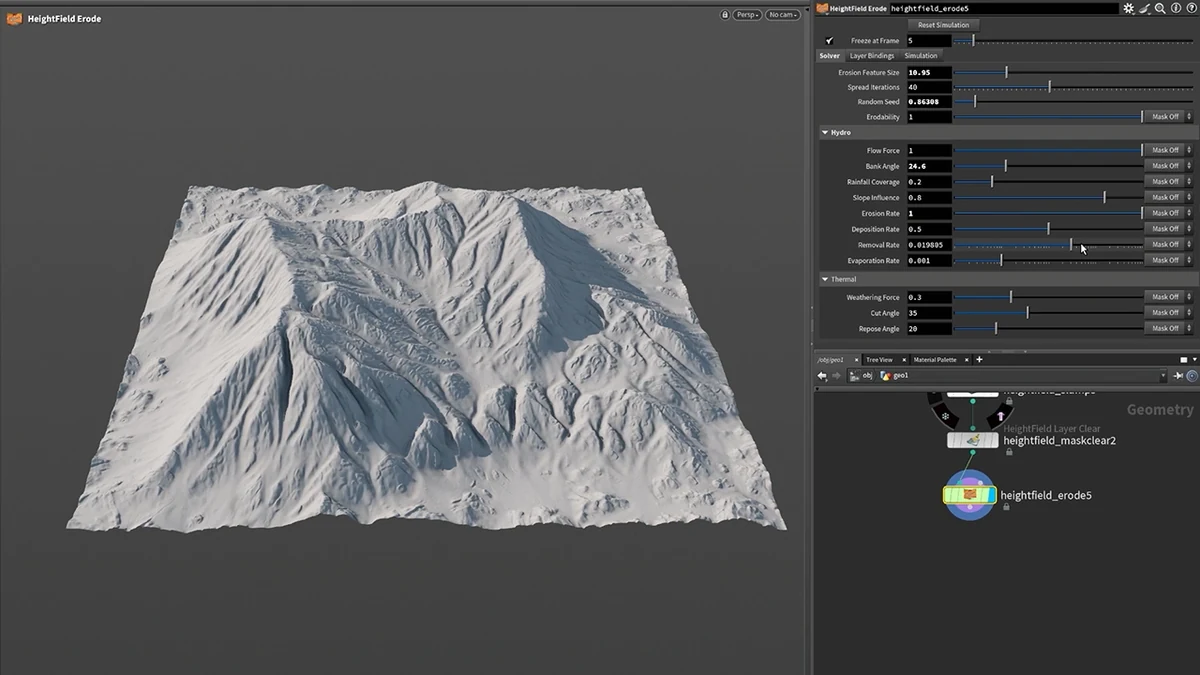
AI procedural generation in the terrain domain ships through three production tools that differ on pipeline depth, hardware profile, and licensing tier. Houdini PDG (Procedural Dependency Graph) from SideFX is a node-based system whose ML augmentation comes through SideFX Labs erosion and biome nodes; it is the AAA-pipeline default and assumes a dedicated tech-art team. World Creator from BiteTheBytes targets solo and small-studio developers with GPU-accelerated terrain generation and real-time feedback, including ML-assisted erosion and biome simulation. Gaea from QuadSpinner sits between the two, used for film-grade hero terrain and AAA cinematic asset work, with ML-powered erosion nodes that handle multi-million-sample height fields without baking out to disk.
Engine selection drives the Unity integration and Unreal Engine plugin path for each. The Unity vs Unreal Engine for VR Games comparison covers the broader engine tradeoffs that determine which terrain pipeline a studio inherits.
Pipeline Integration at a Glance
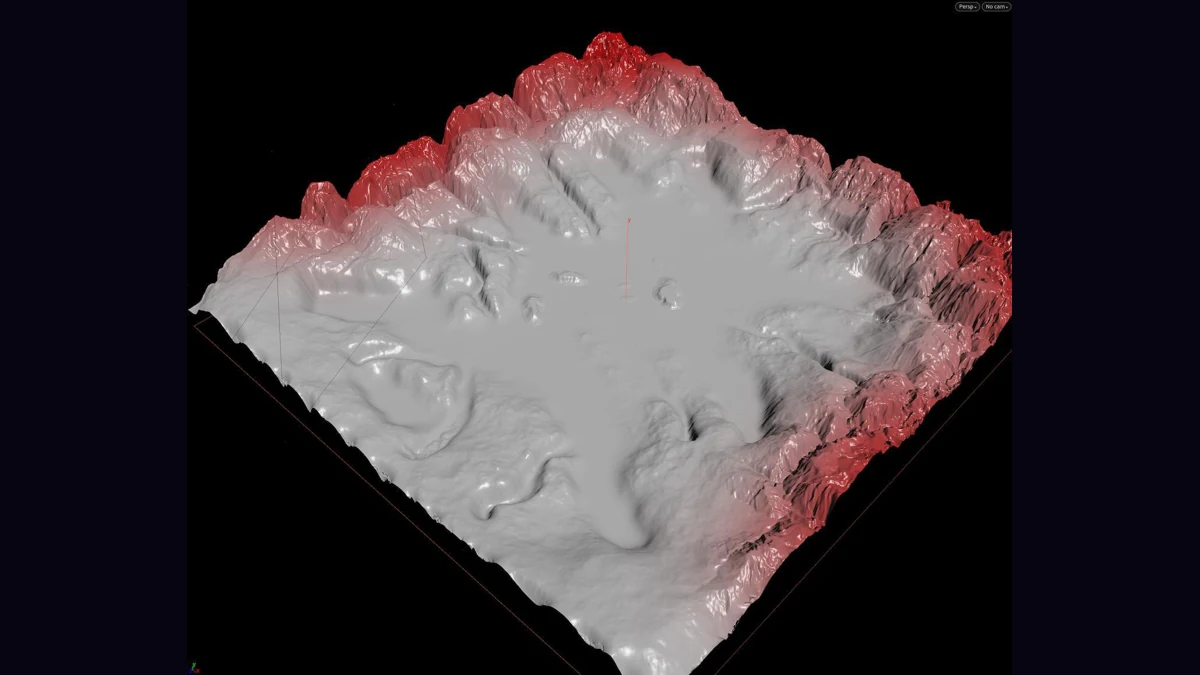
- Houdini PDG. Connects to Unreal via the Houdini Engine for Unreal plugin and to Unity via Houdini Engine for Unity. Both preserve the procedural graph for non-destructive iteration inside the editor. Studios typically bake to a static landscape asset for shipped builds.
- World Creator. Exports 16-bit raw or PNG height maps and splat maps to Unity TerrainData and to Unreal Landscape. Real-time GPU feedback inside the World Creator editor; no live engine link.
- Gaea. Exports tiled height maps, masks, and PBR splat data to either engine. QuadSpinner publishes templates for Unreal Landscape and Unity Terrain that align Gaea's tile coordinates with the engine importer.
Commercial licensing varies sharply across the three. Houdini ships in Indie, Core, and Commercial tiers; the Indie tier caps annual gross revenue and restricts feature set, while Commercial removes both caps. World Creator sells per-user commercial licenses in revenue-based tiers (Indie, Professional, Studio, Enterprise), each as a yearly, perpetual, or lifetime purchase. Gaea offers a free Community tier for non-commercial use and paid Indie and Professional tiers for any commercial title. Studios shipping a paid game need at minimum the Indie equivalent on whichever terrain tool they pick.
Level Design: Promethean AI and Scenario.gg
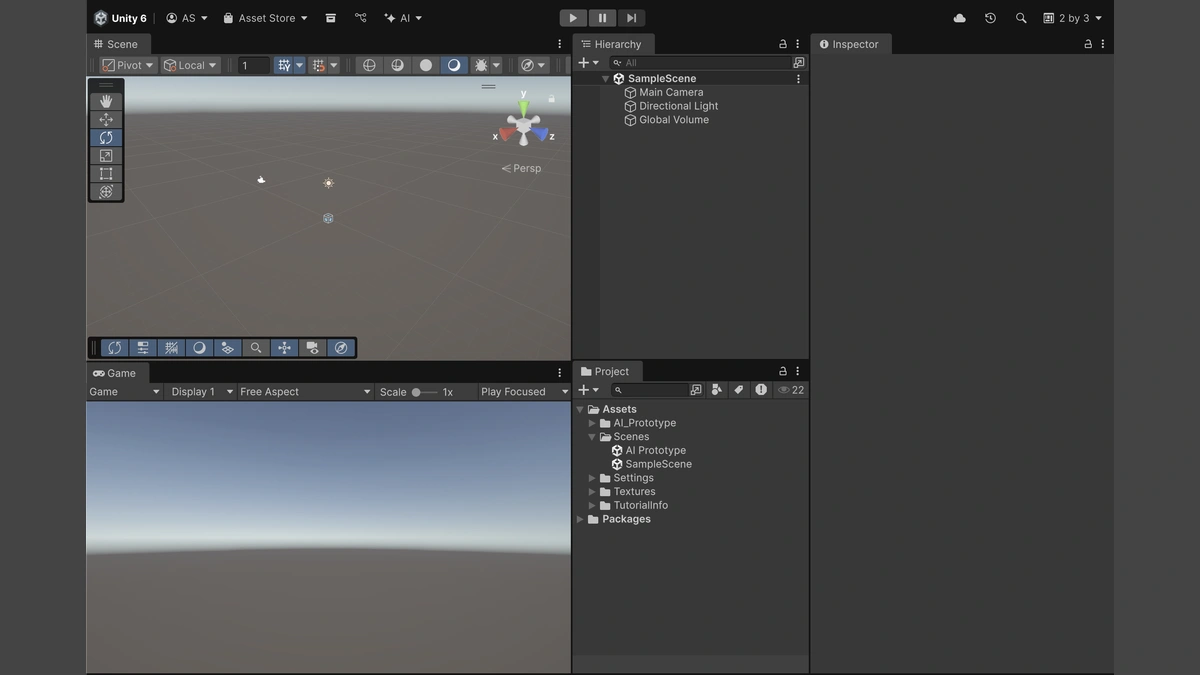
AI procedural generation in the level-design space splits into two structurally different categories, and confusing them leads to bad procurement decisions. Promethean AI is a conversational level design automation assistant that runs inside the Unreal or Unity editor and arranges existing studio-owned assets from natural-language prompts ("scatter rusty barrels around the loading bay, dense near the doors"). It generates no new geometry. Scenario.gg is a generative AI asset platform that fine-tunes diffusion models on studio-owned art and produces novel 2D and 3D outputs from text prompts.
- Promethean AI (authoring assistant). Operates on an existing asset library; outputs scene-graph placements, not new meshes. Unity integration and Unreal plugin both ship native. Commercial licensing is per-seat subscription; the studio already owns the underlying art, so no IP ownership question arises on the placed assets.
- Scenario.gg (asset generator). Trains a private fine-tune on studio reference art and produces new images, sprites, and textures. Commercial use of generated assets is permitted on paid plans, but asset IP ownership terms differ by plan tier, and studios must verify current plan documentation before shipping.
The IP ownership question on Scenario.gg outputs is not unique to one vendor. Under the US Copyright Office's 2023 AI policy guidance, AI-generated works without sufficient human creative input are not eligible for copyright protection. A generated texture used as-is in a shipped title may sit outside the copyright surface even where the commercial license permits use. Studios mitigate by documenting human selection, arrangement, and post-generation editing on every generative AI asset that ships. The Unity vs Unreal Engine for VR Games hub guide covers the editor-side workflow context for both tools.
Character and Animation: Cascadeur and Move AI
AI procedural generation in the character-animation domain delivers production-scale output through two tools that solve different parts of the rig-to-shipped-animation pipeline. Cascadeur from Nekki applies physics simulation plus ML pose prediction to automate secondary motion (tail, cloth, hair, contact corrections) on a hand-keyed primary pose; it exports FBX or BVH that imports directly into Unreal animation rigs and Unity Mecanim. Move AI runs markerless motion capture from standard smartphone or studio cameras and outputs retargetable animation data compatible with Unreal MetaHuman and standard humanoid rigs.
- Cascadeur. Replaces hand-tuned secondary animation polish on AAA cycles; AutoPhysics and quick-rig features cut time on character locomotion sets. Free tier caps rigs at 150 bones and restricts commercial use; paid tiers remove both. Output is production-grade for shipped titles.
- Move AI. Replaces a dedicated motion capture suit and volume for locomotion and gestural data. Video-based capture trades fidelity on finger articulation and high-speed motion against a fraction of the studio overhead. Output ingest goes straight into Unreal MetaHuman and any humanoid retargeting rig.
Cascadeur and Move AI generate animation content; the runtime behavior layer that decides when an NPC plays which animation is a separate concern. The sibling article How To Improve NPC Behavior Using AI covers the in-engine behavior-tree and ML-policy patterns that consume this animation data at runtime.
Narrative and Texture: InWorld AI and Substance 3D Sampler
AI-driven procedural generation covers two further domains that ship one production tool each: real-time NPC dialoge (InWorld AI) and material synthesis from photographs (Substance 3D Sampler from Adobe). InWorld AI exposes a Unity SDK and an Unreal Engine plugin; developers define a character backstory, personality vector, and knowledge base, and the runtime LLM generates contextually grounded NPC dialoge during play. Substance 3D Sampler uses ML to extract PBR materials from a single photograph and synthesise tiling variations, integrating into both engines via the Substance plugin.
- InWorld AI. Runtime LLM character engine. The studio sets policy guardrails for output content; runtime-generated dialoge carries the same uncertain copyright status as any other generative AI asset under current US guidance. Operational cost scales with token volume across concurrent players, a budget line that maps to the same enterprise AI economics covered in AI in Finance Applications.
- Substance 3D Sampler. Adobe Creative Cloud subscription required. Generated PBR materials are licensable for commercial use under standard Adobe terms; Adobe's product documentation details the photo-to-material capture workflow and the export profiles for Unreal and Unity.
Tool Comparison: Nine AI-based procgen Tools Across Five Domains
Procedural AI generation tools compared below all ship to production today; the table isolates where they diverge on the five attributes that decide most procurement outcomes: content domain, ML component type, Unity integration path, Unreal Engine plugin or import route, and commercial licensing posture including Intellectual-property ownership disposition.
| Tool | Domain | ML component type | Unity integration | Unreal integration | Commercial license |
|---|---|---|---|---|---|
| Houdini PDG | Terrain | Procedural dependency graph with SideFX Labs ML erosion and biome nodes | Houdini Engine for Unity plugin | Houdini Engine for Unreal plugin | Indie, Core, Commercial tiers; full IP to licensee |
| World Creator | Terrain | GPU ML-assisted erosion and biome simulation | 16-bit raw and PNG height map import to TerrainData | Height map import to Landscape | Single commercial license per seat; full IP to licensee |
| Gaea | Terrain | ML-powered erosion nodes on multi-million-sample height fields | Tiled height map and splat export to Terrain | Tiled height map and splat export to Landscape | Free Community for non-commercial; paid Indie and Professional for shipped titles |
| Promethean AI | Level design | Conversational level design automation assistant on existing assets | Native editor plugin | Native editor plugin | Per-seat subscription; studio retains IP on underlying art |
| Scenario.gg | Level design | Diffusion model fine-tuned on studio reference art | Image and texture export to Unity asset pipeline | Image and texture export to Unreal asset pipeline | Paid plan; check asset IP rights clause per tier |
| Cascadeur | Animation | Physics-ML hybrid for secondary motion and contact prediction | FBX and BVH export to Mecanim | FBX and BVH export to UE animation rigs | Free tier limited to 150 bones; paid tiers required for commercial use |
| Move AI | Animation | Markerless motion capture from standard video cameras | FBX humanoid retargeting | FBX import to MetaHuman and humanoid rigs | Paid subscription per minute or per plan; full IP to licensee on captured data |
| InWorld AI | Narrative and NPC | LLM character engine with runtime NPC dialoge generation | Unity SDK | Unreal Engine plugin | Usage-based pricing; studio responsible for content policy and IP posture |
| Substance 3D Sampler | Texture and material | ML photo-to-PBR material capture and variation synthesis | Substance plugin for Unity | Substance plugin for Unreal | Adobe Creative Cloud subscription; commercial use under standard Adobe terms |
Two columns in the table are gating, not differentiating. Commercial licensing is the first: a tier that prohibits commercial output or caps revenue below the studio's expected gross is a disqualifier regardless of output quality. Engine integration is the second: a tool that lacks a native Unity integration or a working Unreal Engine plugin forces a custom asset-pipeline build whose cost rarely justifies the gain on a content-generation tool.
The remaining three columns are weighted tradeoffs. Domain decides whether the tool is in the conversation at all for a given content category. ML component type signals the upstream questions a studio must answer before committing: a diffusion model fine-tune requires curated training art, an LLM character engine requires content-policy infrastructure, and a physics-ML hybrid like Cascadeur slots into an existing animation pipeline with low retraining cost. Asset ownership disposition (which sits inside the commercial license column above) is the column most studios under-weight at procurement and over-weight at ship date; verify per-plan terms in writing before any generative AI asset enters a master build.
IP, Copyright, and Licensing Considerations for AI-Generated Game Assets
AI procgen pushes two unsettled legal questions into every studio's shipping checklist. Neither is theoretical, and neither is resolved by a tool's commercial-use licensing alone. The list below names the two areas a studio must run past legal counsel before any generative AI asset enters a release branch; nothing here is legal advice.
- Asset IP control for the studio's own output. The US Copyright Office's 2023 guidance holds that works generated by a machine learning model without sufficient human creative input are not eligible for US copyright protection. A texture generated through Scenario.gg, a line of NPC dialoge produced at runtime by InWorld AI, or a material captured through Substance 3D Sampler may not, on its own, be copyrightable. The mitigation is documented human creative selection, arrangement, and modification at each generation step. WIPO's AI and IP resource Practitioners should also map outputs against the NIST AI Risk Management Framework when assessing pipeline risk. tracks the same question across jurisdictions for studios shipping internationally.
- Training-data provenance on the vendor's model. A model trained on unlicensed third-party art creates downstream infringement exposure for any studio that ships output derived from it. Studios procuring an AI-ProcGen tool should request the vendor's training-data attestation in writing: whether training material was studio-supplied, licensed, public-domain, or scraped. Vendor silence on this question is a procurement signal.
Distribution and platform-policy compliance for AI-generated content is a third area worth flagging without expanding here; Stream Optimization: Internet Requirements and Quality Settings covers the related distribution-side questions that surface when AI-generated content ships into live and streamed contexts.
Further reading
- Unity vs Unreal Engine for VR Games (hub guide covering the engine-selection tradeoffs that determine which AI-ProcGen pipeline a studio inherits)
- How To Improve NPC Behavior Using AI (runtime behavior layer that consumes Cascadeur and Move AI animation output in-engine)
- Stream Optimization: Internet Requirements and Quality Settings (distribution-side considerations when AI-generated content ships into streamed and live contexts)
- AI in Finance Applications (enterprise ML infrastructure cost patterns that map to runtime LLM character engine budgets)
Frequently Asked Questions
Does Scenario.gg allow commercial use of AI-generated assets in shipped games?
Commercial use of Scenario.gg-generated assets is permitted on paid plans, but asset IP retention terms vary by subscription tier. Studios should verify the current plan documentation before shipping AI-generated assets in a commercial title, specifically whether the plan grants full IP holding to the subscriber or retains a license for Scenario's training use.
Can Houdini PDG-generated terrain be used directly in Unreal Engine without re-baking?
Houdini PDG terrain can be streamed into Unreal Engine via the Houdini Engine plugin, which preserves the procedural graph for non-destructive iteration. For shipped builds, terrain is typically baked to a static landscape asset to avoid the runtime dependency on the Houdini Engine plugin, which adds overhead unsuitable for player-facing builds.
What is the legal status of AI-generated game assets under current US copyright law?
The US Copyright Office's 2023 guidance holds that AI-generated works without sufficient human creative input are not eligible for copyright protection. For game studios, this means AI-generated textures, terrain, or dialoge may not be independently copyrightable unless a human author contributed sufficient creative selection, arrangement, or modification. Studios shipping AI-generated assets should document the human creative decisions made during and after generation to support any future copyright claim.