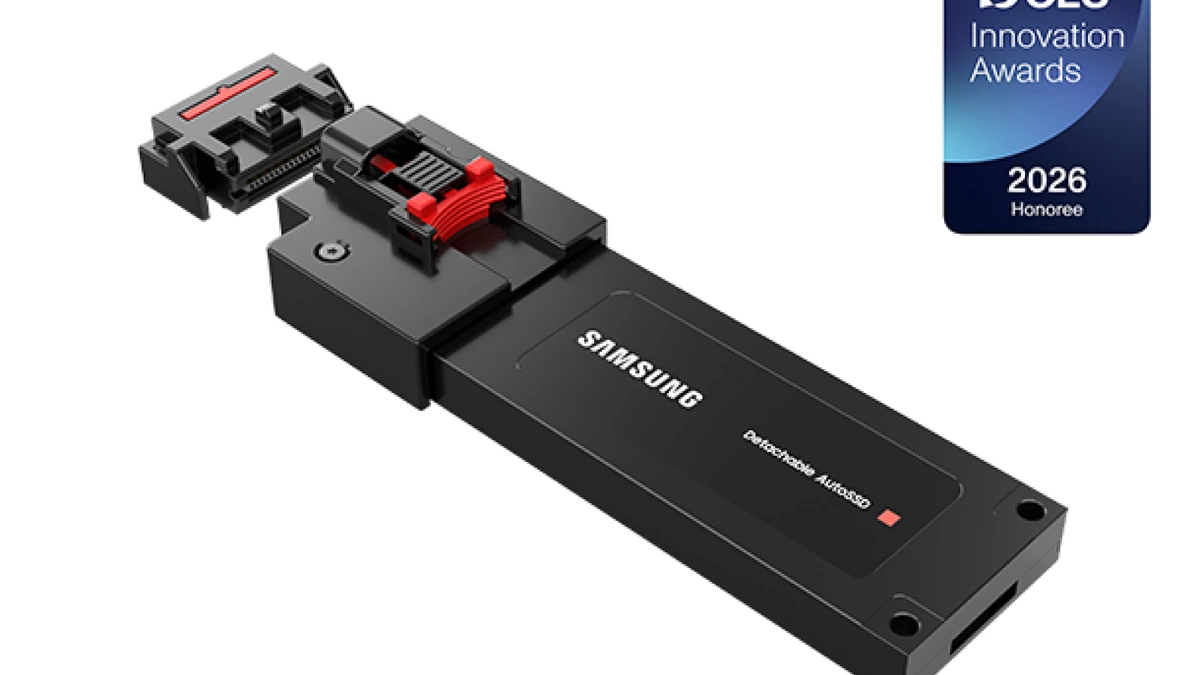
Samsung built an automotive SSD that splits into two pieces. The Detachable AutoSSD separates the storage controller from its NAND flash chips in a modular E1.A form factor, up to 4TB, rather than soldering everything into one sealed unit the way most in-vehicle storage works today. Samsung says it's the largest-capacity automotive SSD available and won a CES 2026 Innovation Award for the design.
The separation solves a specific problem. Cars run hotter and longer than consumer electronics, and a sealed storage module that fails means replacing the entire unit. Splitting the controller from the NAND lets each part be swapped independently, spreads heat across more surface area than a single embedded chip, and lets Samsung stack multiple automotive-grade V8 NAND packages for more capacity than a fixed design allows. The drive also carries self-encrypting drive protections and meets CSMS ML3 cybersecurity certification, standards that matter more in a vehicle that's constantly network-connected than in a laptop that mostly isn't.
Samsung is pointing to a real capacity problem behind the design choice: it estimates an autonomous or connected vehicle can generate between 3 and 18 petabytes of sensor data over its lifetime, from cameras, LiDAR, radar and ultrasonic sensors running continuously alongside in-car streaming and gaming. Whether modular, swappable automotive storage becomes standard or stays a niche fix depends less on Samsung's engineering than on whether automakers are willing to design service and warranty processes around a component that's meant to be opened and replaced, something the industry hasn't had much reason to do with storage before now.