Surfer SEO is a content optimization platform that analyzes top-ranking SERP pages to generate a data-driven content score, guiding writers toward the keyword density, heading structure, and word count that correlate with first-page rankings. MarketMuse answers a different question. Instead of scoring the page in front of the writer, it models the full concept space around a subject and reports where a domain's coverage is thin, absent, or already strong.
That difference decides which tool belongs in a content operation. A team with a locked editorial calendar needs execution quality on every page. A team deciding what to publish next needs a map before it commissions a word. Surfer and MarketMuse have both moved since their original positioning: Surfer was acquired by Positive Group and now brands the product simply as Surfer, per Search Engine Journal, while MarketMuse agreed to be acquired by Siteimprove and its pricing page routes every plan through a demo booking. This comparison uses the Surfer SEO name throughout for consistency with how most content teams still refer to the tool.
How Each Platform Approaches Content Optimization
Surfer SEO and MarketMuse both sell content optimization, but the two products compute their recommendations from different inputs and deliver them at different points in the production cycle. The vocabulary overlaps enough to obscure that, so it helps to fix the terms before comparing features:
- Content score. A live numeric target derived from what ranks for one query today. It measures a single page against its direct competitors.
- Topic model. A statistical map of the sub-topics, questions, and entities that define a subject. It measures a domain against a concept space rather than a query.
- Coverage gap. A sub-topic the topic model says a subject requires and the domain does not yet cover, or covers weakly.
- Topical authority. An industry term, not a published Google metric, for the compounding benefit a site sees when it covers a content cluster completely rather than publishing isolated pages.
Surfer SEO: SERP-Data-Driven Content Score
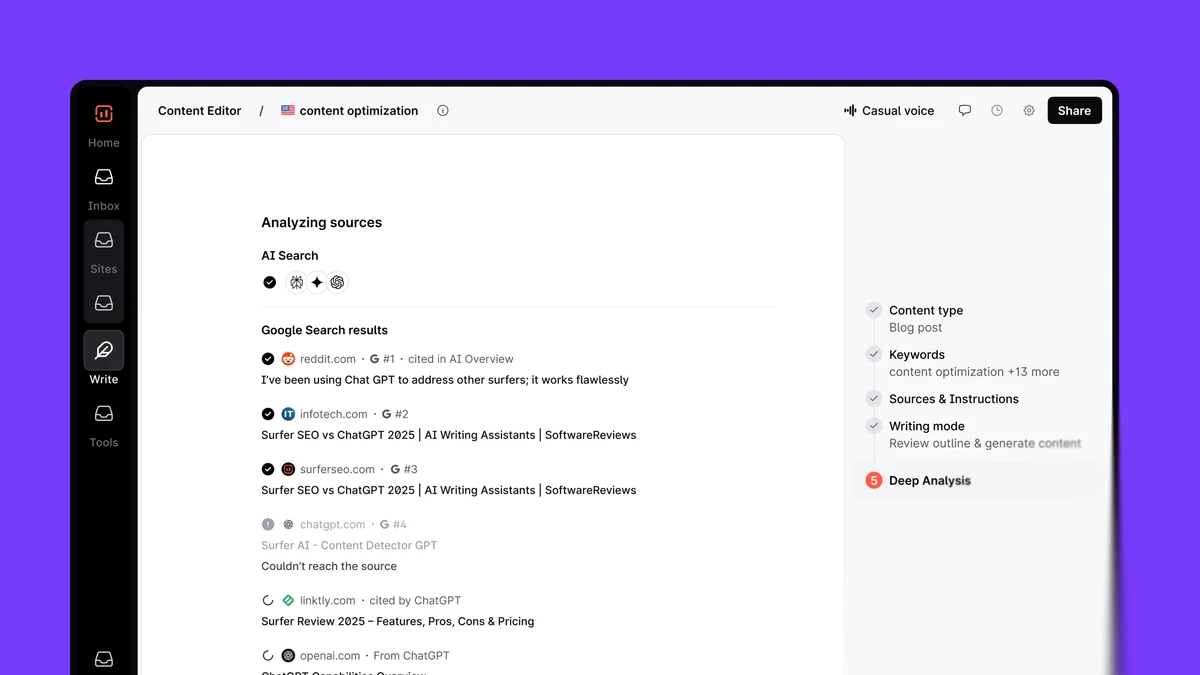
Surfer SEO's content editor runs a fresh SERP analysis for the target keyword each time a document is opened, reading the organic competitors ranking for that query alongside the pages most often cited by AI answer engines. Surfer describes its guidelines as drawn from more than 500 ranking factors covering keyword usage, entity extraction, link equity, content relevance, and topic coverage, per the Surfer content editor documentation. Those inputs collapse into the content score, a number that moves in the editor as the writer adds or cuts text. Surfer also applies natural language processing to identify semantically related entities, the same class of technique exposed publicly by the Google Cloud Natural Language API and AWS Comprehend. The practical result is a writing environment where keyword density and heading structure carry immediate, visible feedback, and where on-page optimization becomes a measurable task rather than an editorial judgment call.
MarketMuse: Topic Model and Coverage Gap Analysis
MarketMuse builds its topic model by analyzing the semantic neighborhood around a subject rather than the top results for a single query, then scores the pages a site already owns against that model. MarketMuse states that its planning product assesses a site's content against the SERP and returns a personalized difficulty metric, described on the MarketMuse content planning page as a measure of how hard a topic will be for that specific domain rather than a generalized score. The output is a prioritized content brief for each gap: the sub-topics a planned page must address, the questions it must answer, and the related entities it must name before it can compete for the content cluster's head term. This is architecture before authoring, and it produces a plan rather than a per-page score.
Feature Comparison: What Each Tool Actually Delivers
Surfer SEO and MarketMuse overlap on the surface labels and diverge on the source and scope of every recommendation. Reading the two feature sets side by side makes the decision defensible rather than preferential. For teams weighing Surfer's place inside a wider keyword-research stack, the Semrush vs Ahrefs vs Surfer comparison for startups covers how those tools interlock at the research layer, and teams still shortlisting vendors can work through the content optimization platform evaluation framework for a broader selection method.
| Capability | Surfer SEO | MarketMuse |
|---|---|---|
| Content brief generation | SERP-derived: term targets and structural recommendations taken from the competitor pages that rank for the target keyword | Topic-model-derived: sub-topic requirements and concept-space coverage taken from a domain-wide gap analysis |
| Keyword density guidance | Explicit term targets drawn from competitor SERP analysis, expressed as a live score in the editor | Term importance weighted by role in the full concept space rather than by competitor frequency alone |
| Semantic analysis | Natural language processing applied on top of frequency analysis to surface related entities | Proprietary topic models that score conceptual completeness across an entire content cluster |
| Where the work happens | Live editor with Google Docs, WordPress, and Contentful integrations, so writers stay in their existing tools | Web application producing plans and briefs, with guidance delivered upstream of the draft rather than inside it |
| Audit scope | Page-level audit against the live SERP for one keyword | Portfolio-level inventory scoring every page a domain owns against the topic model |
| Pricing transparency | Public self-serve tiers listed on Surfer's pricing page | Plan features published, dollar amounts quoted through a sales conversation |
When to Use Surfer SEO: Page-Level Optimization at Scale
Surfer SEO earns its place when the keyword list is already settled and the variable is execution quality across writers. The content score gives every contributor the same target without a long brief-review cycle, and page-level optimization is where that feedback loop pays for itself. Four conditions predict a good fit:
- Steady monthly production against pre-defined keyword targets. The score sets a repeatable quality floor across a mixed roster of staff and freelance writers.
- Agency delivery with short turnaround windows. The Google Docs and WordPress integrations let writers optimize inside the tools they already use, which removes a tool-switching step from every assignment.
- Publishers auditing live pages against current competitors. The page-level audit surfaces which published pages have slipped below competitor thresholds and which terms are dragging the score down.
- Operations where strategy is fixed and quality is the open question. When the calendar is locked, the bottleneck is per-page keyword density and heading structure, and Surfer addresses that bottleneck directly.
Surfer SEO's content workflow does carry a structural ceiling. Because the platform anchors to individual queries rather than a domain-wide map, a team using it alone can build a content cluster riddled with missing sub-topics, and those holes suppress the cluster's authority for its head term without ever showing up in a page-level optimization report. Plan structure has also changed since the Positive Group acquisition: the Surfer pricing page now lists Discovery, Standard, Pro, Peace of Mind, and Enterprise tiers priced by document volume and AI-visibility tracking rather than the older per-article credit packaging, and API access is reserved for the two highest tiers. Teams whose needs outgrow that model will find a fuller assessment of the best Surfer SEO alternatives including Clearscope, Frase, and NeuronWriter.
When to Use MarketMuse: Topical Authority Before the First Draft
Where Surfer SEO answers "how good is this page," MarketMuse answers "which pages should exist at all." The topic model resolves that strategic question before writer hours are committed, which is why the tool tends to land with planners rather than editors. Four situations make the coverage gap diagnostic worth its cost:

- Building a calendar for a vertical with little existing coverage. The model surfaces the full concept space required for topical authority before a single draft is commissioned, which prevents paying for pages that cannot rank because adjacent sub-topics are missing.
- Managing a content cluster of 50 or more articles. A gap in a high-importance sub-topic caps the whole cluster, and the portfolio inventory makes that visible instead of leaving the team to infer it from ranking noise.
- Planning on a quarterly cycle with a defensible road map. The output documents which sub-topics the domain owns, which are weak, and which are absent, which gives a content director an evidence base for budget requests.
- Entering a vertical where rivals already hold topical authority. The audit names the specific gaps behind a ranking deficit, which enables a targeted catch-up plan rather than a generic increase in production volume.
Two constraints temper that. Surfer SEO publishes its tiers openly, while MarketMuse now lists Free, Optimize, Research, and Strategy plans on its pricing page with the dollar figures replaced by a demo request, so a shortlist cannot be costed without a sales call. The model also needs indexed history to produce reliable coverage gap scores, which limits its usefulness during a site launch. Neither constraint is fatal, but both belong in an evaluation, and both cut against the assumption that a topic model is simply a better version of a content score.
Cost-Per-Article Analysis for Content Teams at Scale
Surfer SEO's document-volume pricing and MarketMuse's quoted plans produce different cost curves, and neither invoice captures the full economic picture. A team managing 50 or more articles across a defined cluster carries two costs Surfer and MarketMuse do not share: the tooling cost per article produced, and the opportunity cost of coverage gaps that hold the cluster's head term down. The second number is larger and almost never modeled. For content operations that connect to the wider revenue stack, our guide to the CRM as a system of record across sales, marketing, and service covers the systems on the other side of that handoff.
Model it directly. Take the quarterly article count, divide the annual platform cost by it to get a tooling cost per article, then estimate what share of those articles a coverage gap analysis would have re-prioritized or canceled. One canceled article that could never have ranked usually exceeds a quarter of platform fees. Because Surfer publishes its tiers and MarketMuse quotes, build the Surfer side from Surfer's pricing page and treat the MarketMuse side as a range until a quote arrives. The practical framework by scale:
- Fewer than 20 articles per month: Surfer SEO's content workflow covers the need. The cluster is small enough that gaps can be tracked by hand without a portfolio audit.
- 20 to 50 articles per month: The transition zone. Run one MarketMuse cluster audit before the next planning cycle to test whether existing coverage deficits are capping priority head terms.
- More than 50 articles per month in a defined cluster: Run both. MarketMuse sets the plan, Surfer SEO enforces on-page optimization inside it, and the combination removes wasted commissions before a writer is assigned.
- Domains younger than six months: Start with Surfer SEO. The topic model needs indexed history, so schedule the first MarketMuse audit once the site has one.
Integrating Both Tools Into a Single Content Workflow
Surfer SEO and MarketMuse sit at different stages of production, which is why mature teams run both rather than choosing. Keyword research sits upstream of either one, and our Ahrefs vs Semrush keyword analysis comparison covers that research layer. It is worth being precise about why the sequence matters, because the popular explanation overstates the mechanism. Google Search Central describes ranking as page-level: relevance is determined by hundreds of factors, and the signals it names are collected about the canonical page and its contents. Google publishes no site-wide authority number. Coverage gaps still cost traffic, for a simpler reason: a question the domain never answers has no page to rank at all, and a page-level score has nothing to say about the pages that were never written.
A four-step combined content workflow:
- Run the cluster audit in MarketMuse. Score the target content cluster against the topic model, then convert each coverage gap into a prioritized content brief.
- Hand the brief to Surfer SEO. Move the structural brief into the content editor manually or through middleware, and let the SERP analysis layer competitive term targets on top of it.
- Write against the combined target. The writer works toward the content score while honoring the sub-topic structure and entity requirements from the plan, which folds quality control into drafting instead of a separate review pass.
- Re-score after indexing. Put the published page back through the audit to confirm the gap closed. A page that does not move the cluster score signals a disconnect between brief and execution, which is feedback for the next cycle.
Neither Surfer nor MarketMuse ships a native integration with the other, so the handoff is a manual step or a middleware dependency, and it is the weakest joint in this editorial workflow. Teams running the combination should document the handoff as a standard operating procedure so brief data is not compressed or lost in transit. That missing integration is the clearest signal that content-tool vendors have not yet built for the architecture-before-authoring sequence that mid-size and enterprise teams actually run.
Further reading
- Semrush vs Ahrefs vs Surfer: Best SEO Tools for Startups
- Best Surfer SEO Alternatives Reviewed: Clearscope, Frase, MarketMuse, NeuronWriter
- Ahrefs vs Semrush for Keyword Analysis: A Direct Comparison
- How To Choose a Content Optimization Platform: An Evaluation Framework
- CRM as a System of Record: Operational Patterns Across Sales, Marketing, and Customer Service