Marketing automation platform is a B2B software category that unifies lead capture, email nurturing, segmentation, and pipeline analytics inside a single operational layer connecting marketing to CRM.
Three platforms dominate the B2B marketing automation space: HubSpot, Marketo Engage, and Salesforce Account Engagement (formerly Pardot, now abbreviated SAE). Each targets a distinct buyer profile, carries a different CRM integration model, and handles behavioral triggers at a different level of complexity. Choosing the wrong one creates rework measured in months, not weeks.
What Marketing Automation Platforms Do
A marketing automation platform connects inbound lead capture, email campaign execution, behavioral segmentation, and CRM data synchronization into a single operational layer for B2B revenue teams. The platform sits between demand generation channels and the CRM, enriching raw contact records with behavioral signals before handing them to sales.
Core MAP functions include progressive lead profiling, rules-based lead scoring, multi-step email nurture sequences, landing page and form management, and closed-loop attribution reporting. The CRM integration layer is where platforms diverge most sharply: native-built integrations move data in real time, while third-party connector setups introduce latency and field-mapping maintenance overhead. For organizations evaluating how the marketing stack relates to their revenue database, the CRM as the system of record for sales, marketing, and customer service covers the architectural decisions that shape every downstream MAP evaluation.
The category also bifurcates by buyer size. Mid-market teams typically prioritize ease of onboarding and breadth of native tooling. Enterprise teams prioritize behavioral trigger depth, custom object support, and granular attribution models. That bifurcation maps almost directly onto the three platforms compared here.
HubSpot Marketing Hub: Strengths and Limitations
HubSpot packages marketing automation inside its broader CRM suite, making it the lowest-friction entry point for teams that want a single vendor to own marketing, sales, and service workflows. The core advantage is architectural: because the HubSpot CRM is the native data layer, contact records, deal stages, and behavioral events share the same object model without requiring a separate sync configuration.
HubSpot's workflow automation builder is visual and condition-based, supporting branching logic, delays, enrollment triggers based on CRM properties, and cross-object actions. The email marketing editor is drag-and-drop with A/B testing on Professional-tier plans and above. Pricing scales across Starter, Professional, and Enterprise tiers, with the higher tiers unlocking predictive lead scoring, custom behavioral events, and revenue attribution reporting. For current plan details and feature gates by tier, see the HubSpot Marketing Hub pricing overview.
For teams evaluating how HubSpot fits into a broader email stack, the integrating CRM with email marketing platforms guide covers the sync architecture in detail.
HubSpot strengths and limitations:
- Native CRM unification: Contact, deal, and ticket data share one object model, eliminating sync lag between marketing and sales records.
- Accessible workflow automation: The visual workflow builder requires no developer involvement for standard lead nurturing sequences.
- Broad App Marketplace: Connects to Salesforce, Slack, Zoom, Shopify, and hundreds of other tools via maintained integrations, documented on the HubSpot vs. Pardot comparison page.
- Email marketing depth limited on lower tiers: Advanced send-time optimization and adaptive testing require Professional or Enterprise plans.
- Behavioral trigger granularity: Complex multi-touch event sequences available in Marketing Hub Enterprise, but enterprise MAP specialists often find them less configurable than Marketo Engage's Smart Campaign architecture.
- Reporting ceilings: Multi-touch attribution and custom report builder are available on higher-tier plans; teams needing deeply customized attribution models may hit limits compared with dedicated BI integrations.
Marketo Engage: Strengths and Limitations
Marketo Engage is Adobe's enterprise-grade marketing automation platform, built for organizations that run complex, multi-stage B2B demand generation programs requiring deep behavioral triggers and granular attribution. The platform operates on its own database independent of any single CRM, which gives it flexibility to connect to Salesforce, Microsoft Dynamics, SAP, and other enterprise CRM systems while maintaining its own contact and activity history.
The engagement studio in Marketo Engage is the primary nurture orchestration surface. It uses a canvas-based drag-and-drop interface to build adaptive content streams that branch based on behavioral signals: email opens, web page visits, form fills, content downloads, and custom API events. The engagement studio supports wait steps, A/B content testing within streams, and stream transitions triggered by scoring thresholds. For a full reference on engagement studio concepts and core taxonomy, see the Marketo Engage glossary and the Marketo Engage product documentation on Adobe Experience League.
Lead scoring in Marketo Engage is configured through scoring programs using behavioral and demographic scoring rules. The platform supports multiple score fields simultaneously, enabling lead scoring by product interest, account tier, and engagement level as separate scored dimensions.
- Engagement studio depth: Canvas-based nurture builder handles complex branching, multi-stream programs, and behavioral wait conditions at a granularity that exceeds most mid-market MAPs.
- CRM-agnostic architecture: Native connectors for Salesforce, Microsoft Dynamics, and Veeva integrate without forcing a CRM consolidation.
- Multi-dimensional lead scoring: Supports parallel score fields for product interest, demographic fit, and behavioral engagement.
- Demand generation program management: Program templates, tokens, and cloning speed up multi-campaign rollouts across business units.
- Onboarding complexity: Marketo Engage has a steeper learning curve than HubSpot; most enterprise deployments involve an implementation partner.
- UI modernization pace: Core interface elements have improved under Adobe's ownership, but some workflow areas still reflect the platform's pre-Adobe architecture.
Salesforce Account Engagement (Formerly Pardot): Strengths and Limitations
Salesforce Account Engagement (formerly Pardot) is a B2B marketing automation platform built around Salesforce CRM objects, offering lead scoring, grading, and engagement studio nurture tracks as first-class native features. SAE runs inside the Salesforce platform, which means prospect records, campaign influence, and opportunity attribution write directly to Salesforce objects without a separate sync layer. Pricing is structured across Growth, Plus, Advanced, and Premium editions; see the Salesforce Account Engagement pricing page for current tier details and contact-volume thresholds.
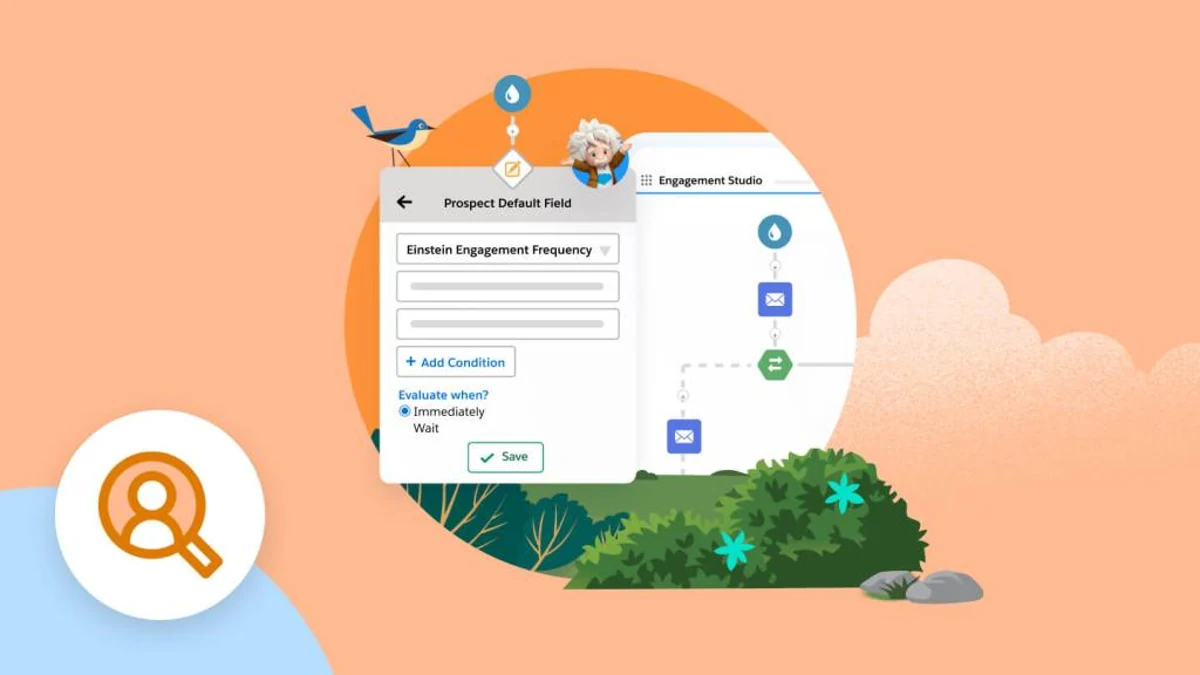
The engagement studio in SAE provides a drag-and-drop nurture builder that triggers actions based on prospect score changes, list membership, email behavior, and custom redirects. Because SAE operates on Salesforce data, sales reps see engagement activity directly in their Salesforce records without needing a separate marketing view.
B2B marketing teams that standardized on Salesforce Sales Cloud typically find SAE's native alignment reduces the integration debt that comes with third-party MAP connectors. Teams outside the Salesforce ecosystem face a more significant setup burden.
- Native Salesforce object model: Prospect, campaign, and opportunity data share the Salesforce schema; no field mapping maintenance between MAP and CRM.
- Lead scoring and grading: Combines behavioral scoring with demographic grading to produce a two-dimensional prospect quality signal visible to sales in Salesforce.
- Engagement studio nurture: Visual canvas supports conditional branching, scoring-triggered transitions, and dynamic content within nurture tracks.
- B2B marketing attribution: Campaign influence reporting ties prospect engagement to pipeline and closed-won opportunities within Salesforce reports.
- Ecosystem dependency: Full functionality requires Salesforce Sales Cloud; organizations on other CRMs pay a significant integration overhead or lose core features.
- Email marketing interface: Email editor and template library have improved but remain less polished than HubSpot's drag-and-drop builder for non-technical marketers.
Feature Comparison: Lead Scoring, Workflows, and Attribution
Comparing HubSpot, Marketo Engage, and Salesforce Account Engagement on four core capability areas reveals where each platform leads and where each requires workarounds or higher-tier plans.
| Capability | HubSpot Marketing Hub | Marketo Engage | Salesforce Account Engagement |
|---|---|---|---|
| Lead Scoring | Contact-based scoring with predictive scoring available on Enterprise tier; single score field per contact | Multi-dimensional scoring with parallel score fields; behavioral + demographic scoring rules configurable independently | Scoring plus grading; behavior score combined with demographic grade for two-signal prospect quality view |
| Workflow Automation | Visual workflow builder; supports cross-object actions, delays, and branching; developer-free for standard sequences | Smart Campaigns with trigger-based enrollment; engagement studio for nurture; supports complex multi-step programs | Automation rules and engagement studio; conditional branching tied to prospect score, list, or CRM field changes |
| Email Marketing | Drag-and-drop editor; A/B testing on Professional+; send-time optimization on Enterprise | Template-based email builder; extensive dynamic content and A/B testing; batch and trigger send modes | Email builder with basic drag-and-drop; variable tags for personalization; A/B testing available |
| Multi-Touch Attribution | Revenue attribution reporting on Professional+; first-touch, last-touch, and linear models; custom report builder on Enterprise | Advanced attribution via Bizible integration (Adobe Marketo Measure); supports full-path and custom models | Campaign influence reporting native in Salesforce; first-touch, last-touch, and even-distribution models within Salesforce reports |
| CRM Integration | Native HubSpot CRM; Salesforce bidirectional sync on Professional+ via maintained connector | Native connectors for Salesforce, Microsoft Dynamics, SAP; CRM-agnostic architecture | Native Salesforce objects; no separate sync layer required for Salesforce Sales Cloud users |
The lead scoring comparison reflects a meaningful architectural difference. Marketo Engage's parallel score fields let teams score the same prospect against multiple product lines or buyer personas simultaneously. HubSpot's single contact score is simpler to configure but requires workarounds for organizations running multiple product lines. SAE's grading system adds a demographic dimension that is absent from the other two platforms out of the box. Vendors are also layering predictive, generative and agentic AI onto lead scoring, content and campaign workflows.
On multi-touch attribution, none of the three platforms offers complete account-level attribution without additional tooling or higher-tier plans. Marketo Engage users requiring full-path attribution typically adopt Bizible (now Adobe Marketo Measure). HubSpot's attribution is self-contained but constrained to the HubSpot data model. SAE's attribution is native to Salesforce but limited to models available within standard Salesforce reporting.
CRM Integration Depth by Platform
CRM integration is the single biggest differentiator when choosing between these three marketing automation platforms, because the depth of native sync determines how accurately pipeline and revenue data flows back to marketing. For teams assessing the broader CRM selection decision, the how to choose a CRM for your business guide covers evaluation criteria that apply before a MAP decision is made. Marketing automation is one layer of a wider martech stack that has to share data with the CRM.
- HubSpot CRM Integration
- Native integration with HubSpot's own CRM requires zero configuration. Salesforce bidirectional sync is available on Professional and Enterprise tiers via HubSpot's maintained Salesforce connector, supporting field mapping, record exclusion filters, and activity sync. For teams running HubSpot as the primary CRM, the integration layer is invisible by design.
- Marketo Engage CRM Integration
- Marketo Engage maintains native connectors for Salesforce, Microsoft Dynamics 365, and SAP. The Salesforce connector supports bidirectional sync of leads, contacts, campaigns, and opportunities. Because Marketo Engage's database is independent of any CRM, it can hold prospect records that have no corresponding CRM entry, which is useful for pre-sales nurture programs targeting unqualified leads.
- Salesforce Account Engagement CRM Integration
- SAE operates on Salesforce infrastructure. Prospect records map to Salesforce lead and contact objects directly; campaign influence and scoring data write to Salesforce fields without a connector. This native alignment eliminates field-mapping drift and sync latency for organizations on Salesforce Sales Cloud. Teams on other CRMs require third-party middleware to replicate equivalent data flows.
Which Platform Fits Your Team
The right marketing automation platform depends on your existing CRM stack, team technical capacity, and the complexity of the nurture programs you intend to run. For teams also evaluating adjacent tooling, the choosing collaboration tools that complement your CRM guide covers the broader productivity stack context.
Three profiles map cleanly to the three platforms:
- HubSpot: Best fit for growth-stage B2B teams that want marketing automation, CRM, sales sequences, and service ticketing inside one platform. The absence of a separate CRM integration project reduces time-to-value significantly. Demand generation programs of moderate complexity, lead nurturing tracks with standard branching, and email marketing campaigns all run without developer support. Teams that later need Salesforce connectivity can activate the bidirectional sync connector on higher-tier plans.
- Marketo Engage: Best fit for enterprise B2B organizations running multi-stage, multi-product demand generation programs across business units or geographic markets. The engagement studio depth, parallel lead scoring dimensions, and CRM-agnostic architecture make it the strongest MAP for organizations that need sophisticated behavioral triggers and attribution without being locked into one CRM vendor. Implementation requires either in-house MAP expertise or a Marketo-certified partner.
- Salesforce Account Engagement: Best fit for B2B marketing teams that operate entirely inside the Salesforce ecosystem and want marketing automation that shares the same data model as their sales team. SAE's lead scoring, grading, and engagement studio nurture tracks feed directly into Salesforce pipeline reporting, eliminating the attribution reconciliation that cross-platform configurations require. Teams outside the Salesforce ecosystem should evaluate the integration cost carefully before committing.
The decision often narrows to one question: does your organization already run Salesforce Sales Cloud? If yes, SAE's native alignment typically outweighs its limitations. If not, the choice between HubSpot and Marketo Engage comes down to program complexity and in-house technical capacity.
References
- HubSpot Marketing Hub pricing and packaging overview (HubSpot Blog)
- HubSpot vs. Pardot comparison (HubSpot official)
- Adobe Marketo Engage product documentation (Adobe Experience League)
- Marketo Engage glossary of core concepts (Adobe Experience League)
- Salesforce Account Engagement pricing (Salesforce)
- Email marketing services comparison (HubSpot Blog)
Further reading
Frequently Asked Questions
What is the main difference between HubSpot, Marketo Engage, and Salesforce Account Engagement?
HubSpot is an all-in-one CRM suite optimized for ease of use across marketing, sales, and service teams. Marketo Engage is Adobe's enterprise-grade platform built for complex B2B demand-generation workflows. Salesforce Account Engagement (formerly Pardot) is a B2B marketing automation tool deeply integrated with Salesforce CRM, suited to teams already invested in the Salesforce ecosystem.
Is Salesforce Account Engagement (Pardot) the right choice for B2B marketing automation?
Salesforce Account Engagement is purpose-built for B2B pipelines, offering lead scoring, grading, and engagement studio nurture tracks that feed directly into Salesforce CRM objects. It is the strongest fit for organizations running Salesforce Sales Cloud as their CRM. Teams outside the Salesforce ecosystem typically face higher integration overhead compared with HubSpot or Marketo Engage.
Can HubSpot integrate with external CRM and sales tools?
HubSpot connects to hundreds of third-party tools through its App Marketplace, including Salesforce, Slack, Zoom, and major e-commerce platforms. Native two-way sync with Salesforce CRM is available on higher-tier plans. For teams that need a single platform to handle both CRM and marketing automation without heavy IT involvement, HubSpot's integration breadth is a practical differentiator.