
AI marketing automation is a software category that uses machine learning and predictive algorithms to personalize, segment, and optimize campaigns across email, SMS, and digital channels.
The category has split into three distinct AI capability layers: predictive AI, which scores and ranks contacts by behavior signals; generative AI, which produces content at scale; and agentic AI, which plans and executes multi-step campaign workflows with minimal human input. Each layer solves a different operational problem, and most enterprise-tier platforms now implement some combination of all three. Choosing between them requires understanding which layer maps to your primary bottleneck.
What AI Marketing Automation Actually Does

Evaluating a marketing automation platform on AI depth means checking whether predictive models are native or bolt-on, how segmentation surfaces new audiences, and whether agentic features operate within governed guardrails. A platform that licenses a third-party AI module for lead scoring will behave differently from one where predictive scoring is trained on the platform's own behavioral data. The former requires custom data pipelines; the latter runs on the shared data model.
- Native vs. bolt-on predictive models. Ask whether lead scoring models are trained on first-party CRM and engagement data within the platform or whether scores are imported from an external AI vendor. Native models update continuously; bolt-on models require scheduled sync jobs.
- Audience segmentation depth. Evaluate whether the platform builds audience segmentation from behavioral clusters and predictive attributes, not just demographic or firmographic filters. Salesforce Einstein's predictive audiences and lookalike modeling surfaces contacts with similar behavioral profiles to your top converters, bypassing manual list logic entirely.
- Dynamic content personalization scope. Determine how far dynamic content personalization extends: subject lines only, or full email body, landing pages, and SMS? Platforms that personalize only at the subject-line level deliver partial value.
- STO at the contact level. Send-time optimization should operate per-contact, not per-segment. Per-segment STO collapses the precision advantage of predictive AI back toward rule-based scheduling.
- Agentic AI governance controls. Before deploying agentic AI campaigns, confirm the platform offers approval workflows, spending limits, and channel access controls that cap what an autonomous agent can execute without human sign-off.
- Lookalike modeling access tier. Lookalike modeling is often restricted to enterprise plans. If expanding into new audience segments is a near-term priority, verify the plan tier that unlocks it before committing to a contract.
Automation Workflows: From Triggered Sequences to Agentic Campaigns
Triggered email sequences represent the baseline of marketing automation, but agentic AI now enables platforms to plan, reason, and execute multi-step campaign tasks with minimal human input. A triggered sequence fires a predetermined email when a contact hits a fixed threshold: a form fill, a page visit, a score crossing a set value. An agentic campaign, by contrast, evaluates real-time context, selects a channel, adjusts message timing using STO, and escalates or de-prioritizes contacts dynamically as the campaign runs.
The progression from triggered to agentic follows a recognizable adoption path. For teams new to sophisticated automation, the guide to setting up automated workflows in project management tools offers a foundation-level reference on workflow logic that transfers directly to MAP configuration.
- Rule-based triggers. Contacts enter a workflow when a single condition is met. The sequence is fixed and runs the same way for every contact. No AI inference occurs at this stage.
- Predictive triggers. The AI marketing automation layer adds score-based branching: contacts with high predictive scores enter an accelerated track, while lower-scored contacts receive a nurture path. Send-time optimization fires each message at the predicted peak engagement window per contact.
- Generative content injection. Generative AI populates email body and subject line variants within the workflow based on contact attributes and segment membership. Dynamic content personalization swaps content blocks in real time at send.
- Agentic orchestration. An agentic AI layer monitors campaign performance, adjusts channel mix, reallocates budget toward higher-performing segments, and flags contacts for human review when conversion signals spike or drop outside expected ranges. Salesforce Agentforce operates at this layer for Marketing Cloud customers.
- Closed-loop attribution. Agentic AI feeds campaign outcome data back into the predictive models, re-scoring contacts and refining audience segmentation for the next campaign cycle without manual data export and re-import.
Choosing the Right AI Marketing Automation Platform
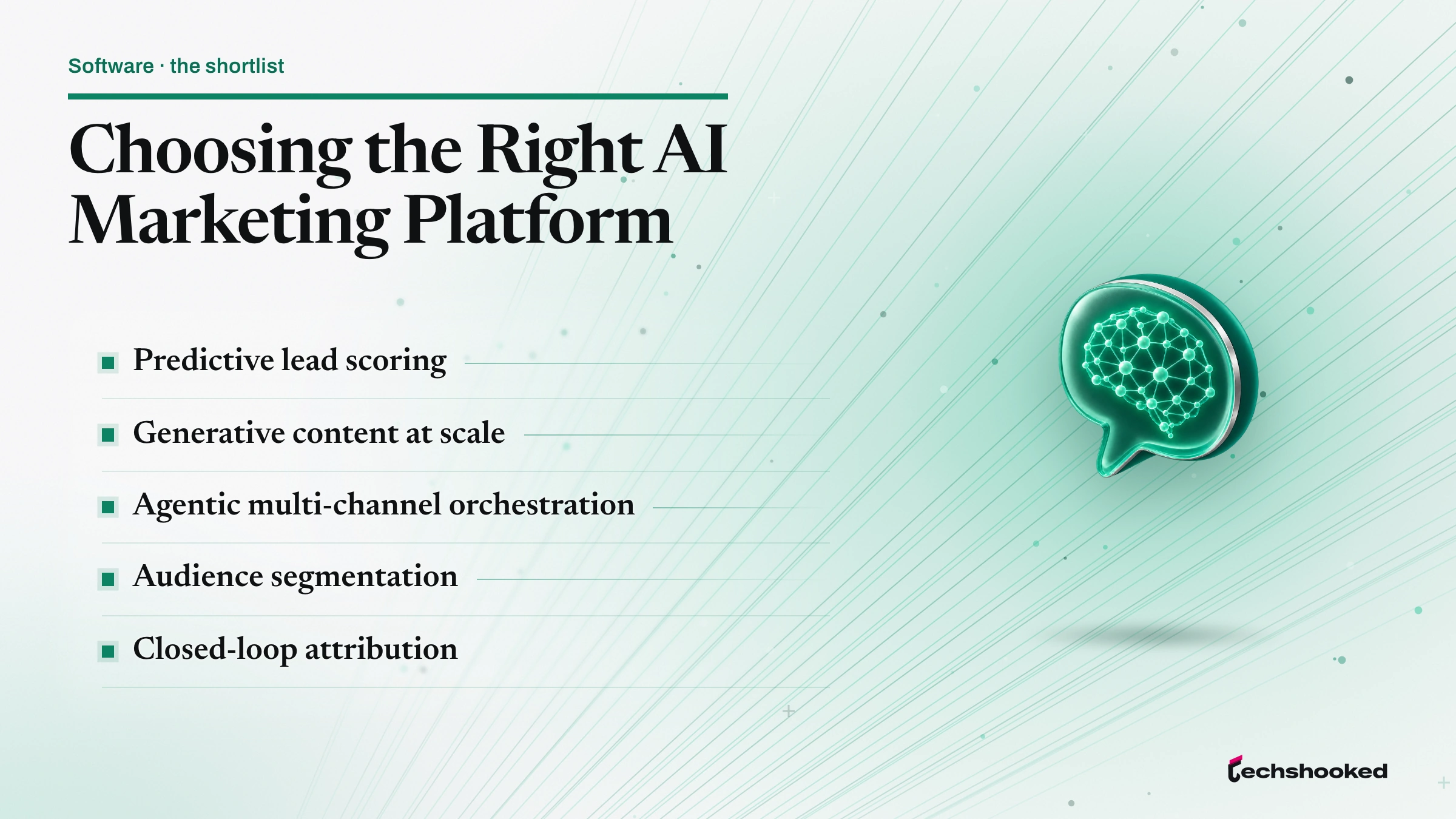
The right AI marketing automation platform depends on whether your primary need is predictive lead scoring, generative content at scale, or agentic multi-channel orchestration. A B2B team with a defined ICP (ideal customer profile) and a large contact database will gain the most from predictive AI: lead scoring surfaces the highest-probability contacts before the sales team manually reviews the queue. A B2C brand running high-volume promotional campaigns will prioritize generative AI for content production speed and dynamic content personalization for segment-level relevance.
For enterprise buyers operating a unified revenue stack, Salesforce Marketing Cloud Einstein offers the most integrated path because all three AI layers share a common customer data model. Salesforce describes this as an AI CRM platform where predictive analytics, generative content, and autonomous agents operate on the same data foundation (Salesforce B2B Marketing Automation). Mid-market buyers with a narrower use case should validate whether they need all three layers before paying for enterprise-tier access to features they will not use.
- Define your primary AI use case. Lead scoring and audience segmentation point to predictive AI. High-volume content production points to generative AI. Multi-step campaign execution with minimal manual oversight points to agentic AI.
- Match AI depth to data volume. Predictive models require substantial historical data to produce reliable scores. Platforms running predictive scoring on a contact database below roughly 5,000 records will produce low-confidence outputs. Verify minimum data requirements with the vendor.
- Assess integration complexity. AI marketing automation platforms that require custom data pipelines to connect to your CRM, ad platforms, or analytics tools add implementation cost that offsets the efficiency gains. Prefer platforms where AI operates on the native data model.
- Evaluate governance maturity for agentic features. Agentic AI campaigns carry real execution risk if guardrails are absent. Before enabling agentic AI in a live MAP environment, confirm that approval workflows, budget caps, and channel access controls are configurable at the campaign level.
The AI capability taxonomy, predictive vs. generative vs. agentic, provides a more reliable selection frame than vendor marketing language. Matching the layer to the operational problem avoids paying for AI features that do not map to the bottleneck your team actually faces.
Further reading
- Salesforce: AI for Marketing, Challenges, Benefits, and Use Cases
- Salesforce Marketing Automation Tools
- Salesforce B2B Marketing Automation Software
- Salesforce Einstein Launch Announcement
- Asana vs Trello vs ClickUp: Project Management Software Compared
- BI Platforms Compared: Tableau vs Power BI vs Looker for the Modern Data Stack
- Best Project Management Tools For Remote Software Teams
- HubSpot: AI Tools for Marketing (Breeze)
- Adobe Marketo Engage: Predictive Content
Frequently Asked Questions
What is AI marketing automation?
AI marketing automation is software that uses machine learning and predictive algorithms to execute, personalize, and optimize marketing campaigns without manual intervention. It handles segmentation, send-time optimization, lead scoring, and content generation at scale, reducing the manual workload for marketing teams.
Which AI capability matters most for lead scoring?
Predictive AI is the core capability for lead scoring, using machine learning to calculate the probability a contact will convert. Platforms such as Salesforce Marketing Cloud Einstein apply predictive scoring across the full contact database, surfacing high-probability leads before the sales team manually reviews them.
What problems does AI solve in marketing automation?
AI addresses three core operational problems: data overload, inefficient audience targeting, and repetitive campaign management. Predictive segmentation surfaces high-value audiences that manual list logic misses, while generative AI reduces content production time and agentic AI handles multi-step workflow execution end to end.