Ahrefs vs Semrush is a keyword analysis tool comparison that determines which SEO tool surfaces more actionable keyword opportunities for content and search strategy. The two platforms approach the same job from different angles: Ahrefs leans on Keywords Explorer for discovery and Keyword Difficulty (KD) scoring, while Semrush leans on the Keyword Magic Tool to expand seed terms across a database of roughly 27 billion keywords (Semrush Knowledge Base). Picking between them is less about a scoreboard and more about which workflow your team will actually use every week. For background on how search engines crawl, index and rank pages, see Google's guide to how Google Search works.
How Ahrefs Approaches Keyword Analysis
Ahrefs centers its keyword analysis workflow on Keywords Explorer, an SEO tool that accepts either a single seed term or a list of keywords and returns search volume history, volume by country, and several keyword ideas reports (Ahrefs API documentation). The same engine powers the web app and the API, so a query a content strategist runs in the browser maps cleanly to what an engineering team can pull through code.

Outside the paid product, the Free Keyword Generator gives new users a low-friction entry point. For every seed term, it returns 20 related keywords plus 20 related questions, along with Keyword Difficulty bands (easy, medium, hard) and rough monthly volume estimates (Ahrefs keyword research guide). That free output is positioned as a discovery surface rather than a research environment.
- Enter a seed term or upload a list into Keywords Explorer to retrieve search volume, KD, and clicks data.
- Open the keyword ideas reports for matching terms, related questions, and parent topics.
- Filter by country to compare regional search volume before committing a content brief.
- Export shortlists to CSV or push them through the API for downstream ranking and prioritization (Ahrefs API docs).
How Semrush Approaches Keyword Analysis
Semrush builds its keyword analysis flow around the Keyword Magic Tool, which draws from a keyword database of approximately 27 billion entries and can surface millions of related terms for a popular seed (Semrush Keyword Magic Tool manual). The interface treats filtering as a first-class action: volume, KD, search intent, cost-per-click (CPC), include/exclude word lists, and language all sit in a single sidebar.
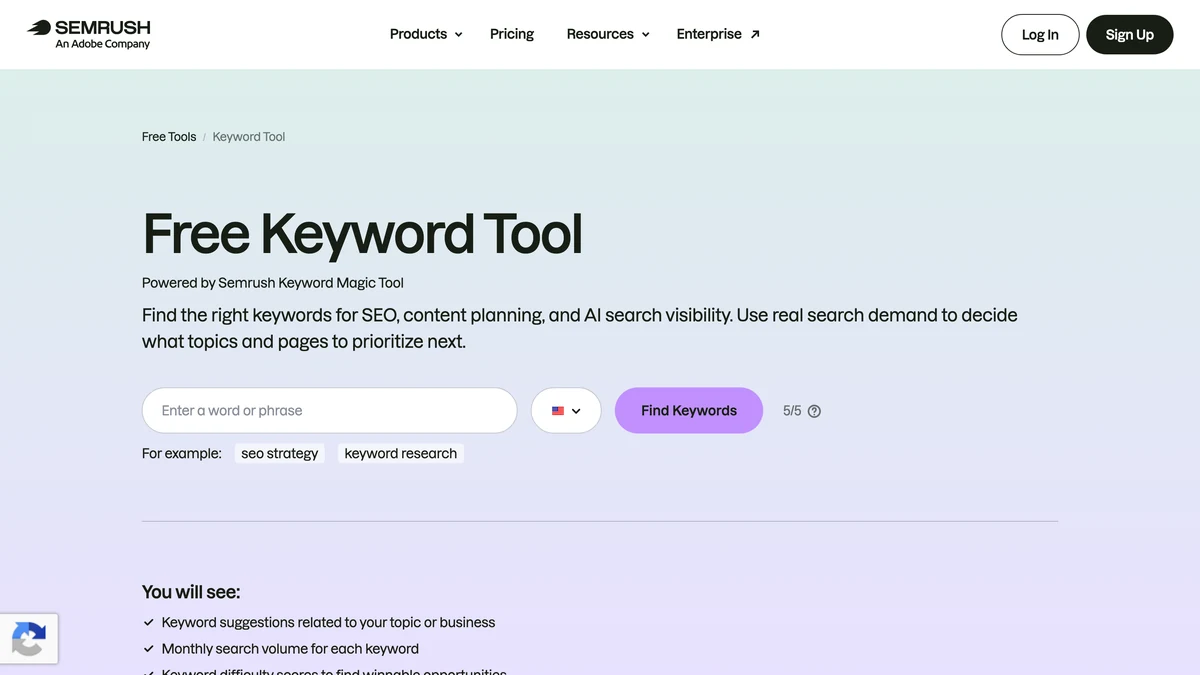
A separate Keyword Overview report adds a per-keyword summary with volume, CPC, competition level, and the number of organic results across regional databases, also exposed through the Semrush Developer API (Semrush keyword reports API). The Batch Keyword Overview accepts up to 100 keywords per call, which matches how many practitioners actually plan campaigns: in bulk, not one term at a time.
- Enter a seed keyword into the Keyword Magic Tool to load related terms from the Semrush keyword database (manual).
- Click the Questions button to isolate question-based keyword ideas for FAQ or how-to content.
- Apply the search intent, KD, volume, and CPC filters to narrow the set to commercially viable terms.
- Push the shortlist into Keyword Overview or Batch Keyword Overview for per-keyword detail and SERP context (developer docs).
Keywords Explorer vs Keyword Magic Tool: Direct Comparison
Ahrefs and Semrush both publish enough documentation to compare the two flagship keyword tools on observable behavior rather than marketing copy. The table below pulls only claims that map back to vendor primary sources; methodology differences mean the difficulty scores are not directly equivalent. A broader three-way view, including Surfer, is covered at Semrush vs Ahrefs vs Surfer.
| Feature | Ahrefs Keywords Explorer | Semrush Keyword Magic Tool |
|---|---|---|
| Keyword database scale | Not publicly stated; example seed returns up to 1.7M keyword ideas (source) | ~27 billion keywords (source) |
| Difficulty metric | Keyword Difficulty (KD) score; free generator returns easy/medium/hard bands | Keyword Difficulty (KD) score as filterable column |
| Search intent | Not surfaced as a primary filter in documented endpoints | Intent filter built into the main sidebar |
| Volume granularity | Search volume history and volume by country (API docs) | Volume per regional database in Keyword Overview (API docs) |
| Filtering options | Filters available in Keywords Explorer UI; documented exports through API | Volume, KD, intent, CPC, include/exclude, language, Questions filter |
| Batch processing (API) | Single keyword or list of keywords endpoint; free test limit capped at 100 | Batch Keyword Overview: up to 100 keywords per call |
| Free-tier access | Free Keyword Generator (20 related keywords + 20 questions per seed); Ahrefs Free shows all ranking keywords for a site | Limited free tier with capped daily searches; full filtering on paid plans |
Two structural takeaways come out of that grid. First, Semrush treats keyword research as a filtering problem and concentrates every dimension into one screen. Second, Ahrefs treats it as a discovery-plus-analysis pipeline, with the free generator handling ideation and Keywords Explorer handling depth. Neither approach wins on the spec sheet alone; the right choice depends on how a team prefers to move from seed to shortlist.
Data Metrics and Filtering Depth
Both platforms publish similar headline metrics, but the way each surfaces those metrics affects how an analyst structures a brief. The definitions below come straight from vendor documentation rather than inferred behavior.
- Keyword Difficulty (KD)
- Ahrefs exposes a numerical KD score in Keywords Explorer and easy/medium/hard bands in the Free Keyword Generator (Ahrefs). Semrush exposes KD as a filterable column inside the Keyword Magic Tool (Semrush). The two scores are not equivalent in methodology and should not be averaged across tools.
- Search Volume
- Ahrefs publishes search volume history plus volume by country as first-class outputs through Keywords Explorer (Ahrefs API docs). Semrush returns volume per regional database in the Keyword Overview report (Semrush API).
- Search Intent
- Semrush surfaces intent as a filterable dimension inside the Keyword Magic Tool, with explicit informational, navigational, commercial, and transactional buckets (Semrush). Ahrefs documentation does not surface intent as a standalone API field.
- Cost-Per-Click (CPC)
- Semrush returns CPC per keyword inside the Keyword Magic Tool and the Keyword Overview report (Semrush API). Ahrefs surfaces CPC inside Keywords Explorer alongside volume and KD.
- Competition Level
- Semrush Keyword Overview reports include a competition level value derived from paid auction data (Semrush API). Ahrefs does not document an equivalent named field in its core keyword endpoint.
- SERP and Result Counts
- Semrush Keyword Overview returns the number of organic results in the chosen regional database (Semrush API). Ahrefs returns SERP overview data through a dedicated endpoint separate from the Keywords Explorer flow (Ahrefs API docs).
API Access and Workflow Integration
Anyone planning to wire keyword analysis into a content operations stack, a dashboard, or a custom scoring model needs to read the API documentation, not the marketing pages. The two vendors gate their APIs differently and expose different shapes of data.
- Ahrefs API eligibility. The Ahrefs API is available on eligible paid plans, and other plans get a limited set of free test queries (Ahrefs API introduction).
- Endpoints in scope. API v3 covers Site Explorer, Keywords Explorer, SERP Overview, Rank Tracker, Site Audit, Brand Radar, and Social Media Management; Keywords Explorer returns single or list metrics, volume history, volume by country, and keyword ideas (docs).
- Ahrefs free test limits. Free test requests cap the limit parameter at 100, and queries using only "ahrefs" or "wordcount" in the keyword parameter do not consume API units (Ahrefs free test queries).
- Semrush keyword reports. The Semrush Developer API exposes Keyword Overview (volume, CPC, competition level, results count) and Batch Keyword Overview, which accepts up to 100 keywords per call (Semrush keyword reports).
- Complementary surfaces. Ahrefs pairs the analysis with backlink analysis through Site Explorer; Semrush ties keyword research into competitor analysis flows through its Domain Overview and Keyword Gap reports.
Choosing Between Ahrefs and Semrush for competitor analysis
Ahrefs and Semrush both cover the core keyword research job, so the decision rarely comes down to feature parity. It comes down to which platform aligns with the workflow your team already runs and which secondary capabilities you intend to lean on. The criteria below are ordered by how often they prove decisive in practice, not by importance in the abstract. Related platform-fit framing for content workflows is covered at Best Surfer SEO Alternatives and at Semrush vs Ahrefs vs Surfer.
- Filtering depth in one screen. Teams that build large keyword shortlists by stacking intent, CPC, KD, and language filters in one pass tend to find the Semrush Keyword Magic Tool friction-free (manual).
- Content angle discovery. Ahrefs Content Explorer indexes web pages by topic and lets editors find high-performing examples before committing a brief, a capability not directly replicated in Semrush.
- API integration requirements. Engineering teams that need batch keyword reports should map Ahrefs Keywords Explorer endpoints (docs) and Semrush Batch Keyword Overview (docs) against their pipeline before committing to a contract.
- Backlink analysis as a secondary need. Sites where link research drives priority lists usually skew toward Ahrefs, since Site Explorer is its strongest documented surface alongside Keywords Explorer.
- Specialist tool vs all-in-one suite. Semrush positions itself as a broad marketing suite split into toolkits, and its SEO Toolkit alone holds more than 20 tools and reports (Semrush Knowledge Base: SEO Toolkit); Ahrefs reads more like a specialist research platform with deep tooling on a narrower surface.
Run a focused pilot before signing an annual contract: pick five seed terms that matter to your roadmap, run the full keyword research pass in both tools, and check which exported shortlist your editors actually use the following week.
Further reading
Frequently Asked Questions
What is the main difference between Ahrefs and Semrush for the analysis?
Ahrefs strengths are keyword discovery and Keyword Difficulty scoring via Keywords Explorer, while Semrush focuses on broader keyword expansion through the Keyword Magic Tool. Draws from a database of approximately 27 billion keywords. Ahrefs returns up to 1.7 million keyword ideas per seed and surfaces volume by country; Semrush adds query intent classification and CPC data per keyword in the same view.
Which tool gives more keyword data per search, Ahrefs or Semrush?
Semrush Keyword Magic Tool can surface millions of related terms for popular seed keywords and supports filtering by intent, CPC, volume, and language in one workflow. Ahrefs Keywords Explorer returns metrics for a single keyword or a list, including monthly volume history and volume by country. Neither tool publicly specifies a maximum result set; the practical difference is that Semrush centralizes filtering in one UI while Ahrefs separates discovery (free generator) from deep analysis (Keywords Explorer on paid plans).
How do Ahrefs and Semrush compare on pricing for keyword research access?
Ahrefs API and full Keywords Explorer access require an eligible paid plan. A free plan shows all ranking keywords for a site along with KD score and monthly query volume. Semrush offers a limited free tier and multiple paid plan levels. Neither vendor publishes side-by-side limits for standard plan search research usage; consulting each pricing page directly before committing is recommended.
Does Ahrefs have a keyword feature that Semrush does not?
Ahrefs Content Explorer, which indexes billions of web pages and lets users find top-performing content by topic, is not directly replicated in Semrush. Ahrefs also exposes a Free Keyword Generator that returns 20 related keywords plus 20 related questions per seed without requiring an account. Semrush offsets this with Keyword Gap analysis and the Topic Research tool, which serve a comparable content-ideation function.