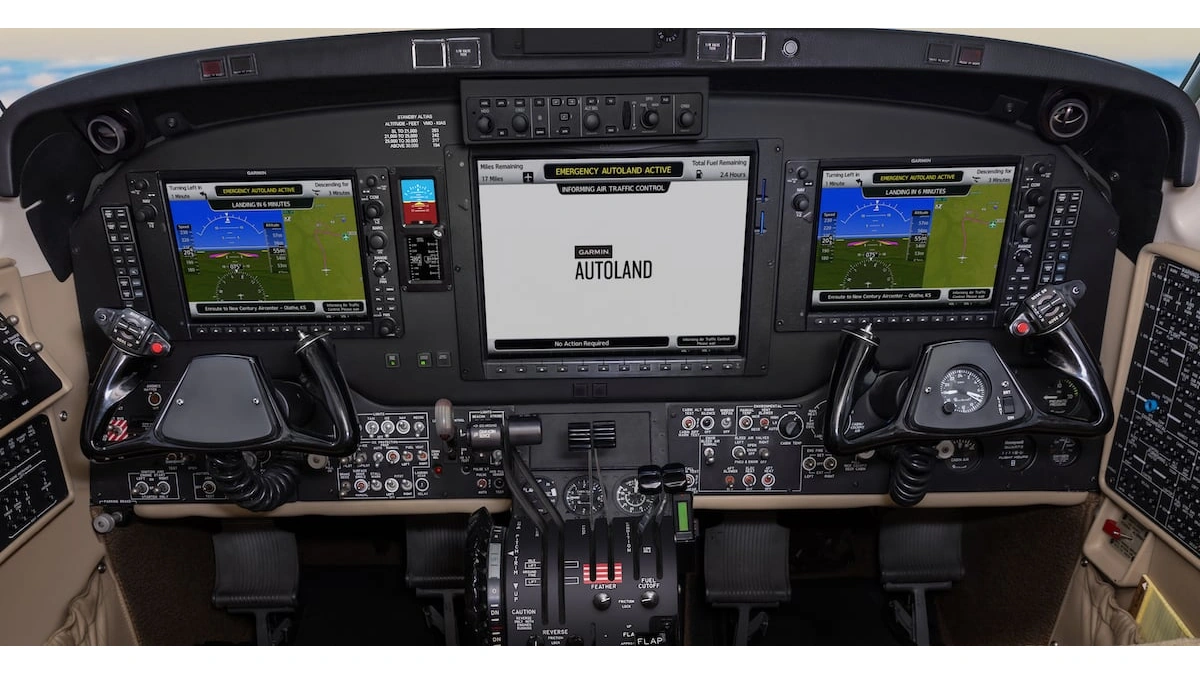
Garmin says more than 2,500 aircraft now carry its Autoland system, the emergency feature that flies a plane to a runway and lands it when nobody on board can. The count arrives just over six years after the first certification, which came in May 2020 on the Piper M600 SLS.
Autoland is built for one bad day. A passenger presses a dedicated button, or the system starts on its own if it detects no pilot interaction. It then picks the most suitable airport, steers around terrain and weather, flies a stabilized approach and lands, handling communication with air traffic control along the way. Per Garmin, nearly 250 of the 2,500 aircraft were fitted after delivery, and the system is now available on more than 15 certified models, from Cirrus piston aircraft to Piper, Daher and Pilatus turboprops, select Beechcraft King Airs and the Cirrus Vision Jet.
Four of those certifications came this year: the HondaJet Elite II, the Embraer Phenom 300EV, the Pilatus PC-12 PRO and the Epic E1000 AX. The two light jets matter most, because they are the first twin-engine jets to get the system. Until now the system was limited to piston aircraft, turboprops and the single-engine Cirrus Vision Jet.
Retrofits are the smaller but telling share. They include platforms delivered without the feature enabled and a full retrofit for King Air aircraft, which Garmin says brings Autoland to an aircraft produced over 50 years ago. By our arithmetic, the nearly 250 retrofits are roughly one in ten of the 2,500 installations, a sign that some owners are adding the capability rather than waiting to replace the airframe.
Garmin also says the feature now spans its G1000 NXi, G3000 and G3000 PRIME flight decks. The next step sits with Textron Aviation: Garmin expects certification in 2027 for the Cessna Citation M2 Gen3, CJ3 Gen3 and CJ4 Gen3 and for the Beechcraft Denali. The announcement gives no per-model fleet counts and no pricing, so how the 2,500 divides across those airframes is not public.