Arduino VENTUNO Q now costs $399, a $100 step up from the $299 introductory price that applied when orders opened in August. The new list price takes effect October 19, and Arduino says anyone who already pre-ordered keeps the lower figure.
Arduino blames the cost of many key components, memory modules in particular, which it says has climbed sharply across the industry and keeps rising. It says it absorbed the increases for as long as it could, and that it had promised an introductory price under $300 for the board, which it introduced in March. The $299 price kept that promise. The board then sold out twice, per Arduino, and orders have kept coming since.
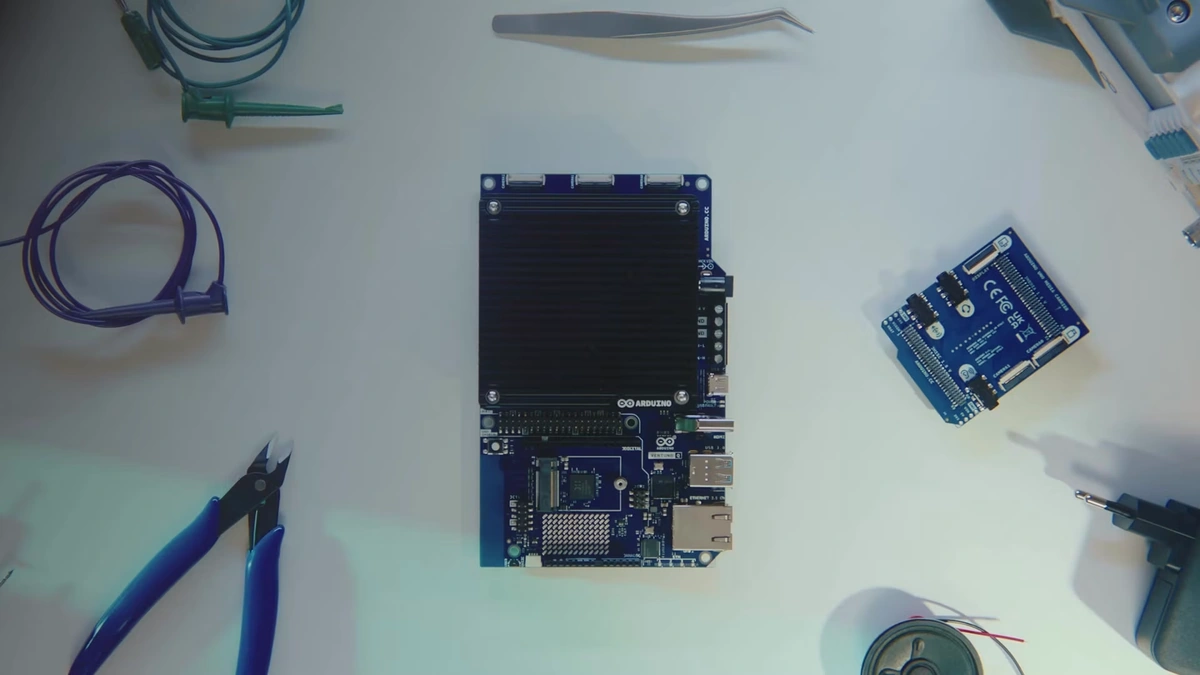
Per Arduino, the board comes with 16 GB of LPDDR5 memory and 64 GB of eMMC storage. It describes that memory as roughly double what typical 8 GB edge boards carry, and says the NPU, CPU and GPU share it.
What the money buys in the Arduino VENTUNO Q is a two-processor design. A Qualcomm Dragonwing IQ8 chip with a Hexagon NPU rated at 40 dense TOPS handles vision models and local LLMs, while an STM32H5F5 microcontroller running at 250 MHz takes care of motor control and other timing-critical work. Expansion runs through an M.2 slot for NVMe drives, three MIPI-CSI camera connectors and 2.5 Gb Ethernet. The software side is Ubuntu on the main processor and Zephyr on the microcontroller, with Debian listed as coming soon.
Arduino says the next App Lab release will add AI models and support for third-party accessories, including Raspberry Pi HATs and MIPI CSI cameras. For teams planning to ship products, Arduino names SECO and Toradex as certified partners with modules built on the IQ8 family, and says compatible apps built in Arduino App Lab move to those modules with no code changes. Beyond its own store, the board is sold through Conrad, DigiKey, Mouser, Farnell, RS and Robu.in, among other distributors.