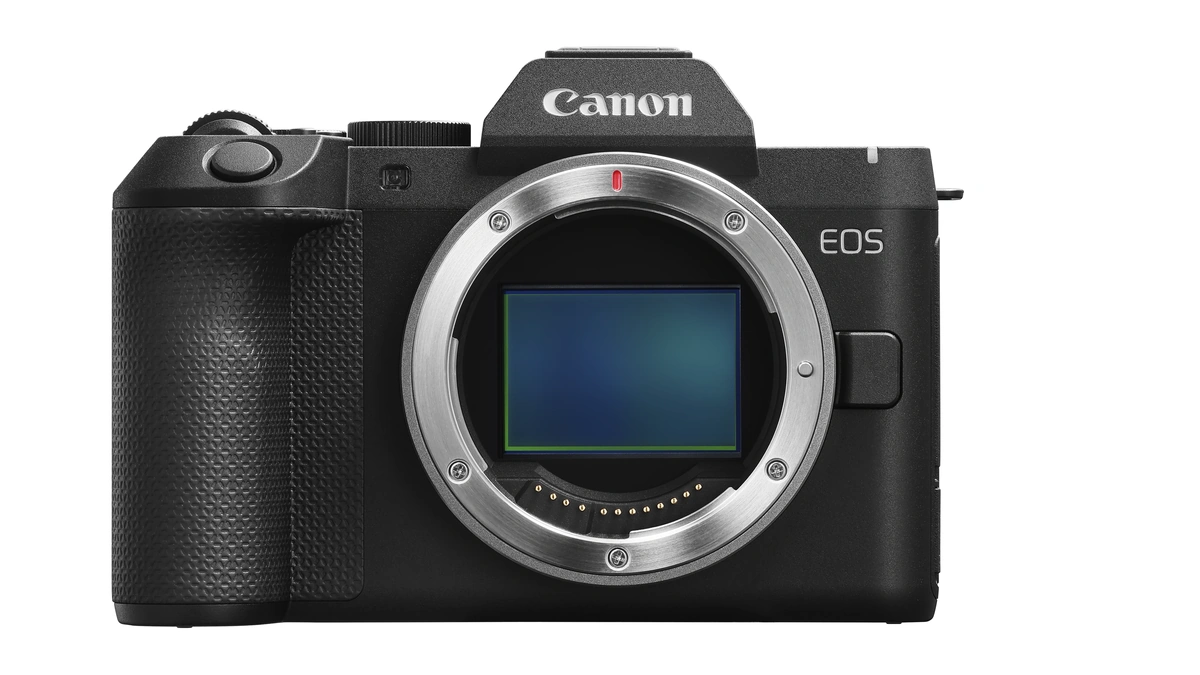
Canon introduced the EOS R8 Mark II, pitching it as the lightest body the company has built with stabilization built in to date. Photographers who skip stabilized full-frame gear specifically to save weight, hikers, run-and-gun documentary shooters, or anyone hauling a bag through an airport all day, are the audience this fills a gap for; until now they typically had to accept a heavier rig or drop stabilization altogether to keep the load down. It's aimed at people stepping up from crop-sensor systems, hobbyists, and creators who want that tradeoff gone. It weighs about 1.2 pounds and measures roughly 5.17 by 3.54 by 3.13 inches, small enough to disappear into a daypack rather than dominate one, the kind of detail that decides whether a camera comes along on a long shoot day or stays behind on a shelf.
Inside the EOS R8 Mark II sits a roughly 24.2-megapixel full-frame sensor rated to ISO 102400, paired with a newer version of Canon's Dual Pixel autofocus that follows people, animals and vehicles anywhere in the frame and can lock onto one saved face over others in a crowd. Per Canon, the electronic shutter fires at up to 40 frames a second, quick enough for a parent chasing a toddler across a yard or a birder waiting patiently on a single wingbeat, not just a specialist built purely for sports. Stabilization comes from a 5-axis unit engineered into the sensor mount to cooperate with a lens's own stabilizer instead of fighting it, which should help handheld shots in dim rooms or at dusk.
On the video side, the EOS R8 Mark II outputs uncropped 4K at 60 frames per second built from oversampled 6K capture, along with slow-motion Full HD footage up to 180 frames per second for anyone who wants to stretch a fast pan into something watchable. Wireless transfer runs on Wi-Fi 6, and the camera can push a live feed over USB-C, HDMI, or Canon's own streaming apps, cutting out the need for a separate capture card at a livestream desk, handy for anyone editing straight off the memory card on a tight deadline.
Two accessories launch alongside the EOS R8 Mark II. The EG-E2 grip twists on to give the camera a taller handhold, which matters because something this light can feel front-heavy once a big telephoto is mounted on it. The Speedlite EL-5 Ver.2 flash extends the wireless range of its predecessor and, Canon says, recharges to full power in just 1.2 seconds, fast enough to keep firing through a run of close portraits without waiting on the flash to catch up. It also throws in Dual Pixel 3D Converter for free, Windows software that turns depth-aware files from the new camera into 3D photos, models, or short clips, a genuinely niche feature aimed more at hobbyists experimenting with the format than working professionals chasing a paycheck.
Alone, the EOS R8 Mark II carries an estimated retail price of $1,899 when it ships in late October, and a kit bundled with the RF24-50mm F4.5-6.3 IS STM lens runs $2,099. The EG-E2 grip and Speedlite EL-5 Ver.2 land the same month at $99.99 and $379, positioning the whole lineup as an upgrade path rather than a one-off purchase for someone already invested in Canon's ecosystem of lenses.