An indie game publishing platform is a digital storefront that handles game distribution, revenue collection, and discoverability for independent developers who release titles without a major publisher. Where a traditional publisher provides an advance and takes creative control, a publishing platform provides infrastructure: file hosting, payment processing, checkout currency conversion, refund handling, and search placement. The developer retains rights and shoulders all production costs. The platform takes a percentage of gross revenue in exchange for access to its audience. According to the Newzoo Global Games Market Report 2024 Distribution-side engineering practices are surveyed at the GitHub Engineering Blog., PC gaming accounts for the largest segment of global digital game sales, and indie titles represent a growing share of that spend. Four platforms dominate where independent PC developers choose to sell: Steam, itch.io, Epic Games Store (EGS), and GOG. Each makes a different set of tradeoffs on revenue share model, upfront submission costs, algorithmic discoverability, and audience composition. Epic Games Store takes a 12% revenue cut from titles published through the store, with no platform submission fee. See also: SSD.
What an Indie Game Publishing Platform Does
Epic Games Store offers the highest developer revenue split of the four platforms: 88% to the developer with no tiered adjustment, per Epic Games Store Developer Documentation. There is no platform submission fee, but EGS is a curated storefront that selectively accepts titles. A submission is reviewed by Epic's team; acceptance is not guaranteed for a first-time indie developer without a track record or press coverage.
EGS has a significantly smaller active user base than Steam. Organic algorithmic discoverability through EGS is low for titles without an existing audience because the platform has no user review system and no user-generated discovery queue. Most EGS players arrive through Epic's free game programs or publisher promotional agreements. EGS's 88% payout to developers is meaningfully better than Steam's base rate, but lower unit volume on EGS can mean lower total net revenue compared to Steam's 70% split on a larger sales count.
GOG: Curated, DRM-Free, Niche-Loyal
GOG is a curated storefront built around DRM-free distribution. Every game sold on GOG must ship without digital rights management software, which is the platform's foundational brand promise to buyers who value offline play and long-term preservation. The developer revenue split is 70/30 with no tiered adjustment. There is no platform submission fee, but GOG reviews all submissions and rejects the majority. GOG Connect links a user's Steam library to their GOG account for supported titles, allowing players to obtain DRM-free versions of games they already own on Steam, which can drive GOG sales for titles with strong Steam install bases.
GOG's audience is smaller than Steam's and more homogeneous: they prioritize preservation, offline functionality, and a curated catalog. Discovery relies on editorial featuring for accepted titles rather than an algorithmic discovery queue. A title that passes GOG's curation gate gains a loyal buyer segment that other platforms cannot fully replicate.
Revenue Share and Fee Comparison
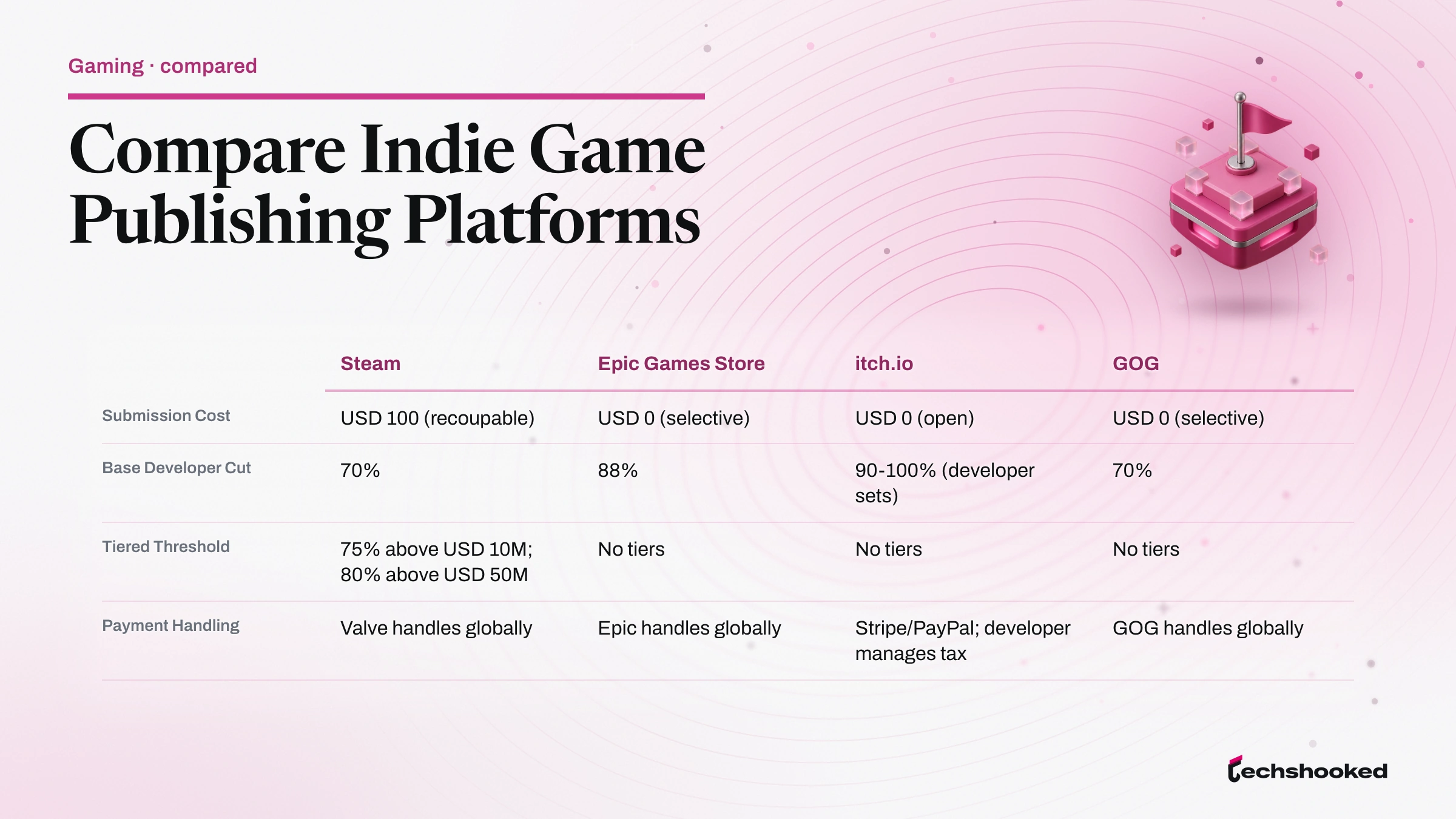
The revenue share model and platform submission fee determine how much of each sale the developer actually receives. The table below consolidates the key economic variables across all four platforms.
| Platform | Submission Cost | Base Developer Cut | Tiered Threshold | Payment Handling |
|---|---|---|---|---|
| Steam | USD 100 (recoupable) | 70% | 75% above USD 10M; 80% above USD 50M | Valve handles globally |
| Epic Games Store | USD 0 (selective) | 88% | No tiers | Epic handles globally |
| itch.io | USD 0 (open) | 90-100% (developer sets) | No tiers | Stripe/PayPal; developer manages tax |
| GOG | USD 0 (selective) | 70% | No tiers | GOG handles globally |
To make the developer revenue split concrete: a game that earns USD 50,000 in gross sales nets the developer USD 35,000 on Steam (70%), USD 44,000 on EGS (88%), USD 45,000-50,000 on itch.io depending on the fee the developer sets, and USD 35,000 on GOG (70%). The free-to-upload model on itch.io produces the highest gross-to-net ratio at that revenue level, but itch.io's total addressable buyer pool is smaller than Steam's by an order of magnitude. EGS produces the second-highest net at USD 44,000, but achieving USD 50,000 in gross sales on EGS requires either Epic's promotional support or an established audience. The Steam Direct fee of USD 100 is effectively a rounding error at USD 50,000 gross; its significance is highest for developers releasing a game priced under USD 5 or projecting fewer than 1,000 sales. Gartner Research on digital distribution platform economics confirms that per-unit revenue share becomes the dominant cost variable at scale, while fixed fees matter most for low-volume or experimental releases.
Discoverability Mechanics: How Each Platform Surfaces New Games
Algorithmic discoverability varies more between these four platforms than any other variable in the comparison. The indie game publishing platform a developer chooses determines which discovery levers are available at launch.
Steam uses a tag-based recommendation engine and the New and Trending queue, which weights first-week sales velocity and wishlist conversion rate. Steam Next Fest (a bi-annual demo event) provides concentrated exposure for upcoming titles. Pre-launch wishlisting is the primary mechanism: a large wishlist pool before release signals demand to the algorithm, which then amplifies placement. Steam curators (community members who publish game lists) add a long-tail discovery layer.
EGS has no user-generated discovery queue and no review-based ranking. New titles surface primarily through editorial featuring by Epic's team or through Epic's free games program. Organic discovery for an unfeatured indie title is low. Developers building a streaming audience alongside their game launch may find the streaming hardware and connection quality considerations covered in the stream optimization and internet requirements guide relevant to their EGS promotional strategy.
itch.io relies on game jam visibility as its primary discovery engine for new developers. Jams create concentrated traffic events with leaderboards and community voting. Outside of jams, the front page favors recently uploaded titles and itch.io community ratings. There is no wishlist mechanic.
GOG surfaces accepted titles through editorial curated features and community forums. There is no algorithmic discovery queue. Word-of-mouth and press coverage drive GOG sales more than platform mechanics. Research from IEEE Consumer Electronics Research on digital distribution ecosystems notes that curated storefronts with smaller catalogs can deliver higher conversion rates per page view than open storefronts, because buyer intent is stronger when catalog size filters for quality.
Ranked by organic discovery ceiling for a first-time developer with no existing audience:
- Steam: highest ceiling via wishlisting, first-week sales velocity weighting in the New and Trending queue, Steam Next Fest demo exposure, and tag-based recommendation at scale
- itch.io: strong ceiling within its niche through game jam visibility and community engagement, with near-zero barrier to entry
- GOG: moderate ceiling for accepted titles within its preservation-focused audience; editorial featuring provides a guaranteed placement window
- Epic Games Store: lowest organic ceiling for unfeatured titles; discovery depends almost entirely on external audience or Epic promotional support
Choosing the Right Platform for Your Game
Selecting an indie game publishing platform requires matching the platform's revenue share model, audience size, and discovery mechanics against the developer's budget, genre, and launch stage. The self-publishing tools available differ enough across platforms that the decision meaningfully affects launch economics and audience reach.
- Mainstream PC audience, developer can fund the Steam Direct fee: Launch on Steam. The installed base, wishlisting mechanics, and organic discoverability make it the default choice for titles targeting a broad PC audience. Submit at least 90 days before release to build a wishlist pool before the New and Trending window opens.
- Game-jam prototype, experimental, pixel-art, or zine game: Launch on itch.io first. The free-to-upload model means zero upfront cost. The itch.io community provides immediate feedback from an audience that expects and values experimental work. Use itch.io data (ratings, download counts, devlog comments) as proof-of-concept before committing to a Steam Direct submission.
- Title with Epic partnership or premium pricing and limited print run: Consider EGS for its 88% developer revenue split. Do not expect organic discovery; plan an external marketing budget or confirmed Epic promotional support before treating EGS as a primary sales channel.
- Polished, DRM-free experience targeting preservation-conscious buyers: Apply to GOG after building critical reception on Steam or itch.io. GOG's curation gate requires demonstrated quality; a strong review score or significant wishlist count on another platform strengthens the application. The GOG Connect program can also extend DRM-free distribution reach to players who already own the title on Steam.
- Multi-platform strategy: Use itch.io as a free demo host and press kit hub while Steam handles the paid full-game launch. This combination costs only the Steam Direct fee, generates wishlist momentum from itch.io traffic, and separates the community-building channel from the commercial one. There is no exclusivity conflict between Steam and itch.io.
Platform selection follows engine and target-platform decisions, not the reverse. The Unity vs Unreal Engine selection guide covers how engine choice constrains platform compatibility, build pipeline, and performance targeting. Once the engine decision is made, the publishing platform choice above maps cleanly to audience and budget constraints. For games targeting non-PC platforms or console certification, the NPC behavior and AI design constraints covered in the NPC AI behavior guide affect scope in ways that may change which platform's audience is the right fit.
Submission Requirements at a Glance
- Steam Direct submission ($100) gets you Steamworks SDK and wishlist tooling
- itch.io accepts free uploads with revenue-share opt-in
- EGS curates submissions and offers 88/12 revenue split
- GOG curates and enforces DRM-free distribution
Further reading
Frequently Asked Questions
What is the revenue split difference between Steam and Epic Games Store for indie developers?
Steam pays developers 70% on gross sales up to USD 10 million, rising to 75% above that threshold, while Epic Games Store pays 88% with no tiered adjustment. For a game that earns USD 50,000 in gross revenue, Steam nets the developer USD 35,000 versus USD 44,000 on EGS. The trade-off is audience size: Steam's active user base is roughly 10 to 15 times larger than EGS, so a lower payout percentage on Steam can still produce higher total net revenue if the title sells more copies.
Can an indie developer publish on Steam and itch.io at the same time?
Simultaneous publishing on Steam and itch.io is allowed and common practice. Many developers use itch.io as a free demo or early-access hub while selling the full game on Steam; itch.io imposes no exclusivity requirement. The practical consideration is key management: Steam and itch.io issue separate activation keys, and the developer must decide whether the itch.io version uses Steamworks DRM or ships as a standalone executable.
Does GOG accept every game that applies?
GOG uses editorial curation and rejects the majority of submissions. The platform prioritizes titles with strong critical reception, a DRM-free-compatible build, and a clear fit with its preservation-focused audience. Developers should submit a press-ready build with review scores or significant wishlist data on another platform before applying to GOG. Acceptance rates are not published, but community estimates suggest fewer than one in five submissions are approved. The 4K gaming graphics card guide covers the adjacent hardware angle.