ASUS ROG arrived at CES 2026 with one of its widest slates in years, spanning laptops, monitors, a prebuilt desktop, AR glasses, and a networking prototype, and leaning hard on a set of "world's first" claims to hold the whole thing together. The piece drawing the most attention is the 2026 ROG Zephyrus Duo, a 16-inch laptop that stacks two full-size 3K OLED touchscreens, pairs them with an Intel Core Ultra 9 386H and up to an NVIDIA GeForce RTX 5090 Laptop GPU, and uses a detachable keyboard to switch between laptop, tent, and portrait layouts.
Two collaborations gave the lineup its personality. The ROG Flow Z13-KJP, a 2-in-1 tablet designed with Kojima Productions artist Yoji Shinkawa, runs an AMD Ryzen AI Max+ 395 with 128GB of unified memory and Radeon 8060S graphics, and comes with a matching white-and-gold peripheral set: the Delta II headset, the Keris II Origin mouse, and the Scabbard II XXL mat. It reads as a halo product for fans of the studio more than a mainstream configuration.
The most substantive display news was a panel change rather than a spec bump. ROG showed monitors built on a full RGB subpixel layout it calls RGB Stripe OLED, which ASUS says sharpens text and color rendering compared with the diagonal subpixel patterns common on current OLED gaming screens. The lead model, the ROG Swift OLED PG27UCWM, runs a dual mode of 4K at 240Hz or FHD at 480Hz, joined by two 34-inch ultrawide OLEDs. Dual-mode IPS options include the ROG Strix XG27JCG at 5K 180Hz or QHD 330Hz.
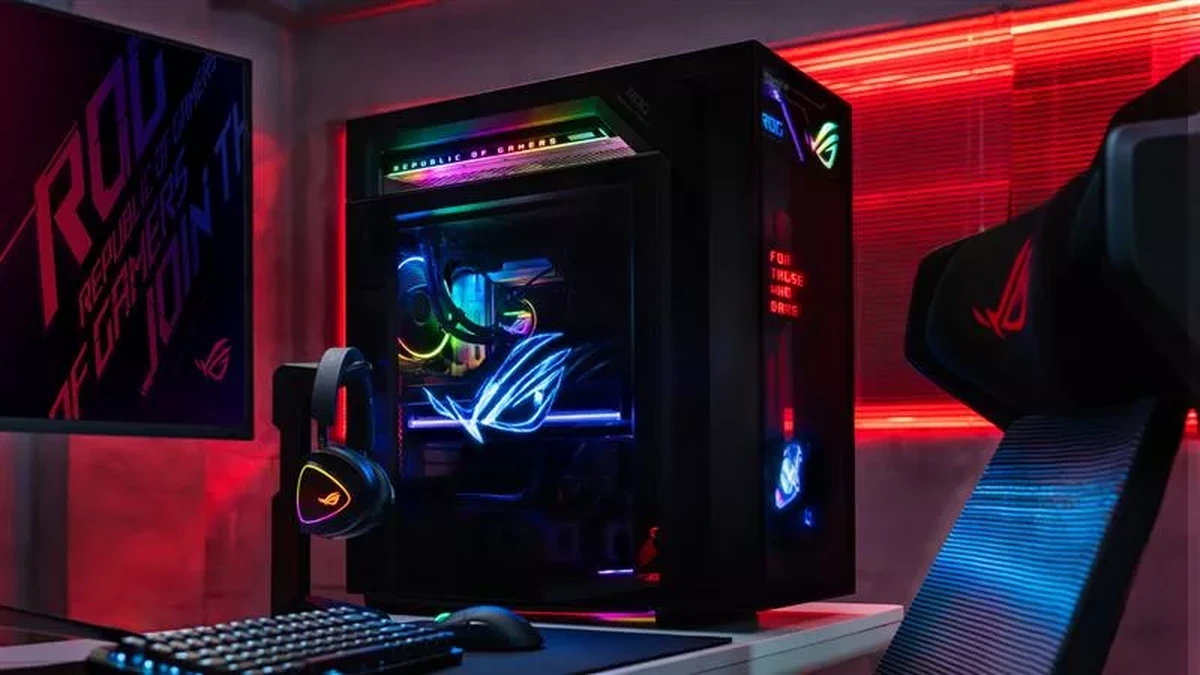
The rest of the show filled in the ecosystem. The ROG G1000 prebuilt tops out at a Ryzen 9 9950X3D and either a Radeon RX 9070 XT or an RTX 5090, and adds an AniMe Holo holographic projection panel on tempered glass. The ROG XREAL R1 glasses put a 240Hz micro-OLED display at a 57-degree field of view and target ROG's own Xbox Ally handheld alongside phones and consoles. Cases, ARGB fans, hot-swap keyboards, and a planar-magnetic headset built with HIFIMAN rounded out the hardware.
The most forward-looking demo was also the least buyable. ROG showed the NeoCore, a WiFi 8 router prototype shaped like an icosahedron to seat antennas at its vertices, which the company says posted a throughput gain of more than 10 percent over WiFi 7 in early testing. That number sits against a hard caveat ASUS states plainly: the WiFi 8 standard itself is still years from being finalized, which makes the NeoCore a look at where networking is heading rather than a product anyone can buy soon.
Almost none of it came with a price or a firm ship date, which is normal for a CES floor and worth holding onto. The Zephyrus Duo and the RGB Stripe monitors are the announcements most likely to matter to buyers, and until ROG attaches costs and calendars to them, the show is best read as a signal of direction rather than a shopping list.