A threat intelligence tool is a cybersecurity platform that collects, processes, and analyzes data about adversary tactics so security teams can defend against attacks before they succeed. The category sits between raw feed aggregators and full-blown detection stacks, and the distinction matters when budget owners try to compare line items. Vendors fold the label onto everything from a free IP blocklist to a six-figure analyst workbench, so the buyer who cannot name the four canonical intelligence types tends to overpay for one layer while leaving another empty. The taxonomy below maps each type to the analyst who consumes it and the workflow that depends on it.
What a TI Tool Does
A threat intelligence tool runs a three-stage pipeline: it collects raw indicators from feeds and sensors, processes that material through deduplication and normalization, and produces contextual analysis that an analyst or another system can act on. Raw indicators (file hashes, IP addresses, domain names) carry no judgment about confidence or relevance. Threat data aggregation turns those streams into a single queryable corpus. Actionable intelligence is what remains after the platform has scored confidence, tagged the threat actor, and mapped the behavior to a known technique.
That last step is where a TI tool diverges from adjacent products. A SIEM correlates events inside the network. A feed aggregator pipes external data into a bucket. A TI platform sits in front of both, enriching what comes in and ranking what goes out. The definition list below sharpens the boundaries so procurement does not buy the same capability twice.
- Threat intelligence tool
- Ingests external feeds, enriches indicators with adversary context, scores confidence, and pushes prioritized intelligence into downstream detection and response systems.
- SIEM (security information and event management)
- Aggregates internal log data, correlates events against rules, and surfaces alerts. Consumes intelligence from a TI tool but does not generate it.
- Raw feed aggregator
- Subscribes to one or more indicator streams and writes them to a shared store. No scoring, no enrichment, no analyst workflow.
Four Types of Threat Intelligence
Every threat intelligence tool produces output that falls into one of four types, and each type answers a different question for a different audience. Strategic intelligence answers "what should we worry about over the next budget cycle." Operational intelligence answers "who is targeting us and how." Tactical intelligence answers "what attacker behaviors should our analysts hunt for." Technical intelligence answers "what should we block at the firewall today."
The MITRE ATT&CK framework anchors the tactical and technical layers by giving every adversary technique a stable identifier (T1566 for phishing, T1059 for command-and-scripting). A platform that maps its tactical intelligence output to ATT&CK IDs gives detection engineers a vocabulary that survives vendor changes. Strategic and operational intelligence rely more on narrative analyst reporting, often delivered as periodic briefs rather than feed updates.
| Type | Audience | Time Horizon | Example Output |
|---|---|---|---|
| Strategic | Board, CISO | Quarters to years | Annual threat landscape brief naming ransomware groups active in the sector |
| Operational | Incident response leads | Days to weeks | Campaign report describing a named threat actor targeting healthcare with a specific loader |
| Tactical | security operations center (SOC) analysts, detection engineers | Hours to days | MITRE ATT&CK technique mapping with detection logic and hunting queries |
| Technical | Network and endpoint engineers | Minutes to hours | Feed of malicious file hashes, IPs, and domains ready for firewall or EDR ingestion |
A common procurement mistake is buying a tool that excels at technical intelligence (indicator feeds) and assuming it will satisfy a board that wants strategic intelligence. The two outputs live in the same product category but require different analyst skill sets to produce.
Six Use Cases Across the Security Lifecycle
A tool wired into threat intelligence feeds earns its keep through specific, named workflows. The six use cases below cover the bulk of operational value in mid-market and enterprise programs, and each draws on a different intelligence type. Each workflow assumes the underlying TI feeds carry confidence scoring and adversary attribution, not raw indicator lists. CISA's information-sharing guidance covers similar workflow patterns for organizations that participate in sector ISACs.
- Security operations center (SOC) alert triage. Tactical and technical intelligence enrich incoming SIEM alerts with adversary context, letting analysts dismiss low-value noise and escalate matches against active campaigns.
- Risk-based vulnerability management. Operational intelligence identifies which CVEs are under active exploitation by relevant threat actors, so vulnerability management teams sequence work by adversary interest rather than CVSS score alone.
- Incident response (IR) enrichment. When an alert fires, IR analysts pivot from a single indicator of compromise (IoC) to the full kill chain through the TI platform, shortening containment timelines.
- Threat hunting hypothesis generation. Tactical intelligence about new adversary techniques feeds the transition from indicators of compromise to threat hunting by giving hunters concrete behaviors to query against historical telemetry.
- Phishing and brand abuse detection. Domain-monitoring feeds inside a TI tool flag lookalike domains and credential-harvesting infrastructure before the lures reach inboxes.
- Executive risk reporting. Strategic intelligence rolls technical findings into board-ready narratives that connect threat actor activity to business risk and security investment.
Teams that operationalize four or more of these use cases recover the cost of a commercial TI platform faster than teams that buy for one. The opposite is also true: a single use case rarely justifies a six-figure subscription.
How Threat Intelligence Feeds Work

Threat intelligence feeds are the input layer of any TI tool. Most modern platforms exchange data through STIX/TAXII, where STIX 2.1 defines the JSON schema for objects like indicators, threat actor profiles, and attack patterns, and TAXII 2.1 defines the HTTPS transport. The IETF draft for safe IoC sharing formalizes the privacy and integrity expectations for organizations that exchange indicators through these protocols.
Feeds split into three broad categories by source, and a mature program subscribes to at least one of each. The list below describes what each category contributes and where it tends to fall short.
- Open-source feeds. AlienVault OTX, abuse.ch URLhaus, and Spamhaus publish high-volume indicators of compromise (IoC) at no cost. Coverage is broad, but confidence scoring and adversary attribution are minimal.
- Commercial feeds. Vendors such as Recorded Future, Mandiant Advantage, and CrowdStrike Falcon Intelligence sell curated feeds with analyst-written context and confidence ratings. Latency from observation to publication is shorter, and tactical reports map to the MITRE ATT&CK framework.
- Government and ISAC feeds. CISA's Automated Indicator Sharing program and sector ISACs (FS-ISAC for financial services, H-ISAC for healthcare) provide vetted intelligence about campaigns targeting specific industries.
IoC enrichment is the step that converts a raw feed entry into useful tactical intelligence. The TI platform pulls in additional context (passive DNS history, malware family attribution, related infrastructure) and produces an enriched object that downstream tools can correlate against telemetry. Feed ingestion without enrichment leaves analysts to do the joins by hand.
Selecting a TI Tool: Key Criteria
Tool selection rewards specificity. Vendor demos all look identical at the dashboard level, so the comparison has to descend into ingestion formats, API contracts, and analyst workflow ergonomics. The criteria below separate platforms that will integrate cleanly from those that will create a second silo.
- STIX/TAXII ingestion support. Native STIX 2.1 over TAXII 2.1 is the baseline. Tools that accept only proprietary formats lock the program into the vendor's feed catalog.
- SIEM and SOAR integration APIs. Look for documented connectors for Splunk, Microsoft Sentinel, Chronicle, and the major SOAR platforms. Two-way integration matters more than one-way export. See SIEM vs SOAR: Understanding Threat Detection Systems for the architectural context.
- MITRE ATT&CK technique tagging. Every piece of tactical intelligence should carry an ATT&CK technique ID, ideally with sub-technique granularity. Tagging is what makes intelligence searchable across vendors.
- Feed quality scoring. The platform should expose a false positive rate and source confidence for every indicator. Without that, the tool produces volume rather than signal.
- Analyst workflow UI. Pivoting from an indicator to its enrichment graph should take one click. The teams that abandon TI platforms most often cite friction in this workflow.
Smaller programs face different trade-offs. The Top TI Platforms For SMBs guide covers the budget tier where managed feed services and free community platforms often outperform enterprise products. For monitoring-led requirements, the guide to choosing a real-time threat monitoring tool covers latency-sensitive selection criteria.
Integrating TI Tools into Existing Security Workflows
A TI tool delivers value only when it is wired into the detection and response stack. Standalone deployments produce reports nobody reads. The integration sequence below mirrors what NIST recommends for log management alignment in the SP 800 series, adapted for proactive threat detection rather than purely retrospective analysis. Programs that operationalize proactive threat detection see the largest reduction in dwell time.
- Define intelligence requirements. Document which adversary tactics matter most to the business and which downstream systems will consume each intelligence type. Skipping this step is the most common cause of failed TI rollouts.
- Connect feeds via TAXII endpoints. Configure the TI platform to pull from the chosen open-source, commercial, and ISAC feeds using STIX/TAXII subscriptions. Test latency from publication to local availability.
- Map enriched IoCs to SIEM correlation rules. Push high-confidence indicators of compromise into the SIEM as watchlists. Tune rules so that an IoC hit is correlated with at least one behavioral signal before alerting.
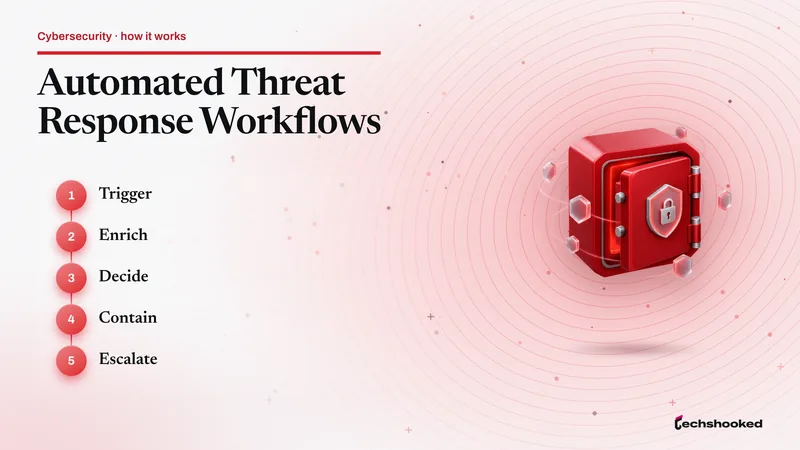
- Route high-confidence TI alerts to SOAR playbooks. The Implement Automated Threat Response Workflows guide details how to gate enrichment, ticket creation, and containment actions behind confidence thresholds rather than blanket automation.
- Close the loop with analyst feedback. Capture which indicators produced true positives and which produced noise, then push that feedback back into feed scoring. A TI program without a feedback loop drifts toward irrelevance within a year.
Intelligence sharing through ISAC participation extends the feedback loop beyond the organization. Submitting validated indicators back to community feeds improves coverage for peers and earns reciprocal visibility into adversary tactics observed elsewhere in the sector.
Further reading
Frequently Asked Questions
What are the four types of threat intelligence?
The four types are strategic (board-level risk context), operational (active campaign details for IR teams), tactical (attacker TTPs for SOC analysts). Technical (specific IoCs for engineers to block at the firewall or endpoint). Strategic intelligence informs long-term security investment decisions. Operational intelligence describes ongoing threat actor campaigns, including targets and timelines. Tactical intelligence maps to MITRE ATT&CK techniques and tells analysts what behaviors to hunt for. Technical intelligence consists of file hashes, malicious IPs, and domain names that tools can ingest and act on automatically.
What are some common threat intelligence tool use cases?
The six most common use cases are SOC alert triage, risk-based vulnerability patching, incident response enrichment, threat hunting hypothesis generation, phishing detection, and executive risk reporting. Each use case draws on a different intelligence type: SOC triage and hunting rely on tactical and technical intel; patching prioritization relies on operational intel about active exploitation; executive reporting relies on strategic intel. The tool's value depends on which use cases the team actually operationalizes.
How does STIX/TAXII enable TI sharing?
STIX (Structured Threat Information eXpression) defines a standard JSON schema for describing threat objects. TAXII (Trusted Automated eXchange of Indicator Information) is the transport protocol that delivers those objects between platforms automatically. When a tool supports STIX 2.1 ingestion over TAXII 2.1, it can subscribe to commercial or open-source feeds and pull new IoCs, TTPs, and adversary profiles without manual import. This is the same sharing model standardized in the IETF draft for safe IoC sharing. Organizations without STIX/TAXII support fall back to manual CSV imports, which delay detection and introduce transcription errors.