Apple iOS is a mobile operating system that runs iPhone and iPad devices through vendor-controlled hardware integration and kernel security enforcement.
Android is the open-source counterpart most often set against it, maintained by Google on top of a Linux kernel and shipped across a wide OEM fleet. The two platforms now diverge on more axes than they used to, and the gap that matters most to architects, IT leads, and developer teams is no longer the surface user experience. It is the architectural posture: how each kernel isolates workloads, how each distribution channel handles third-party code, how each privacy framework treats cross-app tracking, and how each enterprise management stack behaves under fleet-scale MDM control.
The 2026 ecosystem reshapes several of those axes at once. Android 16 tightened per-app network sandboxing defaults, iOS 19 added entitlement provisioning controls, and the EU Digital Markets Act (DMA) forced Apple to permit alternative marketplaces in the European Economic Area. Reading iOS vs Android through those concrete changes, rather than through generic comparison framings, is the only way to make a defensible platform call.
Kernel Architecture and Sandboxing
Side-load on Android follows a simple flow: the user enables install from a specific source, downloads or transfers an APK, and the package installer runs Play Protect against the binary before installation. F-Droid remains the most-cited open-source alternative store; OEM stores such as Samsung Galaxy and Huawei's AppGallery (the latter dominant in China after the GMS sanctions) extend the channel mix further. Three distribution choices recur in practitioner planning.
- App Store distribution only. Default iOS posture outside the EEA, with the strongest human review gate and the narrowest payment-API surface; the App Store distribution model concentrates trust in Apple's review pipeline.
- Alternative marketplace plus notarization. The DMA path on iOS inside the EEA, where third-party install is permitted only through notarized marketplaces that satisfy Apple's binary-scan requirements and accept the Core Technology Fee terms.
- Play Store with optional direct install. The Android baseline: Play Store distribution is the default, with side-loaded installation available per-source after an explicit user grant, and OEM stores layering on top for region-specific catalogs.
Form-factor distribution context for hardware buyers sits alongside this discussion in Understanding Fanless PCs: Benefits and Best Models and Laptops vs Desktops vs Workstations.
Privacy Architecture: ATT vs Privacy Sandbox
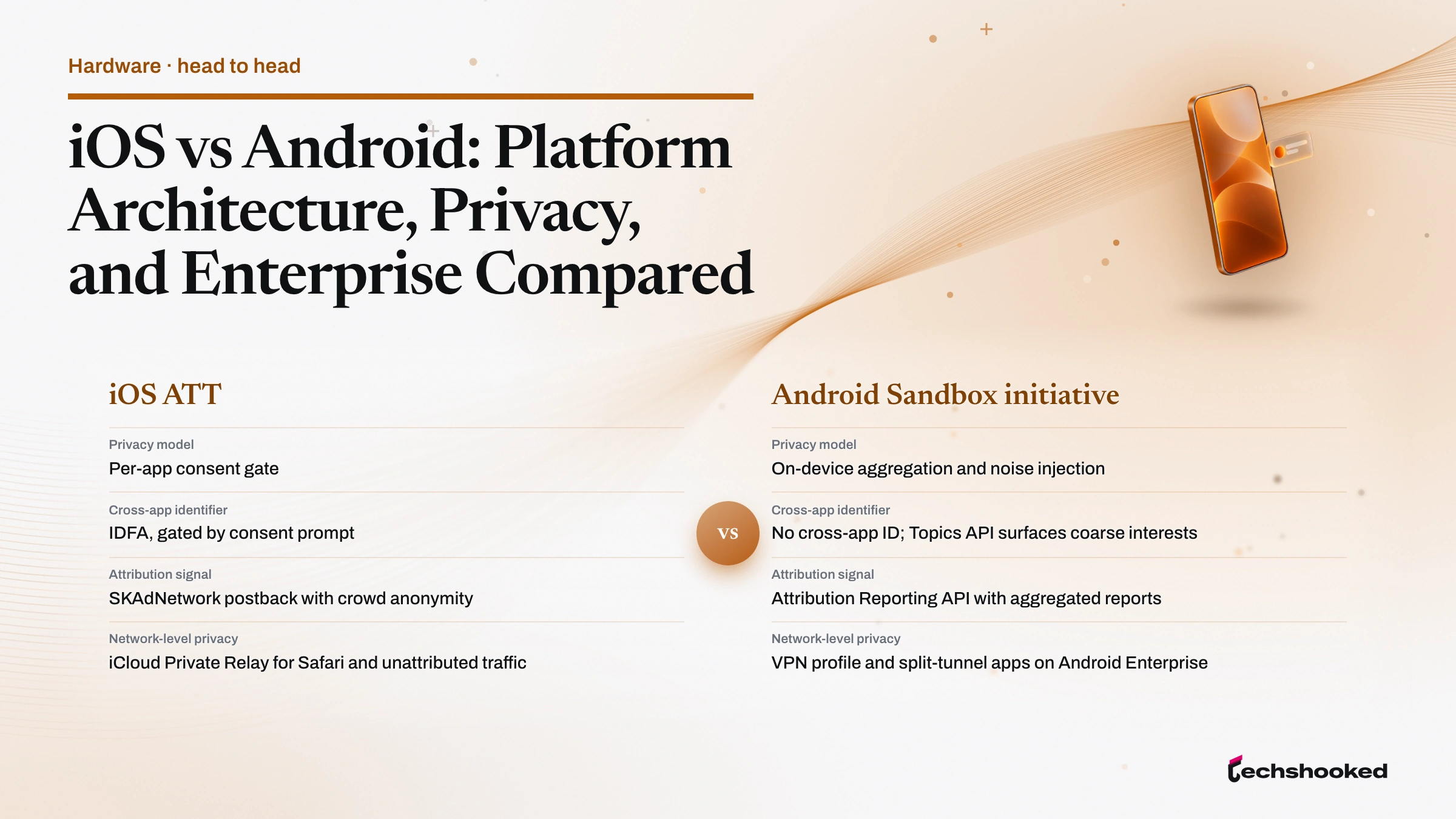
iOS 14.5 shipped App Tracking Transparency (App Tracking Transparency) in April 2021, requiring every app that wants to read the IDFA or perform cross-app tracking to surface an explicit opt-in prompt. Post-prompt opt-in rates settled around 25 percent globally, which collapsed the addressable IDFA pool and rewired the mobile advertising stack around SKAdNetwork's privacy-preserving attribution surface. Android's Privacy Sandbox is Google's structural response, built around the Topics API, the Attribution Reporting API, the Protected Audience API (the FLEDGE successor), and Fenced Frames for isolated ad rendering. ATT and Privacy Sandbox approach the same problem from different angles: ATT is a consent gate, while Privacy Sandbox is a privacy-preserving computation model that aggregates signals before any advertiser sees them.
iOS ATT and IDFA
The IDFA lifecycle on iOS now hinges on ATT consent. An app calls ATTrackingManager.requestTrackingAuthorization, the system shows the consent prompt, and the IDFA returns a zeroed value if the user denies. SKAdNetwork carries the post-install attribution signal back to the ad network through an Apple-mediated postback, with crowd-anonymity thresholds that prevent per-user reconstruction. The IDFA itself remains accessible to apps with consent; the ATT enforcement is what made consent the binding constraint rather than the IDFA opt-out toggle that came before.
Android Privacy Sandbox
Privacy Sandbox on Android entered general availability across Android 14 and 15 devices, and Android 16 broadened the device population. Topics API classifies the device into a coarse interest taxonomy that ad SDKs can read without seeing individual app history. Attribution Reporting API replaces the IDFA-equivalent advertising attribution flow with aggregated, noise-injected reports. Protected Audience API runs remarketing auctions on-device so the bid request never carries cross-site identifiers off the handset. Location precision toggles complete the picture: iOS exposes Precise Location as a per-app switch, while Android has offered approximate-only location as a permission tier since Android 12.
| Attribute | iOS ATT | Android Sandbox initiative |
|---|---|---|
| Privacy model | Per-app consent gate | On-device aggregation and noise injection |
| Cross-app identifier | IDFA, gated by consent prompt | No cross-app ID; Topics API surfaces coarse interests |
| Attribution signal | SKAdNetwork postback with crowd anonymity | Attribution Reporting API with aggregated reports |
| Network-level privacy | iCloud Private Relay for Safari and unattributed traffic | VPN profile and split-tunnel apps on Android Enterprise |
| Location precision control | Precise Location toggle per app | Approximate-only permission tier since Android 12 |
Enterprise privacy posture extends past the OS layer; Best Privacy Tools for Enterprises covers the tooling that sits above ATT and Sandbox project at the corporate-control layer.
Enterprise Management: ABM vs Android Enterprise
iOS ties into Apple Business Manager (ABM) for fleet provisioning, and ABM brokers the Automated Device Enrollment (ADE) handshake that links each serial-numbered device to the chosen mobile device management (mobile device management) server before the first boot. Jamf Pro, Microsoft Intune, and VMware Workspace ONE are the dominant MDM platforms on the iOS side, and all three consume ABM tokens through the same protocol. Android Enterprise covers the parallel ground on Android, with three operating modes that map to distinct procurement paths: work profile for BYOD, fully managed for corporate-owned devices, and dedicated for kiosk and single-use deployments. Android 16 deprecated the legacy Device Admin API and pushed all new enrolments toward Android Enterprise's EMM API surface.
iOS MDM and Declarative Device Management
ADE moves the enrollment trigger from the user to the supply chain: Apple ships the device, the serial number arrives in the ABM tenant, and the MDM server pushes the enrollment profile at activation. Declarative Device Management (DDM), introduced in iOS 15 and broadened across iOS 18 and 19, moves state evaluation onto the device itself, which cuts the round-trip count and improves convergence time on large fleets.
Android Enterprise Work Profile and Zero-Touch
The work profile container holds corporate apps, data, and policies in a kernel-enforced sandbox that personal apps cannot read or write. Google Zero-Touch Enrollment matches ADE for corporate-provisioned devices, and the Android Enterprise Recommended (AER) certification labels the OEM models that meet Google's hardware and update commitments for managed fleets.
- Zero-touch enrollment paths. ABM with ADE on iOS; Google Zero-Touch on The Android EMM stack; both eliminate the manual enrollment step at activation.
- BYOD separation. iOS uses Managed Open-In to partition managed and unmanaged data flows; Android EMM stack uses the work profile container as a kernel-enforced boundary.
- MDM command depth. iOS DDM ships declarative state objects the device reconciles locally; Android device management EMM API offers richer policy granularity through a longer-standing command set and works across the AER OEM list.
Credential hygiene at the fleet edge is a separate discipline; Best Password Managers for Business covers the secrets layer that sits behind any MDM-enrollled device.
OS Update Cadence and Fragmentation
iOS ships updates simultaneously to every supported device directly from Apple, and the supported-device list for iOS 19 (released in autumn 2025) extends back to the iPhone XR from 2018, an eight-generation support window. Android still carries OEM update fragmentation as its long-running structural weakness, though Project Treble (introduced in Android 8.0 in 2017) decoupled the Android framework from the vendor HAL to accelerate OEM updates. Android 16, released in Q2 2026, paired Project Treble with a new Android Update Policy that requires Android device-management framework framework Recommended devices to receive three years of OS updates and five years of security patches. The practitioner risk is concrete: an iOS fleet sits at a homogeneous patch level, while an Android fleet can span three to four OS generations across active devices unless procurement is locked to a single OEM with extended commitments.
- Apple iOS 19: all supported devices receive the release on day one; support window extends back to the iPhone XR (2018), covering roughly eight device generations.
- Google Pixel: seven years of OS and security updates committed from the Pixel 8 forward, the longest published Android commitment.
- Samsung Galaxy S-series: seven years of OS and security updates, matching Pixel for the flagship line; mid-range Galaxy A-series remains at four-year tracks.
- Android Update Policy baseline: three years of OS and five years of security patches for Android management framework Recommended devices under Android 16.
- Non-flagship OEMs: two to three years of OS updates remains the typical commitment, the root cause of OEM update fragmentation across the wider Android fleet.
For adjacent hardware-fleet considerations in the smart-home space, see Best Smart Home Systems: SimpliSafe vs Ring vs ADT. See also: smartwatch.
Payment APIs and Hardware Integration
iOS routes contactless payments through Apple Pay, which uses the Secure Element and NFC controller with tokenized PANs issued via the Mastercard and Visa token services. Merchant integration uses the PassKit API only, so no card data ever touches the application layer or the merchant's own systems. Google Pay and Google Wallet on Android use Host Card Emulation (HCE) by default, which routes NFC transactions through software rather than a discrete Secure Element on most devices; Pixel and selected Samsung devices ship an embedded SE that supports SE-backed NFC for higher-assurance issuers. Accessory hardware integration diverges along the same proprietary versus open axis: iOS gates accessory makers through MFi (Made for iPhone) certification, while Android relies on USB-C open standards and Bluetooth profiles with no certification gatekeeping, which matters when enterprise procurement needs to source accessories at scale without vendor lock-in. The hardware attestation primitives discussed earlier extend into payments as well, with the Secure Enclave on iOS and StrongBox Keymaster on certified Android devices anchoring the device-binding step that issuers require for tokenized credentials.
| Attribute | iOS payments and hardware | Android payments and hardware |
|---|---|---|
| Payment stack | Apple Pay with Secure Element and PassKit API | Google Pay with HCE; SE-backed NFC on Pixel and select Samsung |
| Token issuance | Network token via Mastercard or Visa token service | Network token via Google or OEM wallet provider |
| Accessory certification | MFi (Made for iPhone) program required | USB-C and Bluetooth open standards; no certification gate |
| App Store distribution constraint | App Store distribution gates payment SDK approval globally | Play Store and sideloaded apps can ship payment SDKs without store review |
Related Reading
For cross-service integration patterns that touch mobile back-ends, see Google Home vs Alexa vs Apple smart assistants. Primary references for the architecture claims above sit with NIST SP 800-124 Rev 2 on enterprise mobile device security, CISA Cross-Sector Cybersecurity Performance Goals and the NIST SP 800-53 Rev 5 for the SC-7 and AC-19 mobile control families, and the European Commission's Digital Markets Act obligations page for the gatekeeper rules driving iOS distribution changes.
Further reading
- iOS vs Android: Platform Architecture, Privacy, and Enterprise Compared (this hub, the Mobile and Wearables sub-pillar entry point)
- Understanding Fanless PCs: Benefits and Best Models (thermal and form-factor design in the Hardware pillar)
- Best Smart Home Systems: SimpliSafe vs Ring vs ADT (connected-device fleet management in the home)
- Laptops vs Desktops vs Workstations (form-factor comparison for the workstation tier)
Frequently Asked Questions
Can iOS apps be sideloaded outside the App Store?
iOS apps can be sideloaded in EU member states under the EU Digital Markets Act, which compelled Apple to allow alternative app marketplaces starting in 2024. Outside the EU, app sideload remains blocked for consumer devices; enterprise and developer devices use Apple Configurator or developer provisioning profiles for off-store installation. Sideloaded apps in the EU still require Apple notarization, which runs automated malware and privacy checks; Apple does not apply human editorial review to notarized-only apps.
Which platform is easier to manage in a corporate MDM environment?
iOS with Apple Business Manager provides a more uniform MDM experience because every supported device runs the same OS version on the same update schedule, eliminating the patch-level variance that Android fleets require IT to track per OEM. The enterprise Android program's work profile is well-designed for BYOD separation, but fleet homogeneity depends on whether the organization standardizes on a single OEM, such as Google Pixel or Samsung Galaxy, that offers extended OS support commitments.
How does the EU Digital Markets Act change iOS vs Android feature parity?
The EU DMA narrows several long-standing iOS restrictions that differentiated the platforms: alternative app marketplaces are now permitted on iOS in EU markets, the WebKit browser engine requirement is relaxed (allowing competing browser engines), and alternative payment processors can bypass Apple's in-app payment system. These changes reduce the regulatory moat Apple held over iOS distribution, though Android's more open model still permits third-party install globally without geographic restriction.