Blockchain gaming is a video-game category that records player-owned assets and in-game transactions on a distributed ledger using smart contracts. The model contrasts with traditional gaming, where publishers hold every item, account, and currency on centralized servers under a revocable license. The structural difference reshapes who controls digital assets, how value moves between players, and where the friction sits in the player experience.
Both models continue to coexist. Traditional gaming still accounts for the vast majority of revenue and active players, while on-chain gaming occupies a smaller but distinct segment built around decentralized ownership, secondary markets, and token-based monetization. The comparison below examines ownership mechanics, monetization, technical constraints, and player trade-offs without treating either model as the default.
How Blockchain Gaming Works
Blockchain gaming places three game-state components on a distributed ledger: asset ownership records, transfer transactions, and the rules that govern both. A player connects a self-custody wallet to the game client, signs an on-chain transaction to claim or trade an item, and the resulting state change is written to the ledger by network validators. The game client reads from that ledger to render which character, weapon, or land parcel belongs to which wallet address.
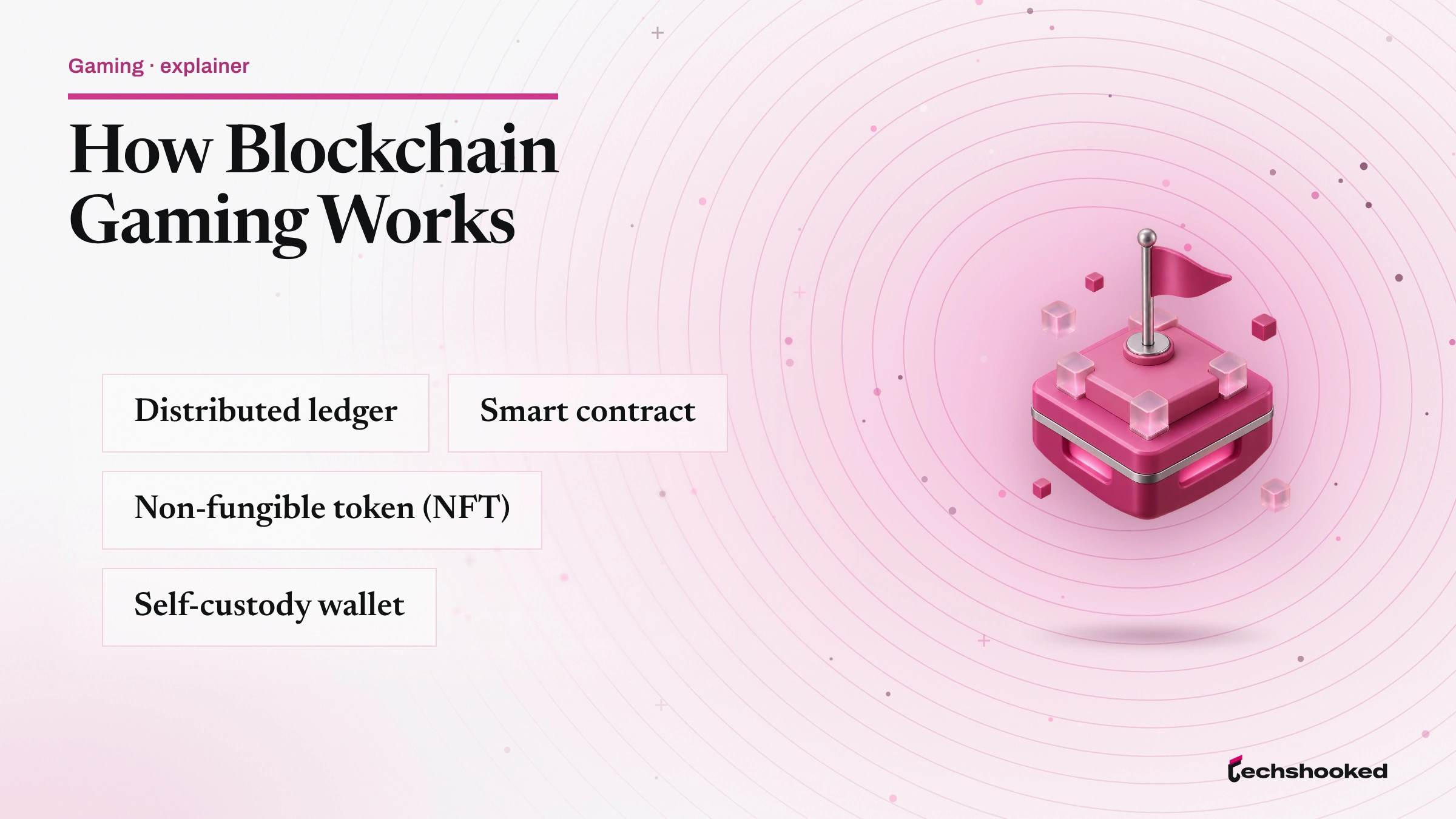
Most blockchain game items are issued as a non-fungible token (NFT), a unique on-chain record that points to metadata such as artwork, stats, or provenance. Fungible in-game currencies are issued as standard tokens. The logic that mints, transfers, or burns these assets lives in a smart contract, code deployed to the ledger that executes deterministically when called. Once deployed, the contract behavior cannot be silently changed by a publisher, although upgrade patterns exist when contracts are designed for them.
Blockchain Games: A Survey (IEEE Conference on Games, 2019) discusses how blockchain is integrated into games and categorizes existing blockchain games by genre and technical platform. The same monetization context applies to other revenue models covered in the game monetization comparison.
- Distributed ledger. A replicated database maintained by independent network nodes that agree on transaction order through a consensus protocol.
- Smart contract. Self-executing code deployed on the ledger that defines how digital assets are minted, transferred, and burned within a blockchain game.
- Non-fungible token (NFT). A unique on-chain record representing ownership of a specific in-game item, with provenance verifiable by any wallet.
How Traditional Gaming Works
Traditional gaming runs on a publisher-controlled architecture where the company that ships the game also operates the servers that hold every account, item, and currency record. Players authenticate against a centralized account system, the server validates each action, and the in-game economy is governed by item tables that the publisher can edit, retire, or rebalance at any time. Ownership of digital goods is granted through an end-user license, not a property transfer.
This license model has been the default since the earliest online games and underlies everything from major MMOs to mobile free-to-play titles. It gives publishers tight operational control over balance, anti-cheat enforcement, and pricing, and it lets developers ship complex multiplayer systems without inheriting the latency overhead of a distributed ledger.
- The publisher controls the canonical item table and can patch, rebalance, or remove any digital asset.
- Player accounts are licensed for use, not owned, and license terms are revocable under the publisher's terms of service.
- No sanctioned secondary market exists for most in-game items; trades outside official channels typically violate platform rules.
- Server shutdown ends access to the game and to all items tied to those servers, with no portable record of prior ownership.
Ownership and Asset Control Compared
The clearest structural gap between blockchain gaming and traditional gaming is the location and durability of the ownership record. In traditional gaming, the publisher's database is the sole source of truth, and the player's claim to an item depends on continued account access. In on-chain gaming, the ledger entry is the source of truth, and the wallet that controls the private key controls the asset.
Decentralized ownership has practical consequences. Player-owned assets can be transferred to another player without publisher intermediation, listed on third-party marketplaces, or held in cold storage independent of the game's continued operation. Provenance is verifiable by anyone with a ledger explorer, which makes counterfeit items harder to pass off and gives high-value collectibles a documented chain of custody. The trade-off is operational: smart contract bugs, key loss, and network congestion all become the player's exposure rather than a publisher support ticket.
| Dimension | Blockchain Gaming | Traditional Gaming |
|---|---|---|
| Asset ownership | Wallet-held NFT or token recorded on a ledger | Publisher database entry under a revocable license |
| Portability between games | Possible when titles share a chain and contract standard | None; assets are bound to a single publisher account |
| Publisher shutdown risk | Asset records persist on the ledger after servers go dark | Access ends when servers are retired |
| Secondary market | Open marketplaces with on-chain settlement | Limited or prohibited by terms of service |
| Provenance verification | Public ledger history visible to any wallet | Internal database, not exposed to players |
Monetization Models Side by Side
Blockchain gaming and traditional gaming diverge sharply on where revenue originates and how it flows back to players. Conventional gaming concentrates revenue in upfront purchases, subscriptions, season passes, and microtransactions, with the publisher capturing nearly all the value created in the in-game economy. The play-to-earn (P2E) model that emerged in on-chain gaming inverts part of that flow by paying tokens or NFTs to players for in-game actions, then taking a cut on marketplace trades.
Token-based monetization brings two costs that traditional players rarely encounter. Each on-chain transaction incurs a gas fee paid to network validators, and the issuance schedule of any in-game token affects its market value and therefore real player earnings. Layer 2 networks cut that cost sharply: Immutable says its layer-2 Immutable Chain offers gas-free transactions for players, but mainnet activity remains expensive during congestion. The game monetization strategies breakdown and the indie game publishing platform comparison set out the revenue models these token economies are measured against.
| Revenue source | Blockchain Gaming | Classic gaming |
|---|---|---|
| Primary player earning mechanism | Tokens or NFTs earned through play and resold on open markets | None; play does not generate transferable value |
| Developer revenue share | Primary sale plus a percentage royalty on each secondary trade | Full capture of primary and microtransaction revenue |
| Transaction costs | Gas fee per on-chain transaction, paid by the initiating wallet | Zero per-action cost beyond storefront commission |
| Market for items | Open, third-party, and 24/7 across multiple venues | Closed; trades occur only inside publisher-sanctioned channels |
| Regulatory exposure | Securities, tax, and gambling rules vary by jurisdiction | Largely consumer-protection and age-rating frameworks |
Technical and Scalability Challenges in Blockchain Gaming
On-chain gaming inherits the throughput and latency profile of the underlying shared ledger, which is the central engineering constraint developers face. A typical Layer 1 chain confirms transactions in seconds rather than the sub-frame timings required by fast-paced multiplayer titles. Most production games push the real-time loop off-chain and reserve the ledger for asset transfers, settlement, and provenance, with periodic state commitments. One published design, Game Channels for Trustless Off-Chain Interactions in Decentralized Virtual Worlds (Ledger, 2016), moves player interactions off the public chain and uses the network only to settle disputes, enabling almost real-time play.
- Gas fee spikes during peak demand. Mainnet congestion can push a single on-chain transaction above $20, pricing routine in-game trades out of the market.
- Throughput vs frame-rate mismatch. Block confirmation intervals are orders of magnitude slower than the 16 ms budget of a 60 fps loop, so combat and physics stay off-chain.
- Wallet onboarding friction. First-time players must install a wallet extension, secure a seed phrase, and fund gas, which adds steps absent from mainstream gaming installs.
- Smart contract audit cost. Pre-launch audits from established security firms run into six figures and remain a hard prerequisite for any contract that custodies value.
- Confirmation latency in trades. Players wait for block finality before an item appears in inventory, a delay that does not exist in publisher-controlled systems.
Player Experience Trade-offs
Crypto gaming and standard gaming each ask the player to accept a different bundle of compromises. Decentralized ownership delivers durable rights to player-owned assets and an exit path through secondary markets, but it loads the player with key management, gas budgeting, and tax recordkeeping. Non-decentralized gaming trades those responsibilities away in exchange for shutdown risk and zero resale rights. The right answer depends on what the individual player values, not on which model is technically purer. See also: Unity.
Hardware and storage choices intersect with both models. Local install footprints, asset streaming, and render performance still matter on either side, and our notes on storage choices for gaming libraries and real-time ray tracing apply equally whether the underlying economy is on-chain or publisher-controlled.
- Asset permanence priorities. If owning items beyond a server shutdown matters, the ledger-backed model is the only option that delivers it.
- Tolerance for transaction friction. Wallet signatures, gas estimation, and confirmation waits add seconds to actions that are instant in centralized gaming.
- Earning intent versus entertainment intent. P2E rewards are taxable income and require active market discipline; entertainment-first players gain little from that overhead.
- Upfront hardware and wallet setup cost. A self-custody wallet, a small gas reserve, and basic key hygiene are prerequisites before the first session.
- Regulatory jurisdiction of the player. Some jurisdictions classify in-game tokens as securities or restrict play-to-earn payouts, which can shape what is legally accessible.
Further reading
- Compare Indie Game Publishing Platforms
- Ethereum Foundation: Gas and Fees
- Getting Started With Game Development Programming Languages
- How To Choose Between Steam Deck And Nintendo Switch
Frequently Asked Questions
How much do gas fees actually cost during a blockchain game transaction?
Gas fees vary by network load and chain. On Ethereum mainnet during high congestion, a single NFT transfer can cost $5 to $50 or more, while on Layer 2 networks such as Polygon or Immutable X the same operation typically costs fractions of a cent. Players should check the prevailing gas price on their chain before initiating any in-game marketplace transaction, because fees are paid regardless of whether the trade completes favorably. Batch operations and Layer 2 settlement are the standard mitigations.
Do I need a crypto wallet to start playing a blockchain game?
Yes. Virtually all on-chain titles require a self-custody wallet such as MetaMask, Phantom, or a chain-specific equivalent to sign transactions and hold player-owned assets. Some games abstract this behind a custodial account for new users, but moving assets off-platform or to a secondary market requires migrating to a self-custody wallet. The onboarding step remains the most common dropout point for players coming from legacy gaming.
Are earnings from play-to-earn games taxable?
In most jurisdictions including the United States, tokens and NFTs earned through P2E games are treated as taxable income at fair market value at the time of receipt, and any subsequent sale triggers capital gains or losses. Tax treatment differs by country and continues to evolve as regulators update guidance. Players with material earnings should consult a tax professional familiar with digital asset rules in their jurisdiction before filing.