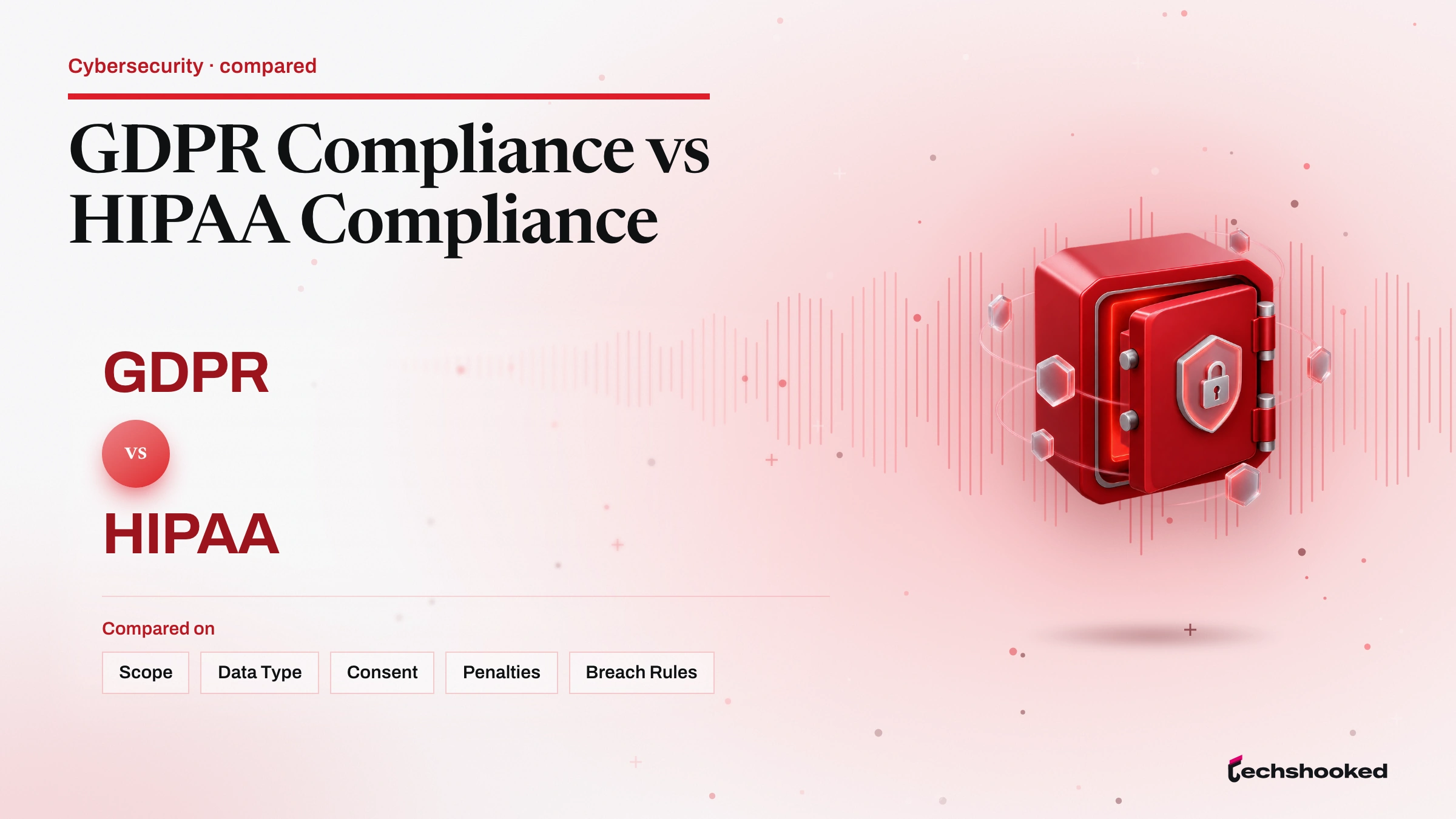
GDPR compliance is a regulatory framework that governs how organizations collect, process, and protect personal data belonging to European Union residents, regardless of where the processing organization is incorporated.
HIPAA compliance is the parallel US framework that governs how covered entities and their business associates handle protected health information (PHI) inside the US healthcare system. The two regimes sit on different jurisdictional axes, define different in-scope data categories, and impose different engineering obligations on the systems that store and move that data. A US healthcare organization that processes health records for an EU resident sits inside both regimes at once, and the same database column is then governed by Regulation (EU) 2016/679 and by 45 CFR 164.312 in parallel. For California consumer data, see how CCPA compares with GDPR and HIPAA.
The two frameworks read like different engineering specs. GDPR uses a principles-based design with eight individual rights and a proportionate-risk standard for technical measures. HIPAA uses a prescriptive rule set with categorized required and addressable safeguards. The cipher choice, the breach notification clock, the data subject request workflow, and the vendor contract chain look different under each framework, and the dual-jurisdiction system has to satisfy the stricter bar on every axis where the two diverge.
Jurisdiction and Data Scope: What Each Framework Covers
GDPR compliance applies to any organization that processes personal data of EU residents, regardless of where the organization is incorporated or where the processing occurs. The General Data Protection Regulation (Regulation (EU) 2016/679, effective 25 May 2018) defines personal data in Article 4(1) as any information relating to an identified or identifiable natural person, which covers names, IP addresses, location data, online identifiers, and health data alike. HIPAA, the Health Insurance Portability and Accountability Act (Public Law 104-191, 1996), applies only to covered entities (healthcare providers, health plans, healthcare clearinghouses) and their business associates within the US healthcare system, and only to protected health information as defined in 45 CFR 160.103.

An EU resident's IP address falls under GDPR but not HIPAA. A US patient's medical record falls under HIPAA but only triggers GDPR if that patient is also an EU resident. The role labels each framework attaches to the parties handling the data are also different, and the contract chain that flows from those labels is one of the largest divergence points between the two regimes.
- GDPR personal data (Article 4(1))
- Any information relating to an identified or identifiable natural person who is an EU resident. Covers names, contact details, IP addresses, location data, online identifiers, biometric data, and health data without distinction.
- HIPAA protected health information (45 CFR 160.103)
- Individually identifiable health information held or transmitted by a HIPAA-regulated party, in any form. The 18 PHI identifier categories are enumerated in 45 CFR 164.514(b)(2).
- GDPR data controller (Article 4(7))
- The natural or legal person that determines the purposes and means of processing personal data. Bears primary accountability for GDPR obligations including the Article 6 processing basis decision.
- GDPR data processor (Article 4(8))
- The party that processes personal data on behalf of the data controller. Operates under a binding processor agreement required by Article 28.
- HIPAA covered entity
- A healthcare provider that transmits health information electronically, a health plan, or a healthcare clearinghouse. Direct primary obligation under the Privacy, Security, and Breach Notification Rules.
- HIPAA business associate
- A person or organization that creates, receives, maintains, or transmits PHI on behalf of a covered entity. Bound by a written Business Associate Agreement (BAA) under 45 CFR 164.504(e) and directly liable for Security Rule violations since the Omnibus Rule (2013).
The DPIA is the formal mechanism that documents the proportionate-risk reasoning behind GDPR Article 32 technical measures, and the process for conducting a data privacy impact assessment sits upstream of any control design decision. The cipher-selection question itself, including the difference between encryption and tokenization, appears in both regimes as a data-protection mechanism choice that the risk analysis or DPIA has to justify.
Side-by-Side Control Comparison: GDPR vs HIPAA
GDPR compliance and HIPAA security safeguards overlap at the engineering layer on access control, encryption at rest, audit logging, and incident response, but the precise citation form, the documentation burden, and the trigger thresholds differ on every row. The table below maps the ten dimensions on which a dual-jurisdiction system has to make implementation decisions, with the byte-identical regulatory citation that each framework attaches to that dimension.
| Dimension | GDPR (EU 2016/679) | HIPAA (US) | Overlap / Notes |
|---|---|---|---|
| Jurisdiction | Global where EU residents' data is processed | US covered entities and BAs | Dual jurisdiction when US healthcare org handles EU resident data |
| Data scope | All personal data (Art 4(1)) | PHI only (45 CFR 160.103) | PHI is a subset of GDPR personal data for EU patients |
| Lawful basis for processing | Six lawful bases under Art 6; consent under Art 7 | Treatment, payment, operations (TPO) default authorization | GDPR consent is harder to satisfy than a HIPAA authorization form |
| Breach notification | 72 hours to supervisory authority (Art 33); without undue delay to data subjects (Art 34) | 60 calendar days to HHS (45 CFR 164.408); 60 days to individuals (45 CFR 164.404) | GDPR 72-hour window is materially stricter |
| Encryption at rest | Appropriate technical measures (Art 32(1)(a)) | Addressable specification (45 CFR 164.312(a)(2)(iv)) | NIST AES-256 satisfies both; document the rationale |
| Data minimization | Explicit principle (Art 5(1)(c)) | Minimum necessary standard (45 CFR 164.502(b)) | Functionally equivalent; different framing language |
| Right to erasure | Article 17 applies in defined conditions | No equivalent individual delete right | Conflicts with HIPAA retention schedules on EU-resident PHI |
| Data Protection Officer | Mandatory in defined cases (Art 37) | No DPO; analogous Privacy Officer (45 CFR 164.530(a)) | GDPR DPO is a regulatory expert role; HIPAA Privacy Officer is operational |
| Security safeguards | Technical and organizational measures (Art 32) | Administrative, physical, technical safeguards (45 CFR 164.308, 164.310, 164.312) | HIPAA uses required vs addressable; GDPR uses risk-proportionate framing |
| Risk analysis | Risk assessment under Art 32; DPIA under Art 35 for high-risk | Mandatory risk analysis under 45 CFR 164.308(a)(1)(ii)(A) | HIPAA risk analysis is an ongoing administrative safeguard; GDPR risk assessment supports Art 32 decisions |
The encryption row is the cleanest deduplication example on the table. GDPR Article 32 cites encryption as one example of an appropriate technical measure without mandating a specific cipher; HIPAA classifies 45 CFR 164.312(a)(2)(iv) as addressable, meaning the HIPAA-regulated party has to implement it or document an equivalent alternative with written rationale. NIST SP 800-111 recommends AES-256 for encryption at rest in HIPAA-regulated environments, and that same AES-256 deployment satisfies the GDPR appropriate-measure standard for the same data. The control register row carries both citations against one configuration.
The cross-framework mapping pattern that this table illustrates is the unified control set approach covered in best practices for securing regulated data. The SaaS variant of the same access-control and encryption rows, where the implementation lands inside vendor consoles rather than on-premises infrastructure, is covered in how to secure SaaS applications at scale. The control-cataloge layer that produces the underlying crosswalk is NIST SP 800-53 Rev 5, whose access control, audit, and system protection families carry the formal HIPAA and GDPR overlay annotations.
Where GDPR Is Stricter Than HIPAA
GDPR compliance imposes materially higher obligations than HIPAA on five dimensions, each of which forces engineering work that HIPAA alone does not. The list below orders them by implementation impact on a system that already meets HIPAA's bar.
- Breach notification window. GDPR Article 33 imposes a 72-hour notification clock to the lead supervisory authority. HIPAA gives covered entities 60 calendar days to notify HHS. The 72-hour requirement forces an automated detection-to-notification pipeline, on-call legal review at incident triage, and pre-drafted notification templates that HIPAA timelines do not require.
- Data subject rights. GDPR Articles 15-22 grant eight individual rights including access, rectification, the right to erasure under Article 17, restriction, portability, objection, automated decision-making review, and withdrawal of consent. HIPAA's individual rights under 45 CFR 164.524-164.526 cover only access and amendment. The right to erasure has no HIPAA equivalent and can conflict directly with HIPAA-mandated retention periods.
- Lawful basis documentation. GDPR Article 6 requires a documented lawful basis for every processing activity, and consent under Article 7 has to be freely given, specific, informed, and unambiguous. HIPAA's authorization requirement for non-TPO uses is less stringent and does not require the same per-activity documentation trail.
- Data minimization principle. GDPR Article 5(1)(c) is a principles-based obligation enforced at the supervisory authority's discretion, and the data minimization standard reaches across collection, retention, and access. HIPAA's minimum necessary standard under 45 CFR 164.502(b) has explicit rule-based exceptions that narrow its operational scope.
- Mandatory data protection officer. GDPR Article 37 mandates a data protection officer for public authorities, for organizations whose core processing is large-scale systematic monitoring, and for large-scale processing of special-category data including health data. HIPAA has no DPO mandate. The DPO has to have regulatory expertise, reports independently to senior management, and cannot be dismissed for performing the role.
The DPIA workflow that operationalizes Article 35 is covered in conducting a data privacy impact assessment, and the software layer that automates data subject rights responses and breach detection is covered in best privacy tools for enterprises.
Where HIPAA Is Stricter Than GDPR
HIPAA compliance imposes stricter obligations than GDPR compliance on four operational areas, each of which adds documentation or contractual scaffolding that a GDPR-only program does not produce.
- Mandatory Business Associate Agreement chain. Every vendor that creates, receives, maintains, or transmits PHI on behalf of a covered entity has to sign a written BAA under 45 CFR 164.504(e). The BAA names required contract clauses, imposes direct Security Rule liability on the BA, and flows down to subcontractors. GDPR's Article 28 processor agreement covers similar ground but is less prescriptive about specific clause wording, and the upstream covered entity remains in violation if any downstream BA in the chain is unsigned.
- Documented risk analysis as a standing administrative safeguard. HIPAA 45 CFR 164.308(a)(1)(ii)(A) mandates an accurate and thorough risk analysis as a required administrative safeguard, updated on an ongoing basis. The output is a deliverable that an OCR investigator can request directly. GDPR Article 32 requires appropriate measures based on risk but does not mandate a standalone risk assessment document separate from the Article 35 DPIA, which is itself triggered only for high-risk processing.
- Required vs addressable safeguard designation. HIPAA categorizes each Security Rule specification under 45 CFR 164.306(d) as either required or addressable. Required specifications have to be implemented without exception; addressable specifications have to be implemented or replaced with a documented equivalent and a written rationale. GDPR uses a proportionate-measures framework with no equivalent classification, which produces a more rigid checklist under the HIPAA Security Rule than under GDPR's risk-proportionate framing.
- Per-violation penalty structure. HIPAA civil monetary penalties under 45 CFR 160.404 are tiered by culpability from $100 to $50,000 per violation, with annual caps from $25,000 to $1.9 million per category. Each instance of non-compliance is counted as a separate violation, and a single breach can yield thousands of violations stacked across affected records. GDPR Tier-2 ceilings of EUR 20 million or 4% of global annual turnover are larger headline numbers but are per-infringement, not per-incident.
The cross-framework deduplication methodology that absorbs HIPAA's required/addressable categorization into a single control register is covered in best practices for securing regulated data. Multi-factor authentication, which HIPAA cites as an addressable specification under 45 CFR 164.312(a)(2)(ii) for access control, is covered in MFA vs SSO comparison. NIST SP 800-66 Rev 2 is the canonical implementation guide for the HIPAA Security Rule and is the reference US healthcare organizations cite when interpreting 164.312.
Dual-Jurisdiction Engineering: When GDPR and HIPAA Both Apply
GDPR compliance and HIPAA compliance collide inside a single system whenever a US-based covered entity or business associate processes health data that includes EU residents. A US telehealth platform serving EU members, a multinational clinical trial sponsor enrollling EU subjects, and a US health insurer with EU expatriate plan members all fall into this pattern. The same database is then subject to GDPR for every record whose subject is an EU resident and to HIPAA for every record that meets the PHI definition, and the two obligation sets are additive rather than alternative.
Four engineering rules govern the dual-jurisdiction case. Each rule resolves a specific point at which the two frameworks impose different controls on the same data:
- Apply the more restrictive control on every divergent axis. For breach notification, the GDPR 72-hour window to the supervisory authority governs the detection-to-notification pipeline, and the HIPAA 60-day notification to HHS still has to be filed. The two notifications are additive, not alternative. The same logic applies to encryption strength, audit log retention, and access review cadence: the stricter standard becomes the design target.
- Stack the lawful basis with the HIPAA authorization. A HIPAA TPO authorization does not satisfy GDPR's Article 6 requirement. For EU-resident PHI, the organization has to identify a separate GDPR legal basis, typically legitimate interests under Article 6(1)(f) for healthcare delivery or explicit consent under Article 9(2)(a) for special-category health data. The HIPAA authorization form continues to operate in parallel; it does not get replaced.
- Document the right-to-erasure conflict explicitly. When an EU-resident patient invokes GDPR Article 17 right to erasure against their PHI, the organization faces a direct conflict with state-law medical record retention schedules of seven to ten years. GDPR Article 17(3)(b) preserves the controller's ability to refuse or partially refuse the erasure where retention is required by law, and the response record has to cite the specific state statute that mandates the retention floor.
- Stack the GDPR data processing agreement and the HIPAA BAA. Every vendor that processes EU-resident PHI has to sign both a GDPR Article 28 data processing agreement between the data controller and the data processor and a HIPAA BAA between the covered entity and the BA arrangement. Most enterprise vendors maintain combined GDPR DPA plus HIPAA BAA templates for this case; the single signed contract carries both regulatory chains.
The unified control set that supports this dual-jurisdiction pattern is covered in best practices for securing regulated data, and the access-control architecture that satisfies both GDPR Article 32(1)(b) and HIPAA 45 CFR 164.312(a)(1) is covered in how to implement zero trust network architecture. ISO/IEC 29134:2017 is the international standard for privacy impact assessments that operationalizes both GDPR Article 35 DPIA and HIPAA risk assessment requirements inside a single methodology, and the CISA Cross-Sector Cybersecurity Performance Goals publish the minimum baseline control threshold that satisfies both regimes simultaneously.
Non-Compliance Penalties: Fines, Enforcement, and Reputational Risk
General Data Protection Regulation violations are penalised under Article 83 of Regulation (EU) 2016/679. HIPAA violations are penalised under 45 CFR 160.404 by the HHS Office for Civil Rights, with the Department of Justice handling criminal enforcement under 42 U.S.C. 1320d-6. The penalty table below maps the tier structures across both regimes against the enforcement bodies that apply them.
| Violation tier | GDPR (Art 83) | HIPAA (45 CFR 160.404) |
|---|---|---|
| Lower-tier procedural | Up to EUR 10 million or 2% of global annual turnover (Art 83(4): Articles 8, 11, 25-39, 42-43) | Tier A (unknowing): $100 to $50,000 per violation; annual cap $25,000 |
| Mid-tier | Same Tier-1 ceiling applies | Tier B (reasonable cause): $1,000 to $50,000 per violation; annual cap $100,000 |
| Higher-tier substantive | Up to EUR 20 million or 4% of global annual turnover (Art 83(5): Articles 5, 6, 7, 9, 12-22, 44-49) | Tier C (willful neglect, corrected): $10,000 to $50,000 per violation; annual cap $250,000 |
| Top-tier willful | Same Tier-2 ceiling applies | Tier D (willful neglect, not corrected): $50,000 per violation; annual cap $1.9 million |
| Enforcement body | National supervisory authorities; lead authority determined by main establishment (Art 55-56) | HHS Office for Civil Rights (civil); DOJ (criminal) |
| Notification-failure trigger | Failure to notify the supervisory authority within 72 hours is itself a Tier-1 violation | Failure to provide timely breach notification is a separate civil violation under 45 CFR 164.408 |
The mathematics of the two regimes diverge on the per-violation question. GDPR fines apply per infringement, with the supervisory authority weighing the nature, gravity, and duration of the infringement under Article 83(2), the number of affected data subjects, and the degree of cooperation. HIPAA penalties are calculated per affected record on a per-day basis, which is why settlements covering breaches of millions of records reach into the tens of millions of dollars even when the per-violation maximum is $50,000. The DPIA workflow covered in conducting a data privacy impact assessment is the documented mitigation that supervisory authorities consider when applying the Article 83(2) cooperation factor.
Related Reading
The authoritative GDPR Article text sits in the EUR-Lex consolidated text, and HHS publishes its canonical Security Rule guidance at HIPAA for Professionals for OCR interpretation of 45 CFR 164.
Further reading
- Best Practices for Securing Regulated Data (cross-framework control deduplication across PCI DSS, HIPAA, GDPR, SOX, and ISO 27001)
- Conducting a Data Privacy Impact Assessment (GDPR Article 35 DPIA process)
- Difference Between Encryption and Tokenization (mechanism-selection decision underneath Article 32 and 164.312(a)(2)(iv))
- Implement Zero Trust Network Architecture (access-control pattern satisfying both Article 32(1)(b) and 164.312(a)(1))
- Best Privacy Tools for Enterprises (software layer for data subject rights automation)
Frequently Asked Questions
What are the penalties for non-compliance with GDPR?
GDPR non-compliance penalties reach up to EUR 20 million or 4% of global annual turnover under Article 83(5) for Tier-2 violations, whichever is higher. Tier-1 violations (typically procedural failures such as failing to conduct a required DPIA or appointing a DPO) carry a lower ceiling of EUR 10 million or 2% of global annual turnover. The supervisory authority has discretion to issue warnings, reprimands, temporary or permanent processing bans, and fines in combination. The fine calculation considers factors including the nature, gravity, and duration of the infringement; the number of data subjects affected; and whether the organization cooperated with the supervisory authority.
Does GDPR apply to US healthcare organizations that process EU residents' health data?
Yes, GDPR applies to any US healthcare organization that processes health data of EU residents, regardless of where the organization is incorporated or where the processing occurs. A US telehealth platform, a multinational clinical trial sponsor, or a US insurer with EU expatriate members must comply with GDPR for the EU-resident subset of its patient data while simultaneously complying with HIPAA for all PHI in its systems. The organization must identify a GDPR processing basis under Article 9(2) for processing special-category health data (typically explicit consent or a public interest/research basis), appoint a data protection officer if it conducts large-scale systematic processing of health data, and meet GDPR's 72-hour breach disclosure window for any incident affecting EU residents' data.
Does GDPR Article 32 require specific encryption standards, and how does that compare to HIPAA's encryption specification?
GDPR Article 32 does not mandate a specific encryption cipher or key length; it requires appropriate technical measures proportionate to the risk, and cites encryption as one example measure. HIPAA's encryption specification under 45 CFR 164.312(a)(2)(iv) and 164.312(e)(2)(ii) is categorized as addressable, meaning covered entities must implement it or document an equivalent alternative with written rationale. NIST SP 800-111 recommends AES-256 for data at rest in HIPAA-regulated environments. When an organization is subject to both frameworks, implementing AES-256 for PHI at rest satisfies HIPAA's addressable specification and constitutes an appropriate technical measure under GDPR Article 32 for the same data; the risk assessment or DPIA should document the selection rationale citing both framework requirements.