A payment processor is a financial intermediary that routes card transaction data between a merchant's checkout and the card networks that authorize it. For an online store choosing between Stripe, PayPal, and Square, the meaningful differences are not interface polish or onboarding speed. They are per-transaction economics, cross-border currency conversion fee structure, and dispute resolution mechanics, which compound differently as monthly payment processing volume grows.
Each of the three processors bundles the gateway, the processor, and the merchant account into one product, so a small or mid-sized merchant can take card payments without a separate acquiring bank relationship. That convenience comes with a fixed flat-rate pricing model that hides interchange detail and a defined PCI DSS compliance scope tied to which integration path the merchant uses.
How Payment Processors Route Your Transactions
Stripe is the payment processor most often chosen by developer-led storefronts and cross-border merchants. Its standard flat-rate pricing for a successful domestic card transaction is 2.9% plus $0.30, published on its pricing page. International card transactions add a 1.5% cross-border fee, and if the buyer's card is denominated in a currency other than the merchant's settlement currency, a further 1% currency conversion fee applies. A non-USD cross-border payment therefore reaches an effective rate of roughly 5.4% before any dispute costs.
Stripe supports payments in more than 135 currencies and can settle in more than 25, the widest cross-border payment coverage among the three processors compared here. Merchants processing above approximately $80,000 per month can negotiate interchange-plus pricing directly with Stripe, which exposes the underlying interchange rate set by the card scheme and adds a transparent processor margin on top. At that volume, interchange-plus pricing typically reduces the blended transaction fee for merchants whose card mix is dominated by lower-interchange debit or regulated cards.
Dispute resolution on Stripe runs through the standard card-network rails process. The platform charges a $15 chargeback dispute fee, refunded if the merchant wins the dispute. Stripe Radar, included at no extra per-transaction cost on the standard tier, runs machine-learning fraud detection on every authorization and lets merchants tune rules against their own loss data. On the compliance side, merchants using Stripe.js or Stripe Checkout qualify for SAQ A, the lightest PCI DSS v4.0 self-assessment tier, because the card data is captured directly by Stripe-hosted elements rather than the merchant's site.
| Stripe fee component | Rate |
|---|---|
| Domestic card transaction | 2.9% + $0.30 |
| Cross-border fee | +1.5% |
| Currency conversion fee | +1.0% |
| Chargeback dispute fee | $15 (refunded on win) |
| Interchange-plus pricing | Available above ~$80,000/month |
PayPal: Buyer Trust and Cross-Border Network
PayPal is the payment processor whose value to a merchant is shaped less by raw rate and more by buyer reach. Its standard PayPal Checkout transaction fee is 3.49% plus $0.49, while PayPal Payments Pro for on-site checkout runs 2.89% plus $0.49, both published on PayPal's merchant fees page. Cross-border payment activity adds a 1.5% international transaction fee on top of the base rate. The currency conversion fee is built into PayPal's exchange rate as a 3% to 4% spread above the mid-market rate, materially wider than Stripe's 1% conversion add-on.
Dispute mechanics differ in kind, not only price. PayPal adjudicates most disputes inside its own system through PayPal Seller Protection rather than routing them through the network. Eligible transactions are covered against unauthorized chargeback dispute claims and significantly-not-as-described complaints, but a merchant has fewer escalation paths when the buyer paid from their PayPal balance or PayPal Credit and the card brand was never involved in the original transaction.
PayPal's buyer network of more than 430 million active accounts is the structural advantage. In markets where buyer adoption is high, including the US, Germany, the UK, and Australia, adding PayPal as a second payment processor alongside a card-rate-optimized primary tends to lift checkout completion. PayPal operates an aggregator merchant account on behalf of the seller, which removes setup friction at onboarding but allows PayPal to hold funds or freeze the account if payment processing volume spikes outside the modeled pattern.
- Standard PayPal Checkout: 3.49% + $0.49 per transaction.
- PayPal Payments Pro on-site checkout: 2.89% + $0.49 per transaction.
- Cross-border fee: +1.5% above the base rate.
- Currency conversion fee: 3% to 4% spread above mid-market rate.
- Dispute resolution: handled inside PayPal Seller Protection, not the network rail.
Square: Unified Commerce and SMB Point-of-Sale Integration
Square is the processor designed around the merchant whose business spans a physical counter and a website. The online transaction fee is 2.9% plus $0.30, matching Stripe's domestic rate; in-person card-present transactions through Square's point-of-sale integration hardware run 2.6% plus $0.10, with the rate sheet on Square's payments pricing page. The unified account model means online and in-person revenue are reported in the same dashboard with shared inventory and customer records.
Geographic reach is the binding constraint. Square processes card transactions in a limited set of countries: the US, Canada, the UK, Australia, Japan, Republic of Ireland, France, and Spain. A merchant outside those markets cannot use Square at all, regardless of how attractive the rate sheet looks. For sellers inside that footprint, dynamic currency conversion at checkout uses Square's exchange rate, and the spread is not publicly itemized in the same way Stripe and PayPal publish their currency conversion fee components.
Dispute economics are the most lenient of the three. Square charges no chargeback dispute fee for card-present transactions processed on Square hardware, and no fee for online disputes under $25; a standard fee applies above that threshold. Fraud detection is included at no add-on cost through Square's built-in risk engine. On compliance, merchants using the Square Web Payments SDK qualify for SAQ A under PCI DSS v4.0, mirroring Stripe.js on scope and reducing the merchant's PCI DSS compliance surface to the lightest self-assessment tier.
- Online transaction fee: 2.9% + $0.30, matching Stripe domestic.
- In-person rate via point-of-sale integration: 2.6% + $0.10 on Square hardware.
- Geographic footprint: 8 supported countries, all anglophone or major EU.
- Chargeback dispute fee: $0 for card-present and for online disputes under $25.
- PCI DSS compliance scope: SAQ A under PCI DSS v4.0 when using the Web Payments SDK.
Fee and Feature Comparison Across All Three Processors
The side-by-side view of payment gateway economics makes the tradeoffs concrete. Rows reflect the figures stated above; no new numbers are introduced.
| Attribute | Stripe | PayPal | Square |
|---|---|---|---|
| Standard online per-charge fee | 2.9% + $0.30 | 3.49% + $0.49 | 2.9% + $0.30 |
| Cross-border fee | +1.5% | +1.5% | Not applicable (limited markets) |
| FX fee | +1.0% | 3%-4% spread | Not itemized |
| Dispute fee | $15 (refunded on win) | Handled via Seller Protection | $0 under $25 and on card-present |
| Countries supported | 40+ markets, 135+ currencies | 200+ markets | 8 markets |
| Interchange-plus pricing | Above ~$80,000/month | Not offered to SMB | Not offered to SMB |
| PCI DSS SAQ tier (hosted path) | SAQ A | SAQ A | SAQ A |
| Fraud detection included | Yes (Stripe Radar) | Yes (built-in) | Yes (built-in) |
Flat-rate pricing is the default across all three and is cost-comparable at low payment processing volume below roughly $5,000 per month, where the per-per-transaction cost differential is too small to outweigh integration or buyer-trust considerations. At higher volume, the forex fee delta dominates the comparison for cross-border-heavy storefronts. Interchange-plus model is reachable only through Stripe at scale; neither PayPal nor Square publishes an interchange-plus tier for SMB merchants.
International Transactions: Which Payment provider Costs Less Abroad
Cross-border payment economics are where the choice of PSP produces the largest cost gap. In a 2017 forecast, Forrester estimated that cross-border shopping would make up 20% of e-commerce in 2022, with sales reaching $627 billion. The currency codes used in any of these transactions are defined by ISO 4217, the International Organization for Standardization framework for three-letter currency identifiers such as USD, EUR, and GBP.
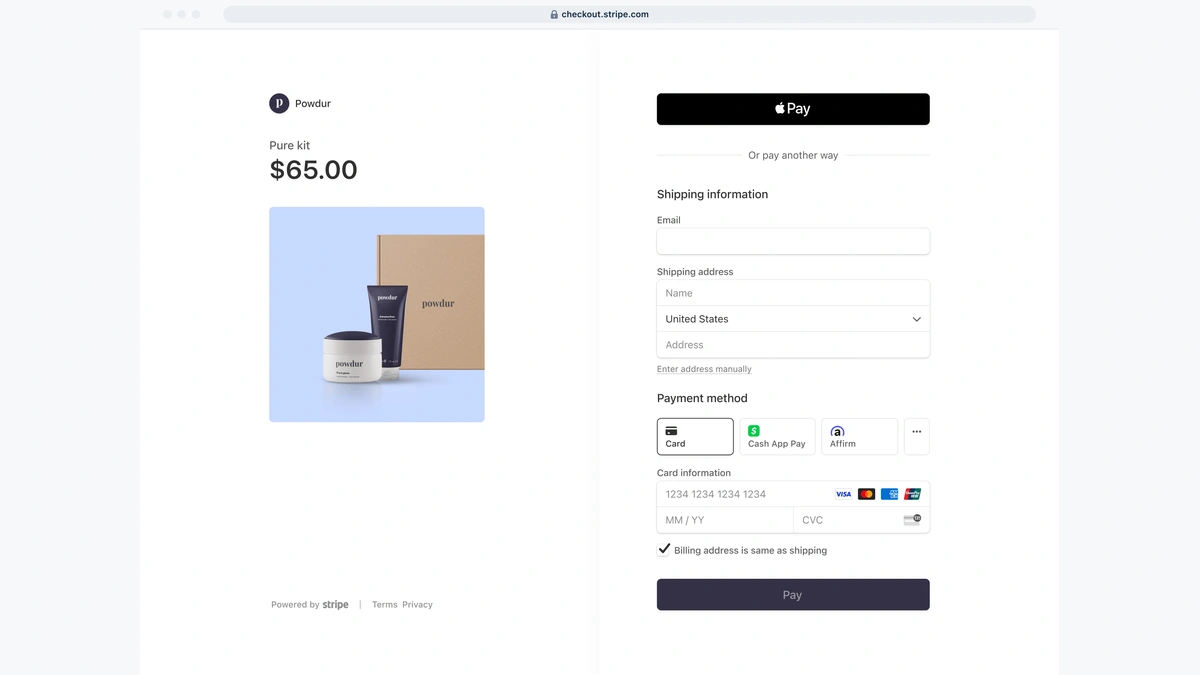
Consider a US merchant settling in USD and selling a $100 item to a German buyer paying in EUR. The cost decomposition stacks three layers on top of the base rate. The math for each gateway provider is below.
- Stripe: $2.90 base fee per transaction plus $1.50 cross-border fee plus $1.00 currency markup, totaling $5.40 or 5.4% of the order.
- PayPal: $3.49 base processing charge plus $1.50 cross-border fee plus an approximate $3.50 to $4.00 currency conversion spread, totaling $8.49 to $8.99 or 8.5% to 9.0% of the order.
- Square: not available, because Germany is outside Square's supported processing markets.
The gap of roughly 3 to 4 percentage points between Stripe and PayPal on a single cross-border transaction is not marginal. On a store doing $200,000 in annual EU-origin revenue, the conversion markup differential alone runs into the mid five figures per year. For sellers whose international mix is rising, this is the line item that justifies choosing a primary merchant processor on FX terms and adding PayPal selectively as a buyer-trust complement rather than the default checkout path. The payment gateway comparison takes the integration-complexity and checkout-conversion view of the same vendor landscape.
Choosing the Right Transaction processor for Your Store
A useful card processor decision framework starts with the constraints that cannot be unwound later: geography, channel mix, and buyer demographic. Rate optimization is the last filter, not the first.
- International reach. If the store sells outside the Stripe-PayPal-Square shared footprint, choose Stripe; 135-currency support and the lowest cross-currency fee make it the default for cross-border-heavy storefronts.
- In-person plus online. If the business runs both a physical and an online channel, choose Square; its point-of-sale integration unifies reporting and removes the need for a second POS-only merchant service provider.
- Buyer trust in specific markets. Add PayPal as a secondary acquiring processor alongside Stripe or Square in markets with high PayPal adoption (US, Germany, UK).
- Payment processing volume. At low volume, flat-rate pricing across all three is comparable. Above $80,000 per month, evaluate Stripe's IC+ pricing tier to reduce the effective per-charge cost.
- Merchant account control. Aggregator models (Square, PayPal, Stripe Standard) reduce setup friction but allow the platform to hold funds during anomalies; merchants that need stricter settlement control should negotiate a direct merchant ID path with Stripe.
The best payment gateways for e-commerce comparison covers the adjacent decision of which gateway to integrate and how that choice affects checkout conversion rate, and the scalable online store architecture overview covers the upstream stack.
Further reading
Frequently Asked Questions
Which merchant gateway charges the lowest fees for small businesses?
Stripe and Square both charge 2.9% plus $0.30 per online transaction, making them comparable on flat pricing at low processing volume. PayPal's standard PayPal Checkout rate of 3.49% plus $0.49 is higher for most transaction sizes. Stripe becomes the lowest-cost option at higher transaction volume because it offers interchange-based pricing for merchants processing above approximately $80,000 per month.
Can I use Stripe, PayPal, and Square for international transactions?
Stripe and PayPal both support cross-border payments in most countries; Square is limited to eight markets (US, Canada, UK, Australia, Japan, Republic of Ireland, France, Spain). For currency conversion, Stripe adds 1% above its cross-border fee, while PayPal's currency conversion spread of 3% to 4% makes it significantly more expensive for transactions requiring foreign exchange. Merchants selling internationally in multiple currencies should model the total transaction cost including conversion costs before choosing a card gateway. See also: Shopify Vs Bigcommerce For Enterprise.
How do chargeback cases differ between Stripe, PayPal, and Square?
Stripe charges a $15 chargeback fee, refunded if the merchant wins the dispute through the scheme process. PayPal resolves disputes internally through its Seller Protection program rather than routing through the card-network operator, which limits escalation options but covers eligible unauthorized transactions. Square charges no dispute fee for transactions under $25 and for in-person card-present transactions processed through its hardware.