An ecommerce platform is a cloud-hosted or self-hosted software system that provides merchants with storefront, checkout, catalog, and order-management tools that run an online store end to end. Adobe Commerce offers both self-hosted and cloud infrastructure options, with cloud plans including Starter and Pro tiers that each feature unique architectures for development and deployment.
The hosting model sits at the center of every platform selection decision. A software as a service (SaaS) ecommerce deployment hands infrastructure management to the vendor; a self-hosted ecommerce deployment hands it to the merchant or a third-party managed host. Both models can power a scalable online store, but they distribute operational responsibility in opposite ways. The four platforms covered here, Shopify, WooCommerce, BigCommerce, and Adobe Commerce, each represent a distinct position on that spectrum.
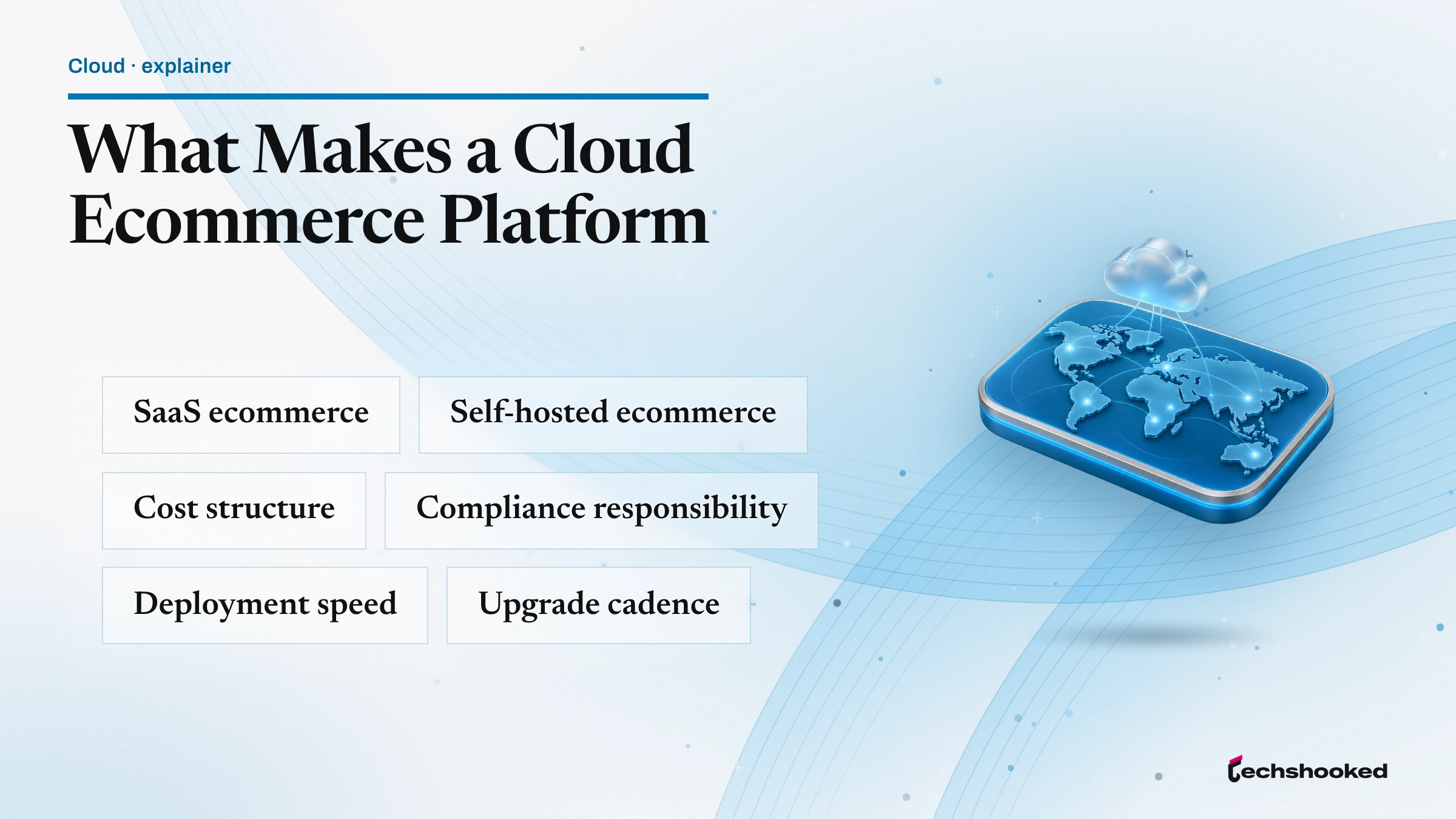
What Makes a Cloud Ecommerce Platform
A cloud ecommerce platform delivers storefront, checkout, and catalog management through remotely hosted infrastructure, removing the need for merchants to maintain on-premise servers. The distinction between cloud hosting and on-premise hosting shapes every downstream decision: cost structure, compliance responsibility, deployment speed, and upgrade cadence. Understanding each delivery model clarifies which ecommerce platform fits a given team's capacity.
- SaaS ecommerce
- The vendor hosts all infrastructure, ships updates automatically, and bundles security and compliance. The merchant pays a recurring subscription and configures the platform through a web dashboard. Examples: Shopify, BigCommerce.
- Self-hosted ecommerce
- The merchant (or their managed host) provisions cloud infrastructure, applies updates, and configures Secure Sockets Layer (SSL) certificates and Payment Card Industry Data Security Standard (PCI DSS) controls. Examples: WooCommerce on WordPress, Adobe Commerce on AWS or Azure.
- Managed hosting
- A middle-ground arrangement where a third-party host handles server provisioning, patching, and backups for a self-hosted ecommerce stack. The merchant retains code-level control while offloading ops overhead.
- Headless commerce
- An architecture where the storefront presentation layer (front end) is decoupled from the commerce engine (back end) via API. Any cloud ecommerce platform that exposes a REST or GraphQL API can serve as the headless back end.
The cloud architecture for scalable online stores covers the infrastructure patterns that underpin both SaaS and self-hosted deployments.
Shopify: Fully Managed SaaS Ecommerce
Shopify is a fully managed software as a service (SaaS) ecommerce platform that handles hosting, SSL certificates, and PCI DSS compliance on behalf of every merchant. Because Shopify owns the infrastructure stack, merchants do not patch servers, renew SSL certificates, or configure firewall rules. That operational simplicity is the platform's primary value for teams without dedicated DevOps capacity.
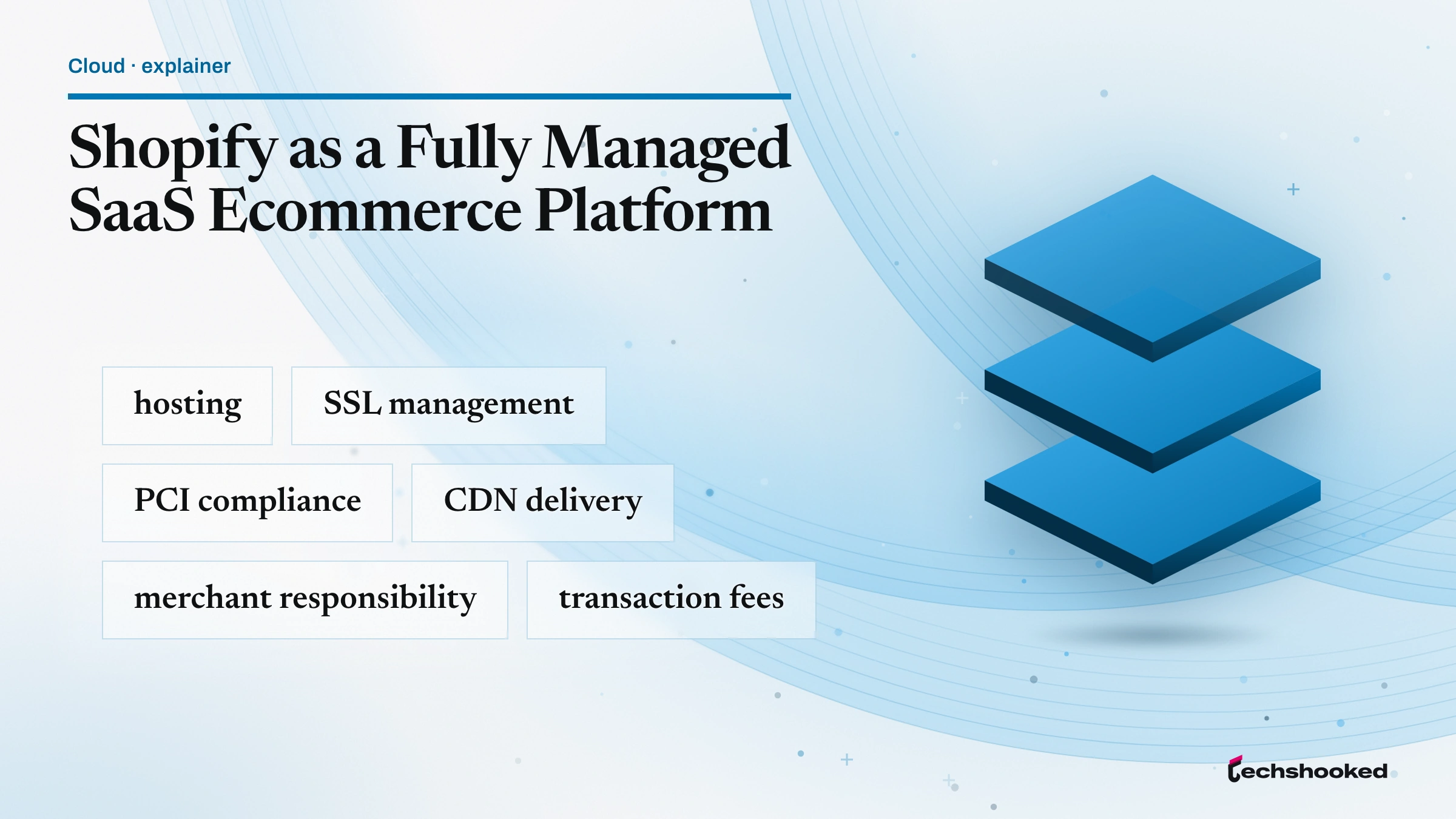
Shopify's managed hosting model covers global CDN delivery, automatic TLS renewal, and the highest tier of PCI compliance under the Payment Card Industry Data Security Standard. Merchants on third-party payment processors pay a transaction fee on top of processing costs; merchants using Shopify Payments avoid the platform transaction fee entirely (Shopify Enterprise: Ecommerce Platform Comparison).
- Hosting model: fully managed SaaS; no server access for merchants
- SSL certificate: provisioned and renewed automatically by Shopify
- PCI compliance: top-tier PCI DSS maintained by Shopify at the platform level
- Transaction fee: 0.5 to 2% on third-party gateways (waived with Shopify Payments)
- Scalability: auto-scales horizontally; no re-platforming required for traffic spikes
- Headless commerce: Shopify Storefront API and Hydrogen framework support decoupled front ends
- B2B: Shopify Plus includes business-to-business (B2B) catalog and pricing features for wholesale merchants
Shopify's constraint is customization depth. The SaaS model restricts server-side code execution to Shopify's own runtime (Oxygen/Remix for headless, Liquid for standard themes). Merchants needing database-level customizations or on-premise data residency must consider a self-hosted ecommerce alternative.
WooCommerce: Open-Source Self-Hosted Commerce
WooCommerce is an open-source commerce plugin for WordPress that requires merchants to source their own hosting, manage SSL certificates, and configure PCI DSS compliance independently or through a managed host. The plugin itself is free; the cost of a WooCommerce deployment lies in hosting, extensions, and developer time. That cost structure suits teams comfortable with PHP and Linux administration, and who want full access to the application stack.
PCI compliance on a self-hosted ecommerce stack built with WooCommerce requires the merchant (or hosting provider) to implement controls across six PCI DSS domains: network security, cardholder data protection, vulnerability management, access control, monitoring, and security policy (WooCommerce: PCI DSS Compliance and WooCommerce). Managed WordPress hosts such as Pressable or WP Engine can absorb parts of that burden, but the merchant remains the responsible party.
- Hosting model: self-hosted ecommerce on any Linux stack; merchant chooses provider
- SSL certificate: merchant-provisioned; Let's Encrypt or host-issued
- PCI compliance: merchant's responsibility; varies by hosting tier
- Transaction fee: none from WooCommerce; gateway fees apply at the payment processor level
- Open-source commerce: full PHP source access; extensible via 900+ official extensions
- Headless commerce: WooCommerce REST API supports decoupled front ends built on Next.js or Nuxt
- Scalability: scales with the underlying hosting plan; vertical or horizontal scaling is the merchant's responsibility
For a detailed feature breakdown, the Shopify versus WooCommerce feature comparison maps the two platforms across checkout, extensions, and total cost of ownership.
BigCommerce: SaaS with Native B2B and Multi-Currency Support
BigCommerce is a hosted SaaS ecommerce platform that builds business-to-business (B2B) catalog rules, multi-currency support across 140 or more currencies, and zero platform transaction fees directly into its standard offering. Unlike Shopify, which charges a transaction fee when merchants use third-party gateways, BigCommerce applies no platform-level transaction fee regardless of payment processor. That pricing model benefits high-volume merchants using specialized gateways or regional processors (BigCommerce: SaaS Ecommerce).
BigCommerce's B2B ecommerce feature set covers customer group pricing, quote management, purchase-order workflows, and tiered catalog visibility without third-party plugins. Its multi-currency support includes both display currency and settlement currency options, making it a strong fit for merchants selling across multiple regions from a single storefront.
- Hosting model: fully managed SaaS; BigCommerce owns the infrastructure
- SSL certificate: provisioned automatically across all storefronts
- PCI compliance: top-tier PCI DSS maintained at the platform level
- Transaction fee: zero platform transaction fees on all plans
- Multi-currency support: 140+ currencies with display and settlement options
- B2B ecommerce: native customer group pricing, quote workflows, and PO management
- Headless commerce: BigCommerce Catalyst (Next.js starter) and open Storefront API support decoupled deployments
The Shopify vs BigCommerce for enterprise deployments compares the two SaaS platforms across plan limits, API throughput, and B2B catalog complexity.
Adobe Commerce: Self-Hosted Open-Source at Enterprise Scale
Adobe Commerce, formerly Magento, is a self-hosted open-source ecommerce platform that requires third-party cloud hosting and ongoing developer maintenance in exchange for maximum customization depth. Adobe Commerce runs on the merchant's own infrastructure, typically AWS, Azure, or Google Cloud, giving development teams unrestricted access to the application layer, database schema, and server configuration. Adobe also offers a cloud-hosted managed edition under the Adobe Commerce Cloud license, but the open-source community edition remains self-hosted ecommerce.
Adobe Commerce's open-source commerce architecture supports catalog structures that would require significant plugin overhead on SaaS platforms: multi-store environments, complex B2B pricing matrices, and custom checkout workflows. Its headless commerce capabilities have expanded through the PWA Studio toolkit and compatibility with composable commerce frameworks like Vue Storefront. The tradeoff is total cost of ownership: server costs, security patching, extension compatibility management, and developer salaries sit with the merchant.
- Hosting model: self-hosted on merchant-provisioned cloud infrastructure
- Open-source commerce: full source access under the Open Software License
- PCI compliance: merchant's responsibility; requires dedicated security engineering
- Headless commerce: PWA Studio and third-party front-end frameworks supported
- B2B: native company accounts, shared catalogs, and negotiated pricing for enterprise wholesale
Teams evaluating a move off Adobe Commerce can review the considerations covered in the article on migrating from Magento to Shopify.
Platform Comparison: Hosting Model, Fees, and Scalability
Choosing between SaaS ecommerce and self-hosted ecommerce comes down to three axes: who manages the infrastructure, what transaction fees apply, and how far each platform scales without re-platforming. The table below maps the four platforms across those dimensions.
| Platform | Hosting Model | Transaction Fee | PCI Compliance Owner | Scalable Online Store Path |
|---|---|---|---|---|
| Shopify | Managed SaaS | 0.5 to 2% (waived with Shopify Payments) | Shopify (top tier) | Auto-scales; no re-platform needed |
| WooCommerce | Self-hosted ecommerce on WordPress | None from platform; gateway fees apply | Merchant or managed host | Scales with hosting plan; merchant manages |
| BigCommerce | Managed SaaS | Zero platform transaction fees | BigCommerce (top tier) | Auto-scales; multi-currency support included |
| Adobe Commerce | Self-hosted on cloud infrastructure | None from platform; infrastructure costs apply | Merchant (requires security engineering) | Scales with provisioned infrastructure; developer-managed |
SaaS ecommerce platforms absorb the operational surface area that self-hosted ecommerce platforms expose. Shopify and BigCommerce both maintain top-tier PCI DSS certification at the platform tier, meaning merchants inherit that certification for their storefronts. WooCommerce and Adobe Commerce shift that burden to the merchant, which requires either in-house security engineering or a managed hosting arrangement with a compliant provider.
Transaction fee structure has the largest effect at scale. A merchant processing $5 million annually on Shopify's standard plan with a third-party gateway pays a meaningful percentage in platform fees. BigCommerce's zero-transaction-fee model eliminates that line item at any volume, making it competitively priced for high-GMV merchants on specialized processors (BigCommerce: Ecommerce Frameworks).
Choosing the Right Ecommerce Platform for Your Store
The right ecommerce platform depends on whether your team has the developer capacity to manage self-hosted infrastructure or whether you need a managed SaaS ecommerce environment that handles patching and compliance automatically. Three variables should drive the shortlist: technical capacity, transaction volume, and whether the business operates a business-to-business (B2B) or direct-to-consumer model.
For teams without server-management expertise, SaaS ecommerce removes cloud hosting overhead, SSL certificate renewal, and PCI DSS configuration from the merchant's plate. For teams that need on-premise data residency, custom database schemas, or deep catalog logic, a self-hosted ecommerce platform on a managed cloud host delivers that control. B2B ecommerce requirements, such as company accounts, negotiated pricing, and purchase-order workflows, tilt the SaaS selection toward BigCommerce, which covers those features natively without additional plugins. Merchants evaluating payment options across regions will also want to assess flexibility across payment gateways for ecommerce stores, and the hosting model choice intersects with the broader considerations in B2B versus B2C ecommerce hosting requirements.
A practical sequence for narrowing the selection:
- Assess developer capacity. If the team cannot maintain a Linux stack, PCI controls, and plugin compatibility, start with SaaS ecommerce (Shopify or BigCommerce).
- Map transaction volume and gateway requirements. High-GMV merchants on third-party gateways should model the total transaction fee cost across platforms before committing.
- Identify B2B ecommerce requirements. If the catalog requires tiered pricing, shared catalogs, or purchase-order workflows, evaluate BigCommerce native B2B or Adobe Commerce enterprise B2B before adding plugins to other platforms.
- Evaluate multi-currency support needs. Cross-border merchants should confirm whether the platform supports both display currency and settlement currency, not only storefront localization.
- Test headless commerce feasibility. If the front-end team wants a React or Vue storefront decoupled from the commerce engine, confirm the platform's API coverage before committing to a SaaS or self-hosted ecommerce stack.
- Pilot with real catalog data. Load representative SKU counts, variant structures, and customer group configurations before final platform selection. Scalable online store performance at projected peak load is only visible under real data conditions.
Further reading
- Shopify Blog: SaaS Ecommerce
- WooCommerce: Enterprise Ecommerce Platforms
- How to Set Up Cloudflare for Website Performance
- IPv4 vs IPv6: What You Need to Know About the Next-Generation IP Protocol
- Load Balancing vs Auto Scaling: A Comprehensive Comparison
- Best WooCommerce Hosting for Growing Stores
Frequently Asked Questions
Which cloud service is best for scalable online stores?
The best choice depends on your team's technical capacity. SaaS platforms like Shopify and BigCommerce handle infrastructure automatically and scale without re-platforming, while self-hosted platforms like WooCommerce and Adobe Commerce let you place workloads on any cloud provider but require your team to manage scaling, patching, and PCI DSS compliance. For stores without dedicated DevOps resources, a managed SaaS ecommerce platform removes that overhead. For high-customization enterprises, self-hosted open-source on a managed cloud host gives full control over performance tuning.
How do I choose the right ecommerce platform?
Start by mapping three variables: developer capacity, transaction volume, and B2B requirements. If your team lacks server-management expertise, a SaaS ecommerce platform eliminates hosting, SSL, and compliance overhead. If you need deep catalog customization or on-premise data residency, an open-source self-hosted platform gives that control at the cost of ongoing maintenance. For businesses with B2B catalog rules and multi-currency checkout, BigCommerce's native feature set avoids plugin dependency. Then pilot your shortlist against real product data before committing.
What features should I look for in an ecommerce platform?
Prioritize hosting model, built-in PCI DSS compliance, transaction fees, multi-currency support, and B2B catalog tools. SaaS ecommerce platforms bundle SSL certificates, PCI compliance, and automatic updates into the subscription; self-hosted platforms delegate those responsibilities to the merchant or managed host. Also evaluate payment gateway flexibility, headless commerce API availability for future decoupling, and the plugin or extension ecosystem for features your business needs natively.