B2B e-commerce hosting is a specialized infrastructure tier that optimizes web server configuration, database isolation, and integration middleware for business-to-business transaction workflows.
The split between business-to-business and business-to-consumer commerce runs deeper than audience type. It shapes which server components carry load, how sessions persist, which compliance frameworks apply, and whether the database layer needs to accommodate purchase-order approval queues alongside standard product catalogs. Getting the hosting architecture wrong for either model produces problems that no front-end optimization can fix.
How B2B and B2C E-Commerce Differ at the Infrastructure Level
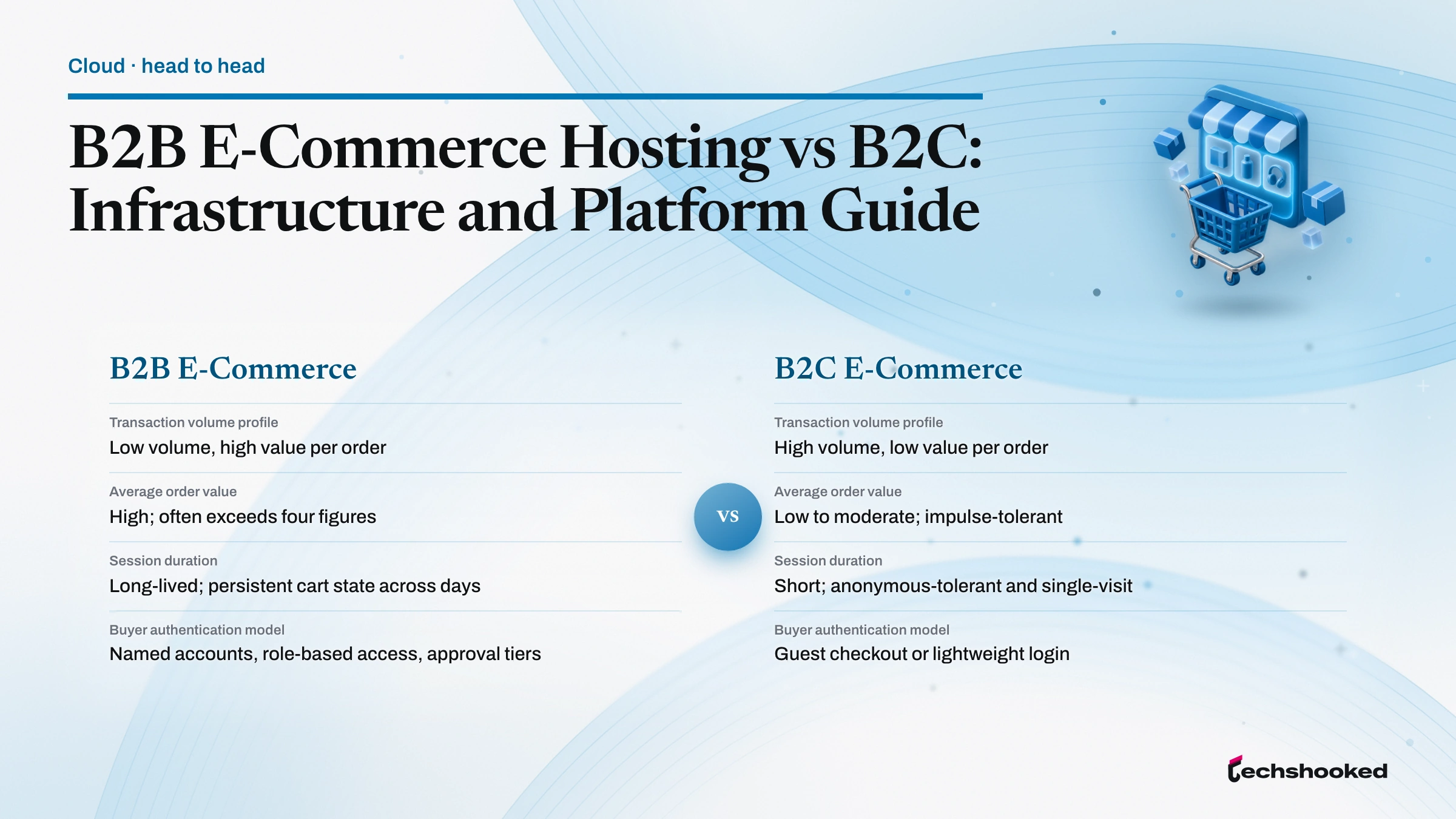
B2B e-commerce hosting and B2C e-commerce hosting impose fundamentally different requirements on the web server, database, and network layers because their transaction models diverge in volume, session complexity, and integration depth. A B2B platform handles fewer orders per day but each order carries significantly more data: negotiated line-item pricing, multi-approver purchase-order workflows, Enterprise Resource Planning (ERP) callbacks, and multi-tenant buyer account references. A B2C storefront reverses those priorities, processing high volumes of short-lived anonymous sessions where checkout conversion speed and page-load latency determine revenue. Session handling illustrates the contrast clearly: B2B sessions must remain persistent for hours or days as procurement managers revisit draft orders, while B2C sessions are tolerant of reset because the basket is typically completed in a single visit. Order management logic follows the same split, with B2B requiring approval routing and invoice generation that typical B2C stacks omit.
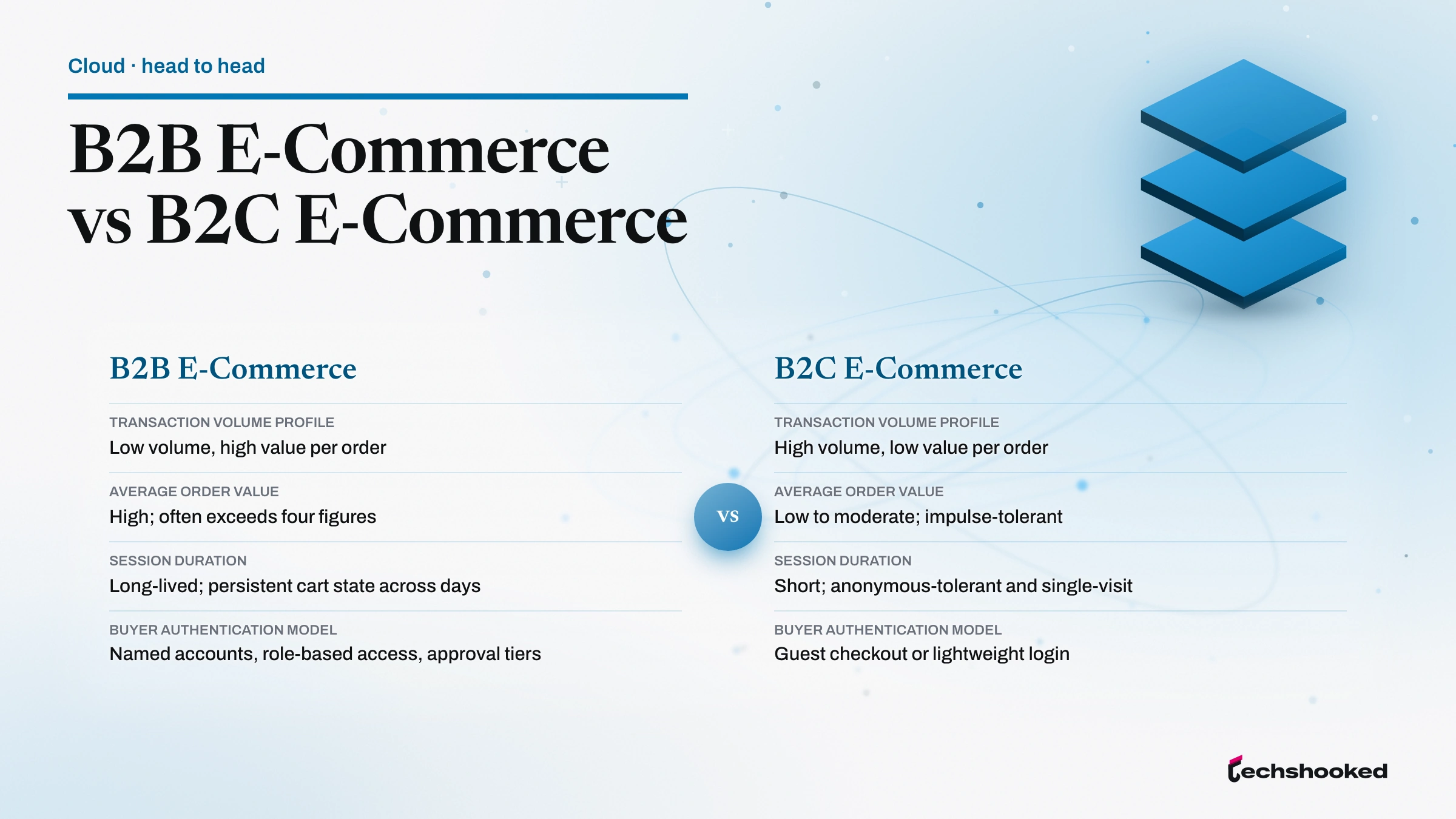
| Dimension | B2B E-Commerce | B2C E-Commerce |
|---|---|---|
| Transaction volume profile | Low volume, high value per order | High volume, low value per order |
| Average order value | High; often exceeds four figures | Low to moderate; impulse-tolerant |
| Session duration | Long-lived; persistent cart state across days | Short; anonymous-tolerant and single-visit |
| Buyer authentication model | Named accounts, role-based access, approval tiers | Guest checkout or lightweight login |
| Catalog complexity | Negotiated pricing per account, contract SKUs | Uniform pricing, promotional rules |
| Integration dependencies | ERP, EDI, procurement portals | Marketing pixels, payment gateways, loyalty APIs |
| Checkout flow complexity | Multi-step approval, purchase-order reference required | Single-page checkout optimized for speed |
B2B Hosting Requirements: ERP, Multi-Tenant Accounts, and Compliance
B2B e-commerce hosting must support ERP integration middleware, multi-tenant buyer account hierarchies, and purchase-order approval workflows that B2C storefronts never encounter. The infrastructure layer needs to sustain persistent API connections to back-office systems, isolate buyer-account data partitions from one another, and enforce role-based pricing rules that change per account contract. The following definitions cover the core B2B hosting concepts that shape stack selection.
- ERP Integration
- ERP integration connects the commerce platform to the Enterprise Resource Planning system governing inventory, finance, and fulfillment. The hosting environment must sustain low-latency API or message-queue connections to the ERP without blocking storefront response times.
- Multi-Tenant Account Hierarchy
- A multi-tenant architecture isolates each buyer organization's data, pricing catalogs, and order history within shared application infrastructure. Hosting must enforce schema-level separation so one buyer's session cannot access another's procurement data.
- Role-Based Pricing
- Role-based pricing engines apply different price tiers per buyer account, contract, or user role. The application and database layers must evaluate pricing rules at query time rather than serving a static catalog, which adds compute overhead that shared hosting cannot absorb reliably.
- Purchase-Order Workflow
- Purchase-order (PO) approval routing requires the platform to queue orders pending multi-level authorization before fulfillment triggers. The database must store order state across extended time windows, often days, with transaction locking that prevents partial fulfillment of unapproved POs.
- EDI Support
- Electronic Data Interchange (EDI) support allows the B2B platform to exchange structured transaction documents (purchase orders, invoices, advance ship notices) with buyer ERP systems. Hosting must provide stable outbound connectivity and, in many cases, dedicated middleware capacity for EDI translation.
These requirements expand the Payment Card Industry Data Security Standard (PCI DSS) compliance surface considerably. When multiple buyer accounts each store tokenized payment credentials within a shared application environment, the PCI DSS scope extends to every system that stores, processes, or transmits that cardholder data, as defined by the PCI Security Standards Council. Database isolation in a multi-tenant B2B stack must therefore align with PCI DSS segmentation requirements, not just business-logic concerns. Compute isolation matters at the database tier for order management, and load balancing vs auto scaling policies should account for the extended-session and ERP-callback load that B2B workloads generate alongside standard HTTP traffic.
B2C Hosting Requirements: CDN Performance, Checkout Speed, and Conversion
B2C e-commerce hosting optimizes for content delivery network latency, checkout conversion rates, and the ability to absorb traffic spikes driven by flash sales and seasonal demand. Unlike B2B stacks, where complexity lives in the application and database tiers, B2C stacks push resources to the edge and the front end. A content delivery network (CDN) is the primary performance lever: by caching static assets and product images at edge nodes geographically close to shoppers, a CDN reduces round-trip time and insulates the origin server from peak load. Background on how content delivery networks improve web performance covers CDN mechanics in detail. Beyond the CDN, B2C stacks require infrastructure tuned for the following workloads.
- Sub-second asset delivery via CDN. Product images, CSS, and JavaScript bundles must be served from edge nodes, not origin servers, to keep page load times competitive across geographic markets.
- Anonymous session support. B2C session handling must accommodate guest checkout without requiring account creation. The session store must scale horizontally to handle millions of concurrent anonymous sessions during peak events.
- Single-page checkout performance. Checkout conversion degrades measurably with each additional page load. The hosting stack must support server-side rendering or pre-rendering for checkout flows to keep JavaScript execution off the critical render path.
- Horizontal auto-scaling for flash sales. Traffic during promotional events can spike an order of magnitude above baseline within minutes. Auto-scaling groups must provision new compute capacity faster than the traffic ramp to prevent checkout abandonment from server saturation.
- A/B testing infrastructure. Checkout conversion optimization depends on controlled experiments. The hosting environment must route traffic variants without introducing latency asymmetry between test and control groups.
- Marketing pixel loading without blocking the critical render path. Third-party analytics and retargeting pixels must load asynchronously. Hosting configurations that block or serialize pixel scripts directly hurt checkout conversion metrics.
Hosting Stack Comparison: What Changes Between B2B and B2C
B2B e-commerce hosting stacks concentrate resources at the application and database tiers to support complex logic, while B2C stacks push resources to the edge to minimize latency for anonymous shoppers. The AWS e-commerce reference architecture documents multi-tier patterns covering CDN, caching, database, and compute layers that reflect this divergence at the infrastructure level.
| Stack Layer | B2B E-Commerce | B2C E-Commerce |
|---|---|---|
| Web server layer | API gateway with ERP connector; long-lived connections | CDN-fronted origin; short-lived stateless requests |
| Caching strategy | Per-account catalog cache; bypassed for PO workflows | Aggressive full-page and asset caching at CDN edge |
| Database architecture | Multi-tenant isolated schemas; transactional integrity priority | Read-replica horizontal scaling; session store separation |
| CDN configuration | Minimal; API responses are account-specific and uncacheable | Central; handles majority of asset and page delivery |
| Authentication model | Named account login, role-based access, approval tiers | Guest checkout or lightweight OAuth session |
| Compliance scope | PCI DSS extended by multi-account token storage | PCI DSS standard checkout scope |
| Integration surface | ERP, EDI, procurement portals, order management APIs | Payment gateways, marketing pixels, loyalty platforms |
Headless commerce architecture provides an escape from the either/or framing of this table. By decoupling the product catalog and order management layer from the storefront presentation tier, a headless commerce backend can serve a B2B procurement portal and a B2C consumer storefront from the same API surface, with each front end optimized independently. The B2B front end routes requests through the ERP integration middleware and enforces role-based pricing; the B2C front end routes the same catalog through CDN-cached responses with anonymous session support. The shared API layer handles PCI DSS tokenization once rather than duplicating compliance controls across two separate stacks.
Choosing the Right Hosting Model for Your Commerce Type
B2B e-commerce teams should evaluate hosting options against ERP integration depth and multi-tenant isolation requirements, while B2C teams should weight CDN coverage, auto-scaling ceiling, and checkout latency. Google Cloud's e-commerce architecture guidance covers scalability and integration patterns applicable to both models. The following checklist structures the decision across the most consequential axes.
- Map buyer account structure. If buyers represent organizations with multiple users, approval tiers, and subsidiary accounts, the hosting layer must support multi-tenant isolation. Flat consumer accounts require no such isolation.
- Audit existing ERP and EDI dependencies. B2B platforms already running SAP, Oracle, or Microsoft Dynamics require hosting that supports dedicated API gateway capacity and message-queue persistence. B2C stacks rarely need more than a payment gateway integration.
- Profile peak traffic patterns. Flash sales and seasonal spikes define B2C auto-scaling requirements. B2B traffic is flatter but generates heavier per-request computation. Match the auto-scaling policy to the actual load profile.
- Assess average order value and approval complexity. High-value B2B orders with multi-step approval require transactional database guarantees. Low-value B2C orders tolerate eventual consistency in non-checkout flows.
- Scope PCI DSS and GDPR obligations. Both models require PCI DSS compliance for card processing. B2B multi-tenant environments extend that scope. GDPR obligations apply to both but require different data subject rights tooling (a consumer-facing rights portal vs. a procurement administrator portal).
- Decide between managed services and self-managed infrastructure. Managed cloud platforms abstract ERP integration and auto-scaling complexity at higher recurring cost. Self-managed infrastructure on bare metal or cloud VMs offers lower unit cost but requires in-house DevOps capacity for both models.
- Determine global caching strategy. B2C operations serving international markets depend on CDN edge coverage and geographic latency. The edge computing vs cloud computing decision maps directly onto where the B2C stack pushes caching capacity, while B2B workloads generally benefit from centralized cloud compute near the ERP rather than distributed edge nodes.
- Evaluate headless commerce readiness. Organizations running both B2B and B2C channels should assess whether a shared headless commerce API layer reduces operational complexity more than the migration cost increases it.
Running B2B and B2C Together: Unified Hosting Architectures
B2B e-commerce and B2C e-commerce operations can share a single hosting backend when a headless commerce architecture decouples the product catalog and order management layer from the storefront presentation tier. The shared API layer serves both storefronts while each front end applies the configuration, caching rules, and authentication model appropriate to its audience. Amazon CloudFront documents how a CDN can cache and deliver web content globally, which supports the B2C storefront's performance requirements while leaving the B2B API gateway traffic to bypass the cache. The following steps describe how to architect this shared infrastructure.
- Define a shared API layer. Build or configure a commerce API (catalog, inventory, order management, pricing) that both storefronts consume. The API must support role-based pricing and account-hierarchy lookups for B2B requests while returning uniform catalog data for unauthenticated B2C requests.
- Configure role-based access control per storefront. The B2B storefront authenticates named buyer accounts against the account hierarchy and enforces multi-tenant data isolation at the API gateway. The B2C storefront routes anonymous sessions through a separate authentication path with guest-checkout support.
- Set B2C CDN caching rules independently from B2B API gateway rules. CDN cache policies for B2C content (product images, category pages, static assets) must not apply to B2B API responses, which are account-specific and must remain uncacheable to prevent data leakage across buyer sessions.
- Isolate B2B database schemas from B2C session stores. The multi-tenant B2B database schema, containing negotiated pricing, PO history, and account hierarchies, must reside in isolated compute and storage from the B2C session store. PCI DSS segmentation requirements apply to both, but the isolation also prevents B2C session volume from contending with B2B transactional I/O.
- Configure separate auto-scaling groups per traffic profile. B2C traffic generates sudden, high-volume spikes during flash sales. B2B traffic generates sustained, computation-heavy requests during business hours. Separate auto-scaling groups prevent a B2C promotional event from exhausting compute capacity that B2B order management workflows depend on.
The governance trade-off in unified stacks is real: shared infrastructure reduces hosting cost and eliminates data synchronization between parallel platforms, but it requires deliberate capacity planning. A B2C flash sale that maxes out shared compute will delay B2B ERP callbacks and stall purchase-order approvals, degrading enterprise customer experience at precisely the moment consumer revenue is highest. Separate auto-scaling groups and dedicated database read replicas per storefront type are the standard mitigation. Teams running both channels on a single backend should also maintain separate HTTP session handling configurations (per RFC 9110 semantics) to prevent B2B long-lived sessions from being evicted by the aggressive timeout policies appropriate for B2C anonymous traffic. Teams still choosing a platform can compare how Shopify, WooCommerce, and BigCommerce host a store.
Further reading
- AWS E-Commerce Reference Architecture (AWS Overview Whitepaper)
- Amazon CloudFront Developer Guide: What Is Amazon CloudFront?
- Google Cloud: E-Commerce Solutions
- RFC 9110: HTTP Semantics (IETF)
- Understanding Headless Ecommerce Systems: Architecture, Trade-offs, and ROI
- WordPress Hosting Performance Comparison: Shared vs VPS vs Managed
- WordPress to Webflow Migration: Best Practices for SEO and Content
Frequently Asked Questions
What infrastructure differences separate B2B and B2C e-commerce hosting?
B2B e-commerce hosting requires multi-tenant account hierarchies, negotiated pricing engines, ERP integration middleware, and higher single-session data throughput than B2C. B2C deployments prioritize low-latency page loads, CDN-heavy asset delivery, and checkout conversion tooling. Both models demand PCI DSS compliance, but B2B adds EDI and purchase-order workflow support that typical B2C stacks omit entirely.
Does a shared hosting plan support B2B e-commerce at scale?
Shared hosting is not recommended for production B2B e-commerce workloads. B2B platforms typically process high-value, low-volume orders with complex ERP callbacks that require guaranteed CPU allocation and predictable I/O throughput. A VPS or managed cloud instance with auto-scaling policies gives B2B workloads the isolation shared environments cannot provide.
How does PCI DSS scope differ between B2B and B2C storefronts?
Both B2B and B2C storefronts that store, process, or transmit cardholder data fall under PCI DSS scope. B2B implementations often extend scope further because procurement portals may store tokenized payment credentials across multiple buyer accounts and subsidiaries. Hosting providers that offer tokenization at the network edge can reduce the merchant's scope regardless of the commerce model.
Can a single hosting stack serve both B2B and B2C storefronts?
Yes, but with careful segmentation. Headless commerce architectures let teams run separate storefronts against a shared product catalog and order management system, with B2B and B2C front ends each optimized for their traffic patterns. The shared backend must support role-based pricing, account hierarchies, and consumer-grade CDN performance simultaneously, which requires deliberate capacity planning.