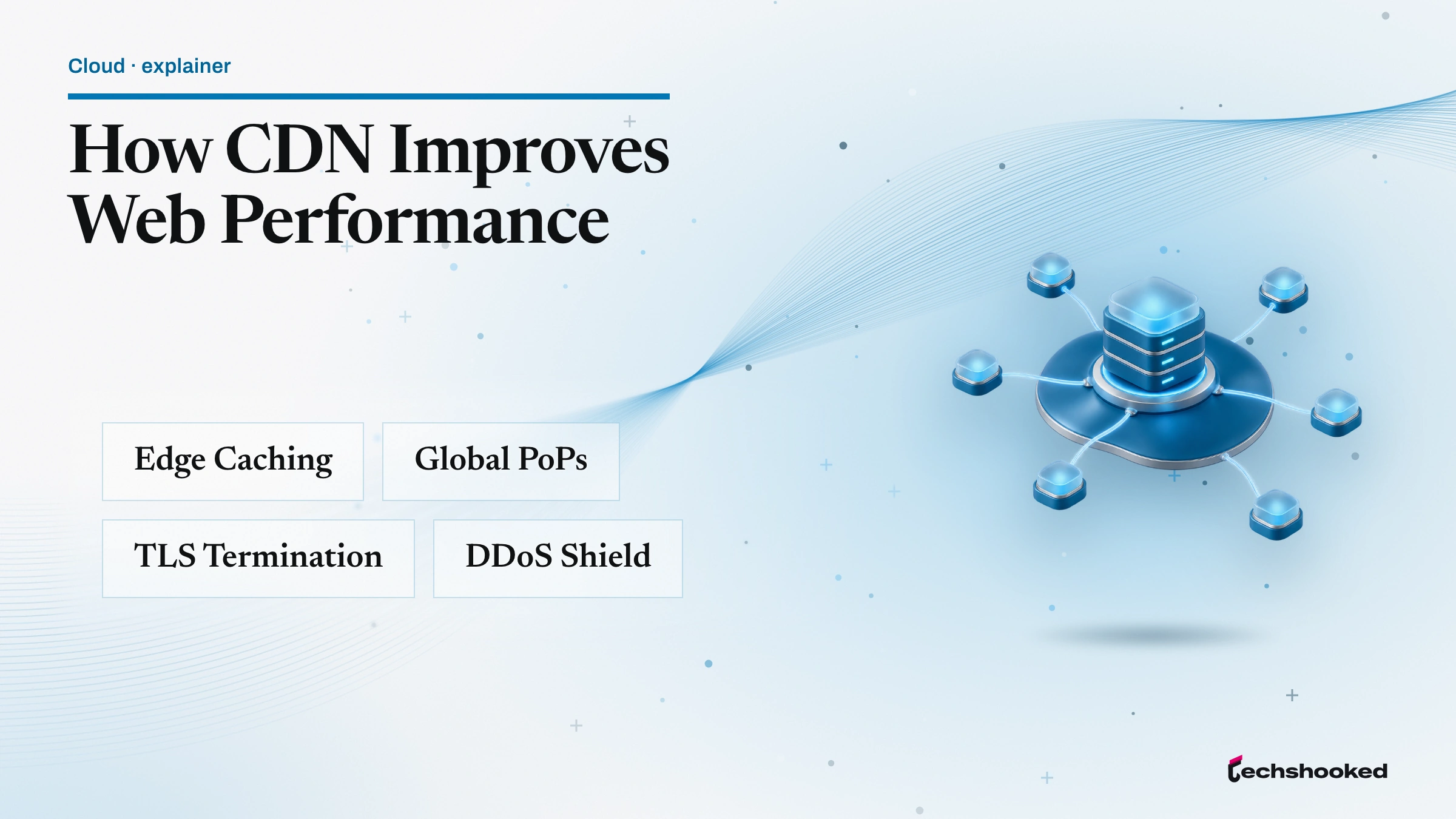
A content delivery network is a distributed infrastructure layer that caches and delivers web assets from edge nodes positioned geographically close to each requesting user. Where a single origin server forces every visitor to traverse intercontinental network paths, a content delivery network short-circuits that distance by serving content from hundreds of geographically distributed locations. The performance gains are structural, not incidental: latency reduction compounds across DNS resolution, TLS negotiation, and byte transfer, producing measurable improvements in Core Web Vitals scores that directly affect organic search ranking.
What a Content Delivery Network Actually Does
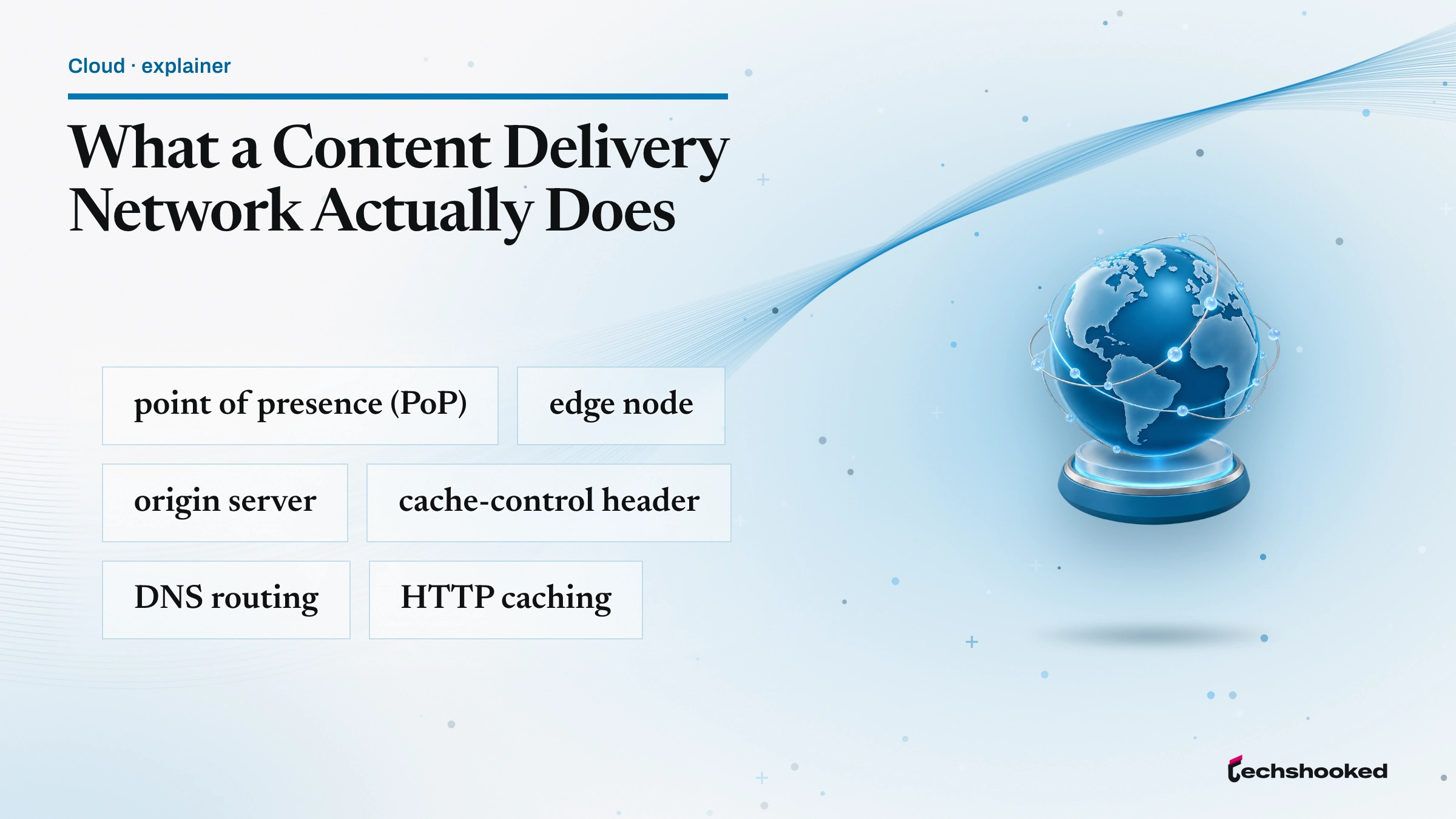
A content delivery network intercepts each HTTP request and routes it to the nearest point of presence (PoP) rather than the origin server. The routing decision happens at the DNS layer: the CDN's authoritative nameserver returns the IP address of the geographically optimal PoP based on the resolver's location. Route 53 and Cloudflare handle that DNS-level routing differently, which matters for steering traffic. Four components define how that delivery path works.
- Point of Presence (PoP)
- A physical co-location facility housing CDN hardware. Each PoP contains one or more edge nodes and terminates user connections at that location rather than forwarding them to the origin. PoP density determines how many users can reach a nearby node; providers typically operate dozens to hundreds of PoPs across major metropolitan and internet exchange regions.
- Edge node
- The individual server or cluster within a PoP that handles HTTP caching, TLS termination, and content serving. An edge node maintains a local cache store, accepts incoming requests, checks for cached objects, and proxies cache misses to the origin server. Each edge node reports cache state independently, so a miss at one node does not guarantee a miss at another in the same PoP.
- Origin server
- The upstream application or hosting environment that holds the authoritative copy of each resource. Under a CDN, the origin server receives traffic only on cache misses or for content marked non-cacheable. Reducing origin server load is a primary operational benefit for high-traffic deployments.
- Cache-control header
- An HTTP response directive, specified in IETF RFC 7234, that instructs both browsers and intermediate caches how long to store a response. Directives such as
max-age,s-maxage, andstale-while-revalidategovern CDN behavior at the edge node level, independent of browser cache settings.
How Edge Caching Cuts Latency
A content delivery network reduces latency by storing a cached copy of each cacheable response at the PoP closest to the requesting user. Static asset delivery benefits most directly: an image, stylesheet, or JavaScript bundle served from an edge node 10 ms away produces a dramatically lower Time to First Byte (TTFB) than the same file served across 200 ms of intercontinental routing. The request lifecycle unfolds in four steps.
- DNS resolution. The user's resolver queries the CDN's authoritative DNS. The CDN returns the IP of the nearest PoP using anycast routing or geolocation-aware DNS responses. Round-trip time to the PoP is typically single-digit milliseconds for users within the PoP's coverage zone.
- PoP cache hit. The edge node checks its local cache for the requested object. On a cache hit, it returns the stored response immediately. No connection to the origin server is required. TTFB reflects only the PoP-to-user network time plus cache lookup overhead.
- Cache miss and origin fetch. On a cache miss, the edge node forwards the request to the origin server over a persistent, pre-warmed TCP connection. The origin returns the response, the edge node stores it according to the cache-control header directives, and serves it to the user. Subsequent requests for the same object hit the cache until the TTL expires.
- Cache-control directive application. The edge node applies HTTP caching directives from the response.
s-maxagegoverns shared cache TTL at the CDN layer;max-agegoverns the browser cache.stale-while-revalidateallows the edge node to serve a slightly stale cached response while fetching a fresh copy in the background, eliminating the user-visible latency of a synchronous origin fetch on TTL expiry.
Latency reduction from static asset delivery compounds when HTTP/2 multiplexing is active at the edge. Multiple assets load over a single TCP connection without head-of-line blocking, reducing the number of round trips required before the page becomes interactive. The HTTP Semantics specification (RFC 9110) defines the header field model that underlies both HTTP/2 and HTTP/3 transport optimization at the CDN edge.
Impact on Core Web Vitals
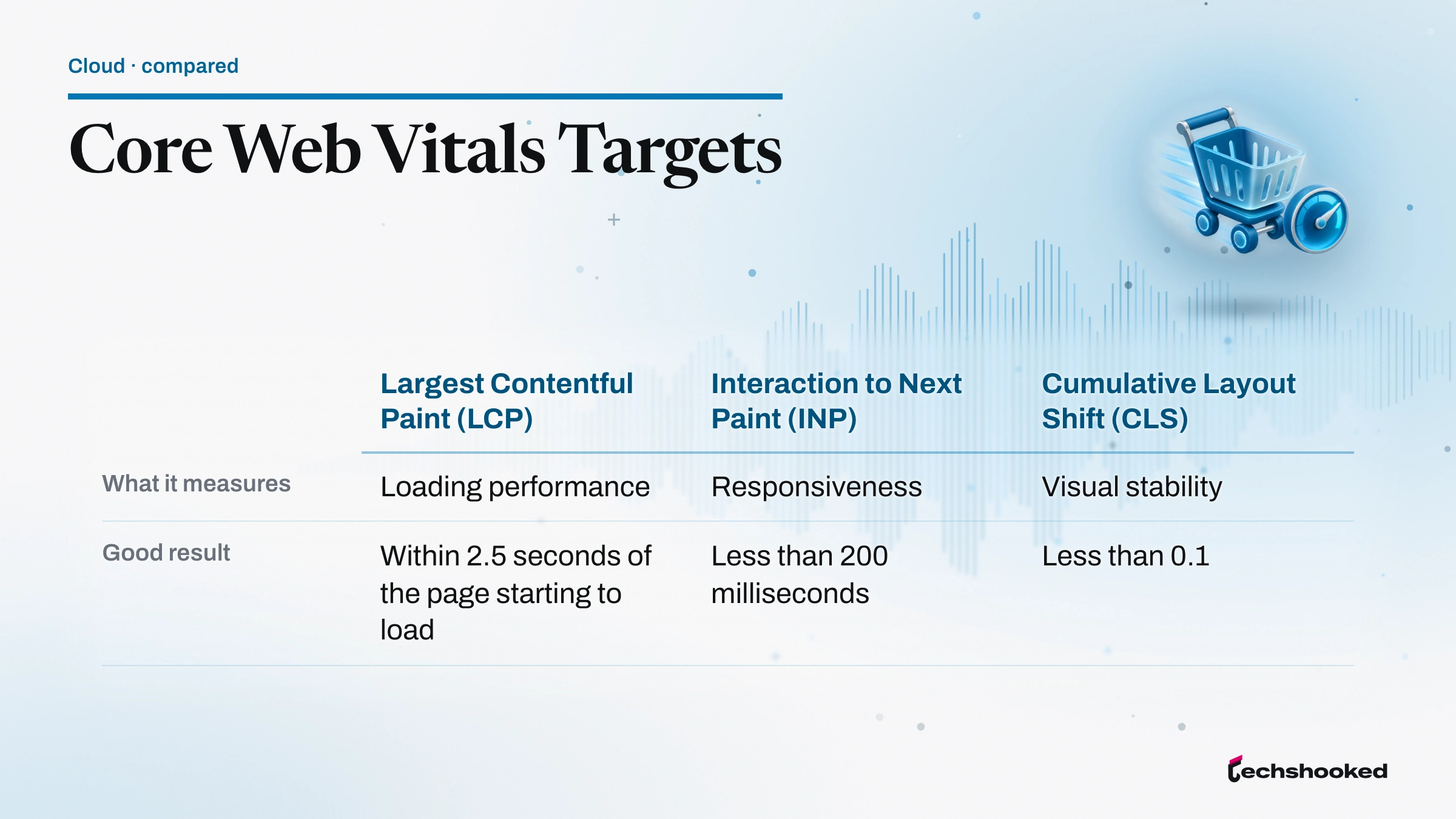
A content delivery network directly improves Core Web Vitals by reducing the network distance assets must travel before rendering in the browser. Google's Core Web Vitals framework measures three user-experience signals: Largest Contentful Paint (LCP), Interaction to Next Paint (INP), and Cumulative Layout Shift (CLS). A CDN affects the first two through latency reduction and faster asset delivery; CLS is unaffected because it measures visual stability rather than load speed. The table below maps each metric to the CDN mechanism that addresses it.
| Core Web Vitals Metric | CDN Mechanism | Improvement Driver |
|---|---|---|
| Largest Contentful Paint (LCP) | Edge-cached static asset delivery | Hero images and above-the-fold resources serve from the nearest PoP, eliminating long-haul transit. AWS CloudFront documentation confirms edge caching as the primary LCP driver for image-heavy pages (CloudFront Developer Guide). |
| Time to First Byte (TTFB) | PoP proximity + persistent origin connections | TTFB falls because the user connects to a nearby edge node rather than the distant origin server. Cache hits eliminate origin round trips entirely; edge nodes maintain persistent HTTP keep-alive connections to origin to reduce miss-path overhead. |
| Interaction to Next Paint (INP) | Faster JavaScript bundle delivery | JavaScript bundles cached at the edge load faster, reducing main-thread parse and execution time. HTTP/2 multiplexing at the edge reduces the round-trip count for multi-asset script loading sequences. |
| Cumulative Layout Shift (CLS) | Not directly addressed | CLS measures visual stability caused by layout reflows, not network latency. CDN deployment does not affect CLS scores; image dimension attributes and font-display strategies address CLS independently. |
Cache Invalidation and Dynamic Content
A content delivery network must also handle cache invalidation to ensure users receive updated assets immediately after a site change. Without an active invalidation strategy, edge nodes serve stale content for the full TTL duration, which can range from minutes to days depending on the cache-control header configuration. Two content categories require different invalidation approaches.
Static asset delivery uses long TTLs, typically 30 days or more, paired with versioned filenames or content-hash query strings. When a CSS or JavaScript file changes, the build pipeline generates a new filename. The old cached object becomes unreachable by new page loads without any active purge. HTML pages carry a much shorter TTL, or use stale-while-revalidate, because page content updates must propagate quickly. For content-managed sites where HTML is the primary delivery surface, active purge APIs are the reliable path to immediate propagation after a publish event. Understanding how DNS propagates updated records across the network is foundational to reasoning about CDN routing; background on DNS mechanics is at the DNS explainer on this site.
The surrogate-key (also called cache-tag) pattern extends cache invalidation precision beyond URL-level purges. An origin server attaches a Surrogate-Key or Cache-Tag response header listing identifiers that group related objects. A purge API call targeting a single key flushes every cached object tagged with it, regardless of URL. A CMS publishing a new article can tag all edge-cached HTML fragments that reference that post's ID and purge them atomically. The workflow below describes the typical purge lifecycle for a content-managed origin.
- Origin attaches surrogate keys. The application layer appends a
Surrogate-Keyheader to cacheable responses, listing the object's content identifiers (post ID, taxonomy term, author slug). The edge node stores the key-to-URL mapping alongside the cached object. - Content update triggers purge API call. A publish webhook or deployment hook sends an authenticated DELETE request to the CDN's purge endpoint, specifying the surrogate key or URL pattern to invalidate.
- Edge nodes mark objects as stale. The CDN propagates the invalidation signal across all PoPs. Edge nodes receiving the signal mark matching cached objects as stale but do not delete them immediately, allowing continued serving during propagation if the CDN supports grace-period delivery.
- Next request triggers origin fetch. The first user request for a stale-marked object causes the edge node to fetch a fresh copy from the origin server, cache it with the new TTL, and serve it. Subsequent requests hit the refreshed cache.
Security and DDoS Mitigation
A content delivery network adds a security perimeter by absorbing volumetric attack traffic at the edge before it reaches the origin server. DDoS mitigation at the CDN layer works because attack traffic is distributed across hundreds of PoPs, each absorbing a fraction of the total volume rather than concentrating it against a single IP. Even large-scale volumetric attacks, which overwhelm most single-datacenter defenses, are absorbed by the aggregate capacity of a global CDN network. The core security capabilities available at the CDN edge include the following.
- TLS termination at the edge. The CDN terminates TLS connections at the PoP, handling handshake overhead close to the user and forwarding requests to the origin over an already-established private connection. This reduces latency for secure traffic and offloads cryptographic processing from the origin server.
- Web Application Firewall (WAF) integration. Most CDN providers offer WAF rule sets at the edge layer, inspecting HTTP request headers, URI patterns, and body payloads for SQL injection, cross-site scripting, and known exploit signatures before requests reach the application. WAF rules can be updated globally across all PoPs from a single policy configuration.
- Rate limiting. Edge-layer rate limiting enforces request thresholds per IP, per user-agent, or per endpoint, blocking credential-stuffing attempts and API abuse before they consume origin resources. Limits are configurable per path pattern, enabling stricter thresholds on authentication endpoints than on public content paths.
- DDoS mitigation via distributed absorption. Volumetric attacks are distributed across all PoPs in the network. Each PoP absorbs its regional share of attack traffic, and anycast routing prevents traffic concentration against a single location. The origin server remains reachable during attacks because it receives only the fraction of traffic that passes edge-layer filtering.
- Bot management. CDN providers offer bot scoring based on behavioral signals, TLS fingerprinting, and challenge-response mechanisms. Requests classified as automated and malicious are blocked or redirected to CAPTCHA flows at the edge without reaching the origin.
Choosing a CDN: Provider Comparison
A content delivery network choice depends on network footprint, pricing model, and integration depth with your existing infrastructure. The four providers with the broadest enterprise adoption are AWS CloudFront, Cloudflare CDN, Fastly, and Akamai. Each occupies a distinct position on the cost-vs-control spectrum. For workloads that already run on AWS compute and storage, CloudFront's deep integration with S3, EC2, and Lambda reduces operational overhead; the CloudFront Developer Guide documents the full integration surface. Teams outside AWS can compare CloudFront alternatives on cache-hit ratio and egress cost. For teams prioritizing edge computing alongside CDN, the comparison between edge and cloud delivery models is covered at the edge computing vs cloud computing breakdown. The relationship between CDN load distribution and origin-side auto-scaling is covered at the load balancing vs auto scaling article.
| Provider | Network Scale | Pricing Model | HTTP/2 + HTTP/3 | WAF Included | Free Tier |
|---|---|---|---|---|---|
| AWS CloudFront | Large global footprint; hundreds of PoPs and regional edge caches across six continents | Pay-per-use: per-GB data transfer out + per-request charges; no monthly minimum | HTTP/2 and HTTP/3 supported at edge | Requires AWS WAF add-on (separate charge) | 1 TB data transfer + 10 million requests/month, always free under pay-as-you-go pricing; a flat-rate Free plan is also available |
| Cloudflare CDN | Very large; operates one of the widest PoP networks, present in most countries | Flat-rate on paid plans; free plan with unmetered bandwidth on basic CDN features | HTTP/2 and HTTP/3 (QUIC) supported on all plans | Basic WAF included on free plan; advanced rulesets on paid plans | Unmetered CDN bandwidth on free plan |
| Fastly | Enterprise-scale; fewer total PoPs than Cloudflare but high-throughput nodes at major internet exchanges | Pay-per-use: per-GB and per-request; real-time billing with no long-term commitment required | HTTP/2 supported; HTTP/3 available on current platform | Next-gen WAF (formerly Signal Sciences) available as add-on | Free tier with usage allowances (for example 100 GB of bandwidth); paid packages above it |
| Akamai | Largest legacy footprint; among the longest-operating CDN providers with deep carrier peering | Contract-based; custom pricing tiers; not self-serve on standard plans | HTTP/2 and HTTP/3 supported across product lines | Kona Site Defender WAF included in enterprise contracts | No free tier; enterprise-focused sales process |
The right CDN for a given deployment depends on three practical axes. First, pricing model: pay-per-use CDNs like CloudFront and Fastly favor variable-traffic workloads where avoiding a monthly floor charge matters; flat-rate CDNs like Cloudflare reduce cost predictability risk at high volume. Second, WAF integration depth: teams that need WAF at the edge without a separate procurement process favor Cloudflare's bundled approach. Third, edge programmability: Cloudflare Workers, Fastly Compute, and CloudFront Functions each expose different execution models for running custom logic at the edge node layer, and the right model depends on whether the application requires Rust/Wasm isolation, V8-based JavaScript, or AWS SDK access at the edge. Choosing a CDN for WordPress adds its own questions, from cache bypass rules to Core Web Vitals impact.
All four providers support HTTP caching via standard cache-control header directives as defined in RFC 7234, ensuring that cache invalidation workflows built to the standard will transfer across providers if infrastructure requirements change.
Further reading
Frequently Asked Questions
Does a CDN work for dynamic content or only static files?
A CDN accelerates both static and dynamic content, but through different mechanisms. Static assets such as images, CSS, and JavaScript are cached at edge nodes and served without hitting the origin server at all. Dynamic content relies on persistent TCP connections and route optimization between edge and origin, reducing round-trip latency even when caching is not possible. Providers such as Cloudflare and AWS CloudFront offer separate configuration modes for each traffic type.
How does a CDN reduce Time to First Byte?
A CDN reduces Time to First Byte by routing the request to the geographically nearest point of presence, eliminating long-haul network hops between the user and the origin server. Edge nodes maintain persistent connections to the origin, so TLS negotiation and TCP handshake overhead applies only once per connection pool rather than per user request. HTTP caching behavior, documented in IETF RFC 7234, enables edge nodes to serve cached responses with no origin round trip at all when a cache hit occurs.
Can a CDN improve Core Web Vitals scores?
Yes, a CDN directly improves Largest Contentful Paint and Interaction to Next Paint, two of the three Core Web Vitals metrics Google uses as ranking signals. LCP improves because hero images and above-the-fold resources load from an edge node within milliseconds of the user location rather than crossing continents. INP improves because cached JavaScript bundles arrive faster, reducing main-thread blocking time. Enabling HTTP/2 or HTTP/3 multiplexing at the edge layer further compounds these gains.
What is cache invalidation and why does it matter for CDN deployments?
Cache invalidation is the process of marking stored content on edge nodes as stale so they fetch a fresh copy from the origin server on the next request. It matters because without timely invalidation, users receive outdated HTML, broken asset references, or stale API responses after a site update. Most CDN providers expose an API or dashboard action to purge cached objects by URL pattern, tag, or path prefix; configuring surrogate-key-based purging is best practice for content-managed sites that publish frequently.